
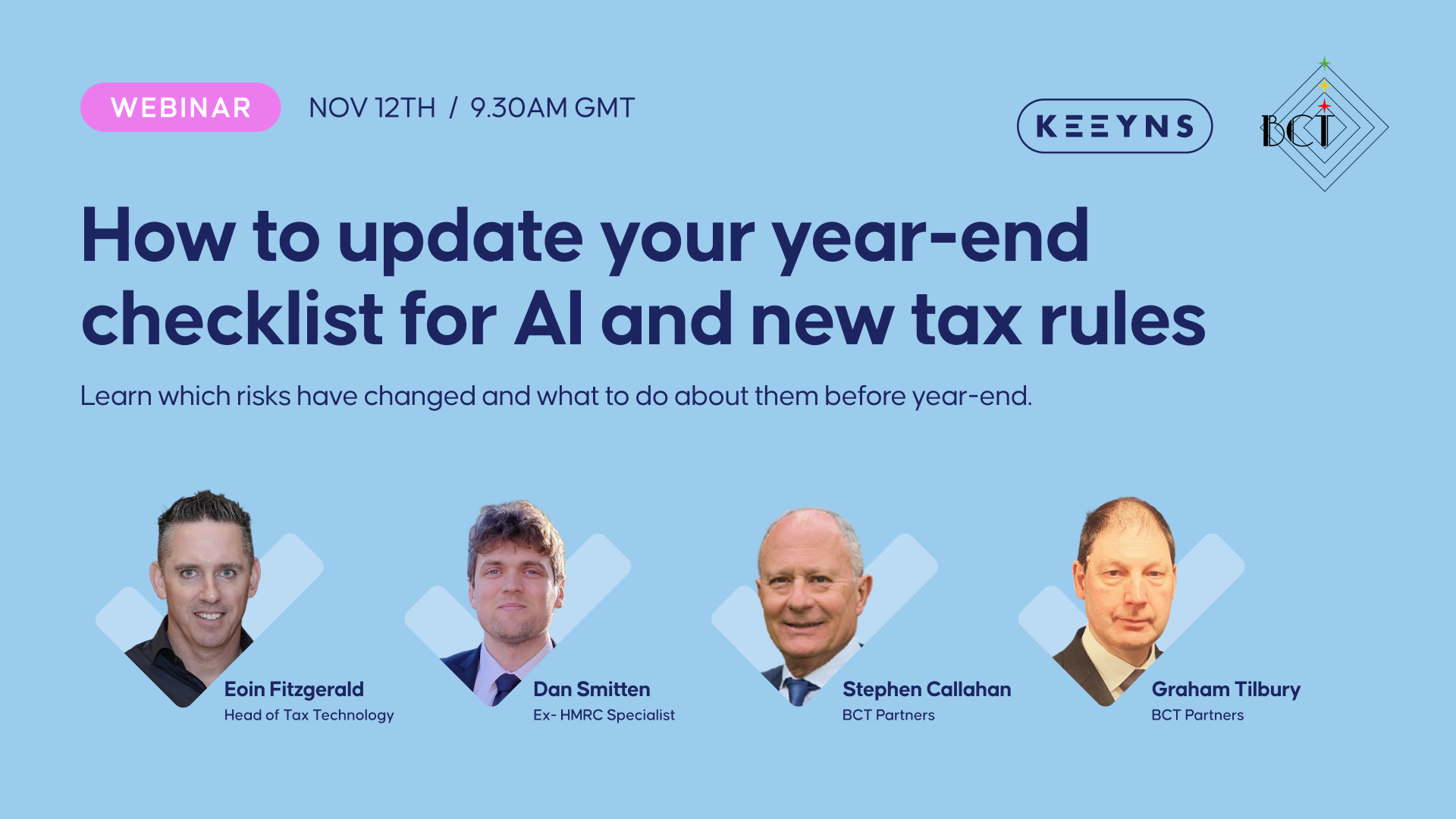

Smaller teams, less offshoring: what tax looks like in ten years
Everyone expects smaller tax departments. Fewer expect less offshoring. In episode 1 of The Audit Trail, Burt Gesner talks to Jim Ackerman, a former IRS auditor who spent a decade in indirect tax at Chevron. They cover who trains the next generation once AI takes the entry-level work, the twenty hours nobody finds to automate an eight-hour task, and a technology project that didn't go to plan.
Webinar · Episode 1 · 16 min · Host: Burt Gesner · Guest: Jim Ackerman
Short on time? Read the 5 key takeaways or jump to the FAQ.
Five things to take from this episode
Everyone expects fewer people. Jim's surprise is "possibly less offshoring of work." Automate the low-value work, then bring the people who are left together on analysis. [03:17]
Entry-level work is where juniors learn the trade. "My trainer was three cubes away." Across time zones that learning stops happening on its own, so Jim wants AI used to build better training. [05:34]
At TEI Jim heard "we're not hiring tax people anymore, we're hiring technology people." He agrees, with one condition: "You're still going to need that tax foundation." [06:51]
An eight-hour monthly task, twenty hours to automate it, and nobody makes the time. "If you don't make the investment today, you get nothing." [10:15]
Jim's advice to tax leaders: "reimagine the process and invest in the technology," with one dedicated person who has "the freedom to express their curiosity." [14:29]


Questions answered in this episode
Probably, and few people expect otherwise. Jim Ackerman expects automation and AI to take over reconciliations and other low-value tasks, so "I don't think it would shock anyone to expect to see fewer people in the departments." The open question is what the remaining people do. [Listen at 02:40]
Jim isn't convinced. Offshoring moved work to cheaper labor, but once the low-level work is automated he'd rather consolidate people "in a single location" and put them on analytical work alongside AI, instead of spreading them across time zones. [Listen at 03:17]
That's the risk nobody has solved yet. Entry-level work is where new analysts learn the foundations. Jim's answer is to use AI to build the training model itself, because with teams spread across time zones you can no longer walk three cubes over and ask. [Listen at 04:41]
Because the time has to be found up front. Jim's example: an eight-hour monthly task, twenty hours to learn the tool and build the workflow, and the temptation to just grind it out today. "It's like compound interest. If you don't make the investment today, you get nothing." [Listen at 09:06]
When the tool no longer fits where the work is going. Jim's team spent heavily on a rules-based transaction review platform, then realized it had "no intelligence component." His point: watch for sunk cost, keep reviewing your solutions, "and sometimes you've got to pull the plug." [Listen at 13:08]
Not sure where your own process stands? Take the free tax process health check.
Who's talking
Burt Gesner, host
Head of US Business Development, Keeyns
Burt works with tax and finance leaders at US groups running more filings across more states than their team can reasonably cover. Keeyns is the Tax Management Platform that brings every filing, deadline and approval across your entities and advisors into one record, as the work happens. Follow on LinkedIn
Jim Ackerman, guest
Indirect tax veteran
Jim started as an IRS auditor, then spent about ten years at Chevron in sales and use tax, income tax audit defense and as indirect tax supervisor, where he led much of the team's technology work. Follow on LinkedIn
About The Audit Trail
The Audit Trail is a webinar series from Keeyns that follows the major shifts happening across tax. Fast, focused conversations with the tax directors and CFOs living them firsthand, hosted by Burt Gesner. This is where the future of tax gets talked about before it happens.
Want more? Listen to Brothers in Tax, the Keeyns podcast.
Keep listening
What a modern tax team needs as the work changes.
Listen now
25 years from paper returns and the fax queue to AI, and the client case that became Keeyns.
Listen now
More filings, more complexity, fewer people: the three Cs squeezing tax teams.
Listen nowFull transcript
Burt [00:00]: It's great to have you here. We're officially launching The Audit Trail, a new webinar series at Keeyns where we have brief conversations with tax leaders all over the industry to really drill down and talk about the future of tax. Obviously focused a lot on tax technology, where we spend our time, and I couldn't be more excited to welcome Jim Ackerman, indirect tax supervisor at Chevron, as our first guest.
Burt [00:29]: So before I start peppering you with questions, Jim, would you introduce yourself and tell our audience a little about your background?
Jim [00:39]: Thanks, Burt. I'm honored to be the pilot, the first guest on this webinar series. So excited to be here. I was surprised to see your invitation, but honored at the same time. I put a lot of thought into the topic and actually had some revelations along the way. Long story short, I've been in indirect tax for about 10 years. I've spent some time in federal tax. I used to work for the IRS as an auditor, and came to Chevron into sales and use tax.
Jim [01:15]: I went back to income tax to do audit defense, on the other side of the table from the IRS, and then came back into indirect tax as a supervisor. And I'm in a transitionary role right now. I'm leaving Chevron in a few weeks, but onto bigger and better things, hopefully.
Burt [01:34]: Well, it's great to have you, not only to hear about your experience at Chevron, but also how you're thinking about the future, because I know there's some big stuff planned for that. Where I think you've sold yourself short is that you told me a lot about how you led the technology charge on the indirect tax side. So you're also uniquely qualified to talk about the technology, which is at the forefront of our industry.
Burt [02:03]: When we first connected at TEI, we talked a lot about it too. So to jump into the questions, I'm going to force you to start 10 years in advance. If we fast forward 10 years and you walk into a typical corporate tax setting, similar to Chevron, what's different? What surprises you the most? Not only on the qualitative side when you look at teams, but also at technology and how it's being leveraged across the department.
Jim [02:40]: I think things will look quite different. I think everybody believes that we'll have smaller departments, right? We're trying to reduce the low-value tasks, reconciliations and things like that. And I think AI is good at doing some of that analytical work. There are certainly automation tools out there that can streamline things. Alteryx was introduced years ago, and people found all kinds of efficiencies with that, so I don't think it would shock anyone to expect to see fewer people in the departments.
Jim [03:17]: What might surprise others is possibly less offshoring of work. In recent years we've seen efficiencies found, at least financially, by taking processes done in the US and moving them to a cheaper labor cost environment. But I think we need to rethink how those processes are done and whether offshoring is the right answer.
Jim [03:49]: So yes, we might have a smaller department, but if we eliminate that lower-level work, and maybe automate it or embed AI into our processes and workflows, what do we do with those people? Can we consolidate them in a single location, rather than have them scattered doing all kinds of things in different time zones, and have them do higher-level, more analytical work in conjunction with AI and the tools that we have?
Burt [04:18]: That's super interesting, especially the AI-automated work freeing up time for the more strategic stuff, which we talk a lot about with folks. You raised something interesting about offshoring and managing junior team members, and I know you've managed a pretty decent-sized team for a while.
Burt [04:41]: What do you think about the future of the junior team member? What does that role look like? And more importantly, how do we develop the next generation of tax leaders if we risk losing some of the high-impact learning that happens at the junior level with automation?
Jim [05:00]: That's a real concern, and a lot of folks are talking about it. I see posts on LinkedIn, it was a talking point at the TEI conference. If we start automating the lower-level work, the entry-level work someone right out of college would do, then how do you build the next generation, five years from now, to cut their teeth on that work and really understand the foundational components of tax?
Jim [05:34]: I think using AI smartly can help. I was thinking about this just this morning: how can we build a training model to help bring a new analyst up to speed, especially when you have people scattered all over? We used to all sit together, and my trainer was three cubes away. I could go talk to her and ask her a question at any time during the day.
Jim [06:06]: Now, with different time zones, maybe halfway across the world, you can't just go. You can't build that relationship the way we used to. But I'm also using Copilot and other tools to help accelerate learning. I'm not a programmer, I don't know VBA, I don't know M and DAX very well, but you can use those tools to help you learn.
Jim [06:29]: To get back to the question, I think from an educational standpoint that's going to change as well. The model we have today teaches accounting and tax foundations and expects folks to go in. Now the demands are on technology. At TEI I heard a lot of folks saying, we're not hiring tax people anymore.
Jim [06:51]: We're hiring technology people. And I agree with that, I think that's important. But at some point you need both pieces to come together. You're still going to need that tax foundation, and I think it'll become even more important, because I think we'll see a shift in tax departments toward a heavier weight on the technology piece.
Jim [07:14]: But you can't lose that tax foundation, because today they're almost different languages. It's going to be interesting to see, but it'll work out in the long run. I think it'll be cyclical. We might see a few years where we really struggle to get the right mix of talent in the positions, and people will have to change who they're hiring, how they're training, how they're educating. It's a real risk, I think.
Burt [07:49]: I couldn't agree more, and I think you hit the nail on the head in terms of change. It's probably more than ever a time of change across tax, and you hit on a lot that will inevitably change or needs to change.
Burt [08:05]: What's also interesting is the stuff that's not going to change but maybe needs to, and we talk a lot about that with our clients: habits. If you think about the habits you see across a lot of tax teams, which one would be hardest to break, but needs to break for this future tax transformation to succeed?
Jim [08:39]: I've seen this for years, and I've been guilty of it myself. I think everybody has it. When you have new technology, you need to learn how to use it, whether it's Excel 20, 30 years ago, or Alteryx, or now AI. It's there, but you need to invest time to reap the benefits of what it can do for you.
Jim [09:06]: So think about a process that takes eight hours every month, and you can automate it with some tool to be more efficient. It might take you 20 hours to learn the tool and build the workflow that turns that eight-hour task into a 30-minute task.
Jim [09:31]: And people are sometimes shortsighted. Like I said, I've been guilty of this too. You say, I could get this done by the end of today if I just grind it out, and I don't have the 20 hours to invest in learning the tool that would basically eliminate this task.
Jim [09:53]: People really need to break that. You need to look beyond today and think about what you're going to gain. I need to find those extra 12 hours to put my head down and figure this out, because next month I'm going to use it for something else. It's like compound interest, right?
Jim [10:15]: If you don't make the investment today, you get nothing. But if you make the investment today, it'll start compounding.
Burt [10:23]: It's interesting you say that, because we spend most of our time saying the exact same thing: just get started. We call it short-term pain for long-term gain.
Burt [10:35]: And that leads me into the next question, because you've been through these projects. You got started, and you did suffer the short-term pain for the long-term gain. Let me ask you to get reflective for a second. If you had to pick one technology project or initiative that didn't go the way you'd hoped, whether that was the implementation or how the platform was used, what can you and our audience learn from it?
Jim [11:11]: We're in an interesting time, with so many platforms and software-as-a-service systems that sometimes it'll spin your head.
Jim [11:26]: We had, and still have, a process where we do transactional reviews. We're trying to make sure our tax engine is doing the right thing, that we're not over-accruing or under-accruing tax, that vendors are getting paid the right amount. We employed a software program that took significant resources and was supposed to reduce the pain of a very manual, very antiquated process: pull a number of transactions.
Jim [12:02]: Look at them, and manually determine that the tax was correct. The platform did well, but it took a substantial amount of time and resources to get it working and refine it. And at the same time, we realized there was really no AI component to it. As we got deeper into the project, we realized it was just formulas, programming rules layered onto a transaction population.
Jim [12:40]: That's a very rudimentary process. It was better than what we were doing, because we got a narrower population with a higher hit rate of transactions that had issues, but there was no intelligence component to it. And as we got toward the end of the project, we realized it's not really the direction we want to go.
Jim [13:08]: Sometimes we get caught up in sunk costs. We don't realize this is a sunk cost, and maybe we should pull the plug, because when we started this a year and a half ago, AI wasn't working the way it is today. It was struggling to do certain things in Excel that it now knocks out of the park.
Jim [13:28]: Things have come a long way. We just need to keep our eyes open and always look at our processes and the solutions we're employing, and ask whether it's the right thing. And sometimes you've got to pull the plug.
Burt [13:48]: Super interesting. With this much change, you have to make some hard decisions sometimes. We like to keep these short, and I just got my two-minute warning, so one final question. You're the perfect person to answer it, because a lot of the folks we talk to have done very little on tax transformation.
Burt [14:14]: And you're a leader who has already done a lot. So as parting thoughts, if you could give one piece of advice to tax leaders just getting started with tax transformation, what would it be?
Jim [14:29]: It'll be like three pieces of advice, but I would say: reimagine the process and invest in the technology.
Jim [14:37]: Organizations are very concerned with opex and reducing opex, which basically means headcount. That's great, but to employ technology, whether it's a software solution or AI, you need someone to really learn the processes and the solutions, as a full-time employee.
Jim [15:02]: We're all trying to do audit work and compliance work, and then initiatives come along like, hey, layer on AI. Well, I don't have time. So in my opinion, have a dedicated person to find solutions, with the freedom to express their curiosity and investigate what other people are working on.
Jim [15:22]: Sit with the team, sit with the staff doing the work, find solutions, and give them the freedom to do that. From a department standpoint, that would be my advice.
Burt [15:33]: That's awesome. And that freedom element too: we see a lot of value in that, and real needle-moving when folks have that freedom. You hit a lot of nails on the head, and you sold yourself short at the top of the call. This is exactly why we thought you'd be the perfect guest. Thanks to everyone for tuning in to The Audit Trail, our webinar series about the future of tax, and of course, Jim, a big thank you for joining. We'll see you all next time.
Jim [16:05]: Thanks, Burt.