
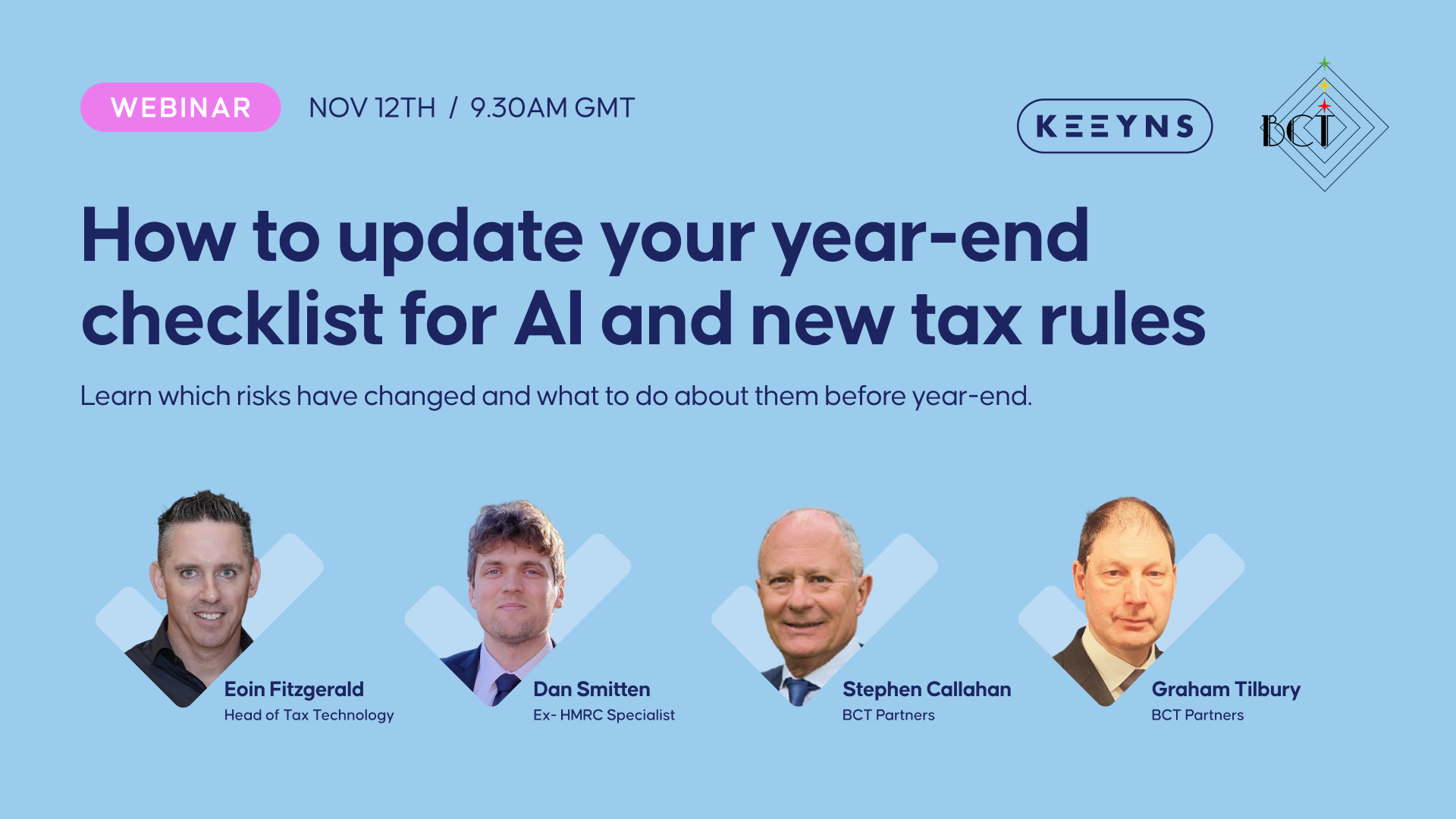

Who to hire first, and why the CFO cares: the tax team of the future
At 30, Ruben van Aarle became interim tax director for a US telecom group. He recalls about 27 countries, 67 legal entities and a team of four or five, with a lot of manual work. In episode 5 of the Brothers in Tax podcast by Keeyns, Ramon hosts as the brothers talk about who they'd hire first today, why tax and finance are being pulled together by data, and why juniors should still prepare a tax return by hand.
Episode 5 · 28 min · September 3, 2026 · Hosts: Ruben and Ramon van Aarle
Short on time? Read the 5 key takeaways or jump to the FAQ.

Five things to take from this episode
Ruben's interim role covered "27 countries, I think 67 legal entities" with a small team, and "a lot of manual work, a lot of ping pong". [02:24]
His first hire would be "a deep generalist someone who is also a little bit at least tech-savvy", who can talk to the business, the CFO, legal and HR. "I would not hire, let's say the micromanager." [08:42]
More risk and liability at board level means more attention on tax. And for a listed company, "tax is cash in the end." [11:20]
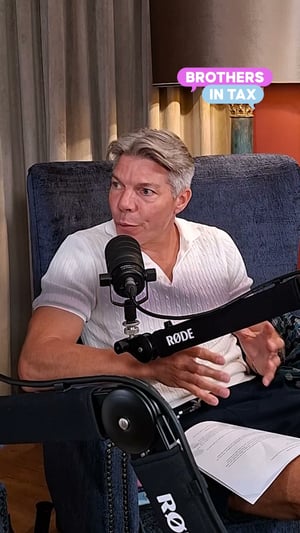
At a CFO round table, the question came up "whether the name of CFO we change into CDO, Chief Data Officer". Ruben expects tax and finance to work together more because of it. [17:17]
If you only trust the automated output, you can't judge it. Ruben wouldn't ask for hundreds of manual returns, "but perhaps ten to get the picture." [20:14]
Short on time? Start with these

11:43 · 40 sec

01:51 · 65 sec
08:42 · 60 sec
15:12 · 74 sec
23:38 · 38 sec
17:17 · 38 sec
Questions answered in this episode
Breadth first. Ruben would hire "a deep generalist someone who is also a little bit at least tech-savvy", who can talk to the business, the CFO, legal and HR, and get things done. Deep specialist questions go to advisors. [Listen at 08:42]
Because risk and liability are rising. "I think it's changing because of the fact that more and more risks are connected to it", Ruben says. For listed companies, a different effective tax rate than peers raises questions, because "tax is cash in the end." [Listen at 11:20]
Partly. Ruben expects routine admin to disappear and teams to "do more with less people", while deep tax knowledge and judgment on grey areas stay with people. Ramon expects the workload to grow with compliance and complexity. [Listen at 14:45]
By doing a few by hand. "I would still encourage, let's say people to make a manual, a tax return just to get the thinking right", Ruben says, so they can tell whether automated output is correct. [Listen at 19:44]
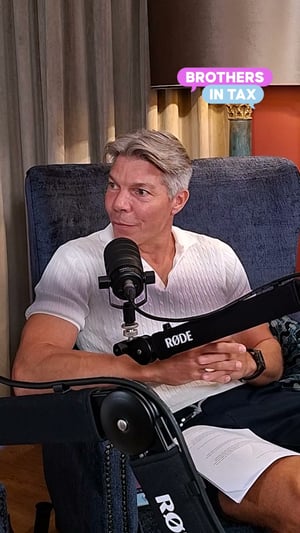
For large groups, rarely. Ruben recalls a listed client's return that took 11 months a year, and is "for sure that the tax return was never a hundred percent correct." Better data is what changes that. [Listen at 23:38]
About the hosts
Ruben van Aarle
CEO and co-founder, Keeyns
Started his career at Arthur Andersen (later merged into Deloitte), co-founded the tax advisory firm Taxperience in 2006 and co-founded Keeyns in 2017. Follow on LinkedIn
Ramon van Aarle
COO, co-founder, Keeyns
Started at Ernst & Young, moved to Arthur Andersen and co-founded Taxperience with Ruben. Follow on LinkedIn
Together they have 25+ years in tax as advisors, entrepreneurs and now software founders.
About Brothers in Tax
Brothers in Tax is the podcast by Keeyns. Ruben and Ramon van Aarle have 25+ years in tax as advisors, entrepreneurs and now founders of Keeyns, the tax management platform for multi-entity companies. Each episode is their unfiltered take on the industry they've helped shape: the wins, the mistakes and the lessons in between.
See all episodes · Subscribe on Spotify · Subscribe on Apple Podcasts
Keep listening

More filings, more complexity, fewer people: the three Cs squeezing tax teams.
Listen now
Why the brothers stepped out of advisory and bet on software.
Listen now
How two brothers both ended up in tax, from Arthur Andersen to founding Taxperience.
Listen nowFull transcript
Lightly edited for readability.
Ramon [01:00]: Okay. Hello everyone. My name is Ramon van Aarle and I'm here with my brother Ruben.
Ruben [01:06]: Hello, my name is Ruben,
Ramon [01:08]: And together we are Brothers in Tax. Welcome. On this episode of our podcast we will talk about our ideas in tax, what is happening with tax technology and our other business endeavours. Last episode we talked about the changes we've seen since we went all in on tax technology. And today we're gonna talk about what we see happening in the roles and responsibilities of CEOs and tax directors. Wow, that's gonna be interesting.
Ruben [01:36]: Thing too.
Ramon [01:36]: Yes. Forward. Yeah. Yeah. Can you talk about your years working at the international groups in the tax departments? When we first started our own business, because that's what you did right in, right?
Ruben [01:51]: Yeah. We didn't have enough business yet. Right. So I was interim slash fractional tax director for an American-based telecom company for the first time. Very young, thirty never worked in-house, had totally different idea, how those tax departments would run and was kind of also amazed, how manual these operations are in such a large company. I was responsible for plus minus 27 countries, I think 67 legal entities, and had a team, four, five people changed some people over time, but there was a lot of manual work, a lot of ping pong, very manual
Ramon [02:45]: And very different than the tax advisory practice.
Ruben [02:48]: Totally different.
Ramon [02:49]: Yeah. Can you, what was different the way of working the tooling or
Ruben [02:56]: Actually everything, because the way of working, how we used to work basically at an advisory firm is you tell someone what's best to do or you're prepared the tax returns and you giving advice, but then on the other side of the table and you're receiving this advice, it needs to be implemented. So it's not that simple. It, as many stakeholders as some things need sometimes to change in supply chain or has totally different legal impact than as a tax lawyer you are aware of or just not possible because of local legislation in a given country. Because, you know, sometimes you ask, let's say a tax advisor advice, okay, roll this out entire Europe, but that's not how it works because in some of the countries you will get pushback because A, B, C, D and you, it was totally different ball game. Very interesting to see very steep learning curve to be honest. So it made me, in the end, a better tax advisor because I saw. Both sides of the table and you really learn there a lot.
Ramon [04:02]: But it also sounds that you have some suggestions for the advisory practice, if I understand you correctly.
Ruben [04:08]: Well, also, there is a big disconnect as well. So I think, let's say in our own firm, we tried, let's say ask open questions and go really to your client understand their business. If it's a factory, walk through the factory, because it gives you a totally different perspective than filing just a tax return for a factory with some numbers in it without, let's say having an idea what actually is happening there and what's all behind the scenes. What you don't see, don't understand, never hear about it. Right.
Ramon [04:47]: That's true.
Ruben [04:47]: That's true. Understanding the business of your client is
Ramon [04:51]: The business. Extremely important. Yeah. And you have to get the board on board as well on some processes and some challenges and some decisions to be made. That takes time
Ruben [05:03]: For sure. Yeah. Now you don't get all the time, air time as well, right. With CFO or CEO. So in my particular case, the first time I spoke with the CFO couple of times a week, which is sometimes already a lot, but that I was lucky there to, because it was really a, I would not say a tax driven structure, but a company with a lot of process which had a lot of tax impact all over the place. And I spoke perhaps once per quarter with the CEO and tried to learn, let's say, where the business was heading or new business ideas. 'cause new business ideas also have new. B business tax no challenges, problems different implications, filings, whatever countries.
Ramon [05:58]: So if you look at the skillset of a tax professional, and then if you make a comparison between tax advisor, the skillset and the tax professional inside the international company, what do you see as a big difference? Or, because they were partners in tech school, right? But it's a total, totally different way of approaching the tax business. Can you elaborate on that?
Ruben [06:27]: Yeah. And this depends also a little bit on how big tax teams are. Let's say if you talk in-house, right? So if you are just, if it's 1, 2, 3, up to 5, 6, 7, basically people tax departments, I think you need to be as we always call it, the deep generalist, right? So you need to understand from everything a little bit just to, or to give the right answer to some stakeholders or to ask the right question, which is even more important. Ask the right question to your advisor somewhere in the world or today to give the right prompt, right to ask really the right question. Otherwise, the answer is not correct. On the other side of the table, the advisory side there, you also need a deep generalist because yeah, he or she needs to talk to basically the client and understand whether it's a corporate income tax, VAT, transfer pricing, whatever, tax topic issue, right? So it's the whole range of taxation matters that you need to be able to talk about the
Ramon [07:38]: Most tax subjects pop up in the meeting. And that's true.
Ruben [07:41]: That's it. But sometimes, let's say it becomes that technical and, you know, how we advices went out in our tax firm. I was, would never be able to make that advice or come to those calculations because it was just some IRS eight and nine calculations for transfer pricing. I had absolutely no clue how they made them, how it was calculated, where the data was coming from. And so for that, you need really a, of course the deep experts with this knowledge. And I don't think everyone you can't be good in everything, right?
Ramon [08:18]: Oh, you do it all together. And that's why the internal tax professionals work together with the advisory practice and they manage to do all the taxation matters worldwide. That's a good thing. Yeah. And today, if you had to work at the international group and you had to hire a tax professional, the first one, what would be the skillset? What will be your, in the interview? What.
Ruben [08:42]: Today I would definitely hire, let's say, someone who would be, if it would be the first hire a deep generalist someone who is also a little bit at least tech-savvy. So if you don't believe in anything which is software or tech or AI, then probably you're not gonna last very long anymore in the industry, because it's shifting so quickly. That would probably be my first hire. A deep generalist. Someone who has a very broad approach, open mind, ask questions, curious, what's happening. I would not hire, let's say the micromanager. Because he gets nothing done or she gets nothing done. No, because the, just, they're micromanaging.
Ramon [09:32]: Yeah. And the burden of work is too big.
Ruben [09:34]: The burden of work is too big. And probably what they do in that small thing is gonna be fantastic. But if it would be my first hire for a tax department, yeah. The company has more than one tax topic to solve. So I would hire someone who can talk to the business, talk to the CFO, talk to legal, talk to HR,
Ramon [09:54]: Get things done internally,
Ruben [09:55]: Also get things done. Because sometimes tax is also kind of the oil into the machine, right? The
Ramon [10:03]: Sometimes I hear the tax that they just don't see me. Pick me, pick me. I'm tax. Is that a thing you saw at the international groups as well or is that a case by case thing?
Ruben [10:19]: I think this is a case by case thing. So the telecom company, where I started that was because the structure as such was so, well all over the place was taxation. That tax was basically you make it or not. If you would not, let's say have a proper tax implementation, you would not make money. But there is also
Ramon [10:45]: That's a tax-effective structure they had.
Ruben [10:47]: Exactly. Yeah. And a lot of things could go wrong and then on fines and penalties and miscalculations, you, we just not make any money anymore from the business. But yeah, from the, basically the tax firm, we also know that there are companies where in the end there is not a lot of attention from C level on tax because they make all so much money that they just don't care and hope, okay, this is just, this is your work, solve it. Don't bother me. Don't call me. Yeah. I think it's changing because of the fact that more and more risks are connected to it and there is more and more on liability
Ramon [11:32]: For the board as well.
Ruben [11:33]: More liability from the board. So probably that, that's also the reason why I think there is more and more attention on taxation matters. Yeah.
Ramon [11:43]: That's, I think that's a good thing. And it's in the newspapers every day at a taxation and being compliant and at pay a fair percentage of tax worldwide. That was totally different 25 years ago. Absolutely. We got promoted when you, the company didn't pay tax and today you go to jail for it. So that's also is that, that's a change, right? You agree on that? Absolute. Is that also a change you need as a tax professional then? So it's no tax planning anymore, but it's just doing the job is that,
Ruben [12:14]: I think there is still, let's say some tax planning because you want to do it efficient of course. But you also want to have, say, not
Ramon [12:21]: To rest. That's,
Ruben [12:22]: You want to have your fair share. It needs to be compliant in all the countries and that, that's already a challenge. Then of course, there is competition. So if, let's say your ETR effective tax rate is different from your competitor, then your CFO or the CEO or the shareholders or this work
Ramon [12:47]: To be done,
Ruben [12:48]: If you're stock listed everyone will ask, how come, why, what do you do wrong? Or where did, where is this leakage of cash and cash in the end? Or tax is cash in the end. Right? So that's true. It's
Ramon [13:04]: They, yeah, they in the business for further growth and or for the shares or growth. Right. So that, that's normal thing. Yeah. So if we pause there for a second, learn that from our US colleague, and then we look 10, 20 years ahead, what do you think the tax team and the professionals in it will look like?
Ruben [13:28]: Yeah. I don't have this crystal ball, but
Ramon [13:33]: Not why, but it's ever changing. So what do you think?
Ruben [13:38]: For sure, let's say you still need people with deep knowledge of tax, that this never goes away and will also not go away with AI. Basically the balancing act, and so the, and the white and black, that will come out by AI, but the grey area, what we sometimes discuss, let's say within tax it's okay. However this weighing pluses and minuses, I think this is something humans still need to do. So you still need this deep generalist. You need someone with an open mind. But we also see, let's say that data becomes more and more important. So you need to have a tech specialist or a head of tax or a tax person in any tax advisory firm who is open and willing to work with all the applications and software, which is there in the market just to, and probably also those people are gonna be challenged by the software itself. So I think you, you're probably gonna need less people. That's what everyone is expecting and do more with less people. Thanks to AI, thanks to software and, basically automation in, in workflows. But more and more the data.
Ramon [15:05]: Yeah, I agree. I don't think that the that that there will be less people working in the tax industry. I think they're gonna do more work, which is also necessary because the complexity and the compliance is increasing. But the, but do you think you can compare it with a self-steering car that the tax team is today at the wheel and they're gonna be at the in the back of the car in a couple of years time, just having a look at the process, but not really doing the steering anymore? Or is that too optimistic?
Ruben [15:40]: I think that's too optimistic. I think they still, perhaps steer or just make corrections if necessary, but that the car can go on autopilot on the highway, right. That for sure is true. And it'll tell, okay, I need to let's say fill up the battery somewhere and I think you need to go to this station suggest it's more suggestions. But
Ramon [16:11]: Perhaps it makes more interesting, maybe makes, if you start a day with five suggestions for your day, that's better than
Ruben [16:17]: Instead of firefighting Yeah.
Ramon [16:19]: Firefighting email and yeah,
Ruben [16:21]: I think it's more going into that direction, but yeah, who knows? I think the low admin work that, that's gonna disappear anyway. Right. So that's gonna be totally,
Ramon [16:31]: But that's okay for the tax professionals, probably they don't care. Right. So
Ruben [16:35]: That's true.
Ramon [16:36]: Okay. And do you think that the ever evolving tax landscape will create a better working environment with tax? If you look at the CFO, so will the CFO have more time for the tax departments? Because the tooling also is gonna dig into the business side of things probably more than 10 years ago. So it's think it's to me it's very interesting that like you told at 10 minutes ago. Yeah. Sometimes at companies you see the CFO once a month, which seems,
Ruben [17:17]: Yeah. We had, if I go a little bit back we had a couple of weeks ago, actually basically a round table where we said that, or it was kind of an id open discussion with CFOs, whether the name of CFO we change into CDO, Chief Data Officer, because it's not only about financials anymore, it's about the data, the quality of the data, and part of the data is tax data. So I think it's all interconnected, because people are using the same data. So my best guess, again, would be that there's gonna be more interaction between. Tax departments and CFO there is of course already a lot Yes. But perhaps even more because we're gonna look more and more to the same data and the quality of the data.
Ramon [18:14]: Yeah. And we all agree that there will be a better working place. Right. Absolutely. And better for the company and better for the professionals in it.
Ruben [18:20]: Yeah. People will also better understand the challenges on both sides, right? The pressure of let's say month and figures or quarterly figures, or let's say reporting for the stock exchange, there is a lot of pressure. On basically the CFO and its entire team where tax is just small part of it, where tax has, let's say same challenges, but it's let's say the month monthly filings for VAT or the quarterly filings or the year end filing for corporate income tax. Right. So I guess let's say that there will be more.
Ramon [19:01]: Interaction, more interaction two disciplines.
Ruben [19:03]: Yeah. I really hope so.
Ramon [19:03]: Really hope so.
Ruben [19:05]: I think that's, that will only increase because of the data component.
Ramon [19:09]: Hope you're right. I hope you're right. And how do you think the juniors the junior tax professionals and finance professionals fit in, fit into this future, right? Because, well, you have to do also the shitty work to get the experience and to use it for the big a clients and for your career. How do you
Ruben [19:30]: Yeah. You,
Ramon [19:31]: How do you foresee that those careers?
Ruben [19:33]: Yeah, you need to really understand and learn also the things that probably are gonna be automated fully, right? But if you don't understand how the process actually works and only rely on the automated process, you never know whether the automated process is good or bad or correct. So probably let's say if, let's say a filing comes out automatically, I think, let's say I, if I would be a tax director or a partner in a tax firm, I would still encourage, let's say people to make a manual, a tax return just to get the thinking right? That you understand how this filing works, and then it's, and you don't need to do hundreds like we did, but perhaps ten to get the picture. And then later on it, it's easier to let's say, evaluate whether the outcome of this automated process is correct or not good, or whether you see a flaw perhaps very quickly. But this is experience, right? And experience comes with years. So how do you then train these youngsters to guide them? And let's say if, let's say there is a more senior person showing, what are you actually looking at? If you look at the tax return or an annual report or just that monthly data, or
Ramon [21:00]: I think it's gonna be training as well, maybe AI training for the juniors to, yeah,
Ruben [21:05]: It could be
Ramon [21:06]: That that's,
Ruben [21:07]: You think that's what should that training look like?
Ramon [21:11]: I don't know. I don't know. But it's I agree with you that you have to do the workload, prepare the tax returns, but that's us talking 25 years of experience. So a little bit of dinosaur within the tax environment. But I foresee that in 10 years time, people just will rely on the data which the systems give them and then proceed with. Work within the company. I don't see in another way, otherwise it will be a double work to be done. So mean you can't check everything. That will be my guess. And I don't know how they're gonna do it, but it's, I have, I trust the tech companies that they will sort things out. But it's in the Financial Times in the Netherlands and probably worldwide every day. How are we going to train the juniors? Now AI is popping up. Yeah.
Ruben [22:07]: But then,
Ramon [22:07]: And every company, yeah.
Ruben [22:08]: But if you would highly rely on the quality of the data, then you need this data officer. So that's where really the, probably the start is going to be, because I think now in large corporates, there are various versions of the truth. And I don't say that one truth is better than the other truth even. So I think also for auditors or let's say tax authorities, very difficult. 'cause we talked to some of the very largest corporates in the world. There is so much data. They have so many people, so many different kind of systems to take really the right data always out of it. Yeah. I think they do everything to the best of their efforts. And that of course. And I believe let's say that people are sincere in whatever they do. However, it's very difficult to sometimes also to audit because again, various versions of the truth may be applicable. Yeah.
Ramon [23:13]: And what do you see during the audit, yeah. And we not in tax advisory business anymore. So maybe this is good to address for a couple of minutes. So we made thousands of tax return, didn't we? How much for 100% correct. Do you think?
Ruben [23:33]: I think the very small companies, you
Ramon [23:35]: Don't have to be fully honest, but
Ruben [23:36]: It's very small companies. But you and I know we made one corporate income tax return for a stock listed company that took us every year, let's say 11 months and then year off for 11 months. And I'm 100%. For sure that the tax return was never a hundred percent correct. No, that's true.
Ramon [23:58]: And we told the tax authorities the tax
Ruben [23:59]: Author as well. So they knew right. Was
Ramon [24:01]: They knew. They knew. So we did,
Ruben [24:03]: But this was the best
Ramon [24:04]: We could, the best estimate of how the tax return should look like. And they agreed. Right? Absolutely. But that's also work. But this is this, it's strange. That is strange because they didn't have the data, they didn't have the proper data set.
Ruben [24:16]: Tax storage is also not, and we try to file a proper tax return,
Ramon [24:21]: But the data will become better. That's what we,
Ruben [24:23]: That that's what I think the data will be because of software AI data will become better. That's at least what I, that's
Ramon [24:32]: A good thing. So probably we're gonna make
Ruben [24:35]: Better
Ramon [24:36]: Tax returns.
Ruben [24:37]: Better tax returns. That's also good because of the risks.
Ramon [24:38]: So then probably the tax paying is more accurate
Ruben [24:41]: For sure,
Ramon [24:42]: And might be less or higher. But that's good
Ruben [24:45]: Of the process.
Ramon [24:45]: So basically everybody's working on a better tax
Ruben [24:49]: I think
Ramon [24:49]: Tax landscape, that's a good thing.
Ruben [24:51]: Yeah, that's a good thing.
Ramon [24:52]: And then if you look at the strategic role of tax departments, is that also changing? Do you see a change, a shift in the last, let's say, decades? Is it becoming more strategic or do we have to be frank and say basically, is this Shelfing papers do it tax returns, more complexity, more compliance?
Ruben [25:13]: I wish it was more strategic. I think some companies are definitely adding there, because of their size or because of their maturity of the tax departments. But I also think that a lot of things are still the same, like 20, 25 years ago, to be honest. This, and I think the same is the 80/20 rule. So, there is still I think a lot of improvements possible, let's say, to make tax more strategic into the business. Where the hard truth is that tax is not the business. So if you are a producer of candy or cars, or I don't know, newspapers or an online shop, that's your business. Yeah. And tax is basically kind of a nah, not nice side effect imposed by governments. Yeah. To get things paid in society. Right. So, it, it'll never fully integrate into the business because of that reason. I think because if you look at the business, they make money somewhere else, but it has to be of course, in control, compliance, and hopefully, let's say more interaction with the business because some business cases just go totally sour because they didn't think about the tax. We know that from our own clients or basically, yeah. My own in-house experiences. If they would've called me earlier, they would never have or bought or took that position or started manufacturing in company or country X, Y, Z because it just didn't make any sense because of import duties or workforce or all kind of legislation, which you sometimes don't oversee if you just make a business.
Ramon [27:12]: That's true. That's true. But if you had to do that job today with all the tooling out there and the help and the advisory firms, you probably, they,
Ruben [27:20]: That's getting easier. Right?
Ramon [27:20]: It's getting easier. No, but that's a good thing, right? So that's
Ruben [27:22]: Absolutely.
Ramon [27:23]: So things are changing. So the tax director is becoming more a friend of the CFO hopefully. Data will become more relevant to the tax director and to the CFO
Ruben [27:35]: And more synchronised.
Ramon [27:37]: More synchronised, and then the tooling will add up. So is gonna be a nice a nice new decade in taxes probably if you look at that. And then the skillset data obviously. And looking tech is becoming more relevant for every tax people
Ruben [27:54]: People need to be able to work with. We even see it within our own companies, right, of course. And so, the youngsters are easier with new systems than
Ramon [28:06]: Way better.
Ruben [28:06]: They're way better at it. We are right.
Ramon [28:08]: And we encourage it as dinosaur at the company. So that's a good thing. Okay. Well, thank you very much Bergman on this episode. My name is we're gonna finish this episode and looking forward to the next one. Thank you for listening.