


From tax planning to tax control: the Brothers in Tax origin story
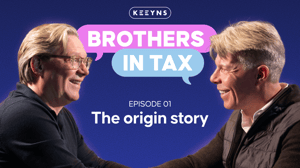
Ruben and Ramon van Aarle picked tax law because they weren't good at maths. Twenty-five years later, they've watched the job move from cutting tax rates to proving control. In episode 1 of the Brothers in Tax podcast by Keeyns, Ramon hosts as the brothers trace their road from Arthur Andersen and EY to founding Taxperience, and Ruben recalls his first in-house job: a multinational tax department running on email ping-pong, lost files and manual work.
Episode 1 · 25 min · April 22, 2026 · Hosts: Ruben and Ramon van Aarle
Short on time? Read the 5 key takeaways or jump to the FAQ.

Five things to take from this episode
Twenty years ago, advisors were rewarded for lowering a client's tax rate: "You got promoted if you managed for your clients to have a lower tax percentage." Today the work is compliance and governance. [17:13]
At 30, Ruben was asked to reorganize a multinational's tax department. "I was really amazed how much manual work there was." [15:24]
He received 20- to 30-page memos he couldn't act on. A tax team needs a call that fits the company: "there is the law and then there are business rules." [16:36]
Quoting one of Keeyns' advisors, Ruben sums up where the profession is heading: not paying as little as possible, but "it's preventing double taxation." [17:22]
With AI moving fast, Ruben expects tax teams to get control of their data and the advice they already paid for, and "stop reinventing the wheel." [19:17]
Questions answered in this episode
It moved from saving tax to staying in control. Ramon remembers that "You got promoted if you managed for your clients to have a lower tax percentage." Today, Ruben says, "It really shifted to compliance, governance and control." [Listen at 16:59]
Because the work is spread across entities, inboxes and advisors. When Ruben reorganized a multinational's tax department, he found email ping-pong, lost files and people leaving. "I was really amazed how much manual work there was." [Listen at 15:24]
Not if you can't act on it. Ruben received 20- to 30-page memos with no certainty, and recalls the old Andersen joke: "you pay thousand euro a page." He remembers bringing one Big Four bill down to about a third. [Listen at 16:14]
Yes, starting with research and data. Ruben wouldn't rely on large language models yet, but says "It's ridiculous how good it is." He expects tax teams to get control of their data and knowledge, and "stop reinventing the wheel." [Listen at 18:17]
Because the law asks for perfection. Ruben says "most people working in tax are kind of control freaks" because "the law prescribes that it has to be perfect." That makes change slow, even as research moves from the library to a few typed words. [Listen at 19:38]
About the hosts
Ruben van Aarle
CEO and co-founder, Keeyns
Started his career at Arthur Andersen (later merged into Deloitte), co-founded the tax advisory firm Taxperience in 2006 and co-founded Keeyns in 2017. Follow on LinkedIn
Ramon van Aarle
COO, co-founder, Keeyns
Started at Ernst & Young, moved to Arthur Andersen and co-founded Taxperience with Ruben. Follow on LinkedIn
Together they have 25+ years in tax as advisors, entrepreneurs and now software founders.
About Brothers in Tax
Brothers in Tax is the podcast by Keeyns. Ruben and Ramon van Aarle have 25+ years in tax as advisors, entrepreneurs and now founders of Keeyns, the tax management platform for multi-entity companies. Each episode is their unfiltered take on the industry they've helped shape: the wins, the mistakes and the lessons in between.
See all episodes · Subscribe on Spotify · Subscribe on Apple Podcasts
Keep listening

25 years from paper returns and the fax queue to AI, and the client case that became Keeyns.
Listen now
Why the brothers stepped out of advisory and bet on software.
Listen now
More filings, more complexity, fewer people: the three Cs squeezing tax teams.
Listen nowFull transcript
Lightly edited for readability.
Ruben [00:00]: If you can't do economics, then let's go for the tax law. Right.
Ramon [00:04]: Well, hello everyone. My name is Ramon van Aarle. I'm here with my brother Ruben.
Ruben [00:13]: Hello, my name is Ruben. Also Ro, of course.
Ramon [00:16]: Yeah. And we are the Brothers in Tax. So welcome to our first podcast where we'll take you while we talk about our first years in tax, what's happening with tax technology and our business endeavours together. This first episode, we will take a sentimental roots and talk about our origin story. How did we become Brothers in Tax, Ruben? Could you start by introducing yourself a little bit further?
Ruben [00:43]: Of course. So again, Ruben, obviously, yeah, that's a long time ago. Ram as you know. Actually, how did we get into tax? Well, we always wanted to do something economically right? But both of us are not very good at mathematics. Nope. So studying economy, yeah, that was not our piece of cake because of all the mathematics. So the second best was kind of tax law. And, yeah, one of our friends you know him. Neils,
Ramon [01:19]: Yeah.
Ruben [01:19]: Currently the head of tax of Philips. But at that time a friend of us playing tennis, but also working with us in the same pub, obviously. He was studying tax law and he was quite enthusiastic about it. So yeah. If you can't do economics, then let's go for the tax law. Right. Let's go. 'cause we just had. Already someone doing exactly the same,
Ramon [01:44]: Right? So you just copy the good friend working in the bar. You thought that could be a nice career in tax after a couple of years studying.
Ruben [01:51]: That's it. So, nah, let's try for the best and nah. That all went fine. Right, right. So, right. Then we started to study.
Ramon [02:00]: Yeah. Yeah. For me, exactly the same. So you copied Neils, I copied you because you were more or less you were excited by the study. Right. So, I joined also. And can you tell something about your first years after the study? Where did you start working?
Ruben [02:16]: Well, started in 98 at Arthur Andersen. That was an internship and I actually did not really like it. It was really long days, just behind the desk. Was not allowed to pick up the phone, not allowed to call any clients and I
Ramon [02:31]: Wearing a suit and,
Ruben [02:32]: Wearing a suit, tie back in the old days. But there were obviously no client meetings for me, so I had no idea why I had to wear a suit. But yeah, those were the days. And then after three weeks, they asked me whether I could visit the main partner there. I was kind of afraid, of course, because I thought, okay, he's gonna kick me out. I did not really like it. I was there, of course, every day, working hard, did my best, but did not like it. And then they surprisingly offered me a job. So, yeah, I had no other job, so yeah. What could possibly go wrong? So I said, okay, yes, then
Ramon [03:07]: Let's do it.
Ruben [03:08]: Let's do it. I'll sign the contract. So we went to the restaurant, famous restaurant in Eindhoven. And that was my first business lunch actually. And I had a contract with Andersen.
Ramon [03:20]: Wow. Congratulations.
Ruben [03:21]: And then started a couple of months later six months later, I had to finish my thesis and. Well started officially in 99, March 99.
Ramon [03:34]: March 99. Wow. Amazing. Yeah. I
Ruben [03:37]: And yourself?
Ramon [03:38]: Yeah. Yeah. Well, I can recall the nice, Friday afternoon drinks you had at Arthur Andersen, and I was, you invited me to come there. So I met basically the entire team. But still I decided to went for, in, at Ernst & Young, currently EY. 'cause I figured, yeah. Brothers working at the same employer. I didn't want to mess with your career, right? So, I thought let's go to the other large firm. So there was, EY didn't really like it there, right? So we had the conversations on Sunday and EY is a great place to work, right? But the team was, it was not the best fit in them both. Back in the days,
Ruben [04:24]: We had a very good team.
Ramon [04:26]: You had a very nice team. So we still had, so I had an internship at EY, I had the drinks with Arthur Andersen back then, and then I think Bar Thomas. He said to me, just apply for a job here, man. What can go wrong? So. In the end I did, and they hired me as well, a couple of — But they were afraid that that we started our own business. Right. Can you tell us something about that?
Ruben [04:52]: Yeah, I can tell something about that. So, the. They had, let's say some negative experiences with brothers or family, within the same firm Andersen at that time. And they were a little bit afraid that they now would step away and then all work together. So it was not really independently, yeah, in the end we went anyway. But perhaps also for the audience, we should go a little bit back to the pub because we started in tax actually earlier, right? Yeah. 'cause we studied tax both together. And a lot of our friends, they started back in the days internet companies and internet marketing companies. And they were also working in the same pub as so, obviously who. Who became the tax advisor? We did. Right?
Ramon [05:39]: Yeah. You, because they, I think they asked you whether we could help them out Right. On some tax technicalities. And they were went fast those internet businesses in the very fast. Yeah. Yeah. In the early two thousands. Yeah. And then I remember that while I was studying. I was basically doing the research and then on Sundays we made the advice to the to our friends, basically. Right. So, right. So in the end, you had a big job at Arthur Andersen and also had a side job on Sundays together. Right,
Ruben [06:14]: Right. We had a flourishing evening practice Yeah. As they say it.
Ramon [06:18]: Yeah. And it was allowed for the people was allowed the followers. So, yeah,
Ruben [06:22]: Our wives were less happy because we were always working, but it
Ramon [06:25]: Yeah. Yeah, yeah. That's.
Ruben [06:27]: It was, yeah. Happened a lot.
Ramon [06:30]: Yeah. So it runs in the family being a tax advisor because we have a brother. Also a tax lawyer.
Ruben [06:37]: Also. A tax lawyer. He actually also, I think he started at EY or Deloitte. I'm not a hundred percent
Ramon [06:44]: EY, I thought
Ruben [06:45]: At EY, at Rotterdam.
Ramon [06:47]: EY Rotterdam and then he shifted to Deloitte and back, or, that's a good one.
Ruben [06:51]: That's a good one.
Ramon [06:52]: Yeah. But he's still in tax also, right?
Ruben [06:54]: He's still in tax. Yeah. He actually also joined Taxperience. Right? Right. Yeah. For six, seven years.
Ramon [06:59]: Yeah. We worked together, I think longer, but it doesn't really matter. Seven, eight years we worked together and still a tax partner at a very large firm, so that's, but that's strange, right? So the, so it's a small industry in the Netherlands, maybe worldwide. So people say, Hey, three brothers
Ruben [07:15]: In tax,
Ramon [07:15]: All studied tax. Well, what do you think if you look back on our childhood and, how did that happen?
Ruben [07:23]: I have no idea actually. It's
Ramon [07:26]: Probably mathematics.
Ruben [07:27]: Yeah. Guido was also the very strong in mathematics. No. So he followed kind of our path and we were of course very enthusiastic. About the teams we were in and we were a little bit older. And then at also the client meetings, we started to enjoy it. We had the ski trips with the company, the Friday evening drink, so it was very nice. I think that's, he also visit some of the Friday afternoon drinks, if I remember correctly.
Ramon [07:53]: So, of course, yeah. It's a, again, it's a small world, right? So that's, but that's where it started, right? That where the Brothers in Tax. Yeah. So, that's nice. Can you, can you talk a little bit a, about the first years being in tax, because the internships, they are a little bit hard, right? So you are a, you are learning, but you don't really know. How to use your, well, your knowledge from university at the clients. Can you tell something about that?
Ruben [08:18]: I think there is a big disconnection between actually what you learn at university and then real life practice. So, and then the other thing is that everything within Andersen was in English. And
Ramon [08:32]: Yes, that's true.
Ruben [08:33]: So also the advisors, the memos, everything we had to write in English and we did not really have. The skills, of the university to write that. So was
Ramon [08:43]: Fully agree, difficult,
Ruben [08:44]: Difficult, kind of frustrating.
Ramon [08:46]: How long did it, did it take you to that it really resonate on your day-to-day work?
Ruben [08:52]: I think year and a half. And then the managers and partners get, got trust in me as a tax advisor. So I was allowed to go more and more. Basically joined meetings, but also have calls. And then actually I created my own meetings. So I was actually not too much in the office, always out with clients, that I really. Yeah, I liked, I always liked the interaction between the people and the business. It's very interesting also to go to a factory, see actually how things are being made, right?
Ramon [09:30]: Real companies.
Ruben [09:31]: Real companies, always nice. And then, yeah, tax was just kind of the subject to meet people and to go out, right? Yeah. So,
Ramon [09:40]: Yeah, fully agree.
Ruben [09:41]: We brought knowledge to them and it, that was nice. Yeah. But it took a couple of years really to — Yeah. To get, let's say, noticed by the colleagues, but also let's say by the clients and yeah, just start to call and two, three years later, totally different ball game. And a lot of freedom and a lot of.
Ramon [10:05]: I fully agree, but now you understand that they keep you at the office for the first year, right? We did basically the same at Taxperience, right? Because experience, if you have a meeting with eight people and you are working for six months, that's a hell of a job if they ask questions, right? Because the client thinks they, you know, everything. Right?
Ruben [10:23]: Right. That's it. So, yeah. Only later let's say in the, during the career, you start to understand. Why it takes a while before they send you out to clients. Right? Yeah. There you go. You need experience, you need more knowledge.
Ramon [10:38]: Yeah, I al I already said Taxperience, that was. That was a nice ride.
Ruben [10:46]: That was very nice.
Ramon [10:46]: Can you elaborate on the founding of the, of that company, how did we do that? What was the, what did we do And decided, let's say the six months before, right? Yeah. Because back then it was new as starting your own tax firm.
Ruben [11:03]: Absolutely. I think we already managed, we had kind of a flourishing evening practice, right? So, we had, anyway. To make a decision or those clients had to come to Andersen slash the Deloitte at that time. Yeah. Against totally different hourly rates. Right. Or, yeah, we should say to our friends, sorry, we can't advise you anymore because it was getting a little bit too much. Anyway. Yeah, the both jobs. But I think both of us were a little bit too restless as well, right? To I it was not fast enough anymore. Was at Big Four, at the Big Four decision making took forever and it was running in the same wheel all the time. And I think we needed a little bit change. And then I think somewhere during the summer of 2005, yeah, we pushed the button and said, okay. Let's start our own firm, make the real decision in September, 2005 and actually started in January, 2006.
Ramon [12:10]: Yeah. Who came up with the name?
Ruben [12:11]: That was Sam all
Ramon [12:13]: Our third partner, right?
Ruben [12:15]: Our third partner,
Ramon [12:16]: Founding partner, Sam.
Ruben [12:17]: Yeah. Yeah. He had
Ramon [12:20]: We have to give the credit to Sam, right? He invented the name. It's, I think it's still one of the best names ever for a
Ruben [12:27]: Company.
Ramon [12:27]: Right. Absolute.
Ruben [12:28]: And I think also those days there were no international tax boutiques. Right? You had Loyens & Loeff, actually, and we always said we're going to build a small Loyens & Loeff. I think in the end we managed to get there was not that easy. No. Nothing is easy. We know that over the years. Right.
Ramon [12:50]: But I know the story, but. Tell the audience you didn't have a full book of business when you started, so take us
Ruben [12:59]: No.
Ramon [12:59]: Yeah. Through the first years. How did, how what did we do? And we had to pay the bills, right? We had to pay the bills. We hired colleagues, I think in month four. After we started. So,
Ruben [13:09]: Yeah, that was kind of a bumpy ride because we always work for corporate and international companies. The partners of Deloitte said, how do you get clients? Because those multinationals will not join you.
Ramon [13:21]: No. What I thought,
Ruben [13:23]: That's what they thought. That was also what we thought, right? So, we had to build a business again. Of course, we had some friends, clients from day one who said, okay, we're going to join you. But we had another, CFO slash friend, Eric o He gave us the opportunity to, for me to reorganise. A tax department at a CN in Amsterdam as in-house tax director. And, yeah. Basically what also happened was that a lot of our, clients from Andersen slash Deloitte they get, did not get a telephone call from the new Deloitte people. They started to call us. Right? So, after six months, basically six to nine months, I think most of the clients for who we were working at Andersen slash Deloitte were our clients at Taxperience again. Yeah.
Ramon [14:25]: Luckily for us,
Ruben [14:26]: Yes. Where it was good. We were brought as in tax because I was still, let's say, working at a CN also 40 hours. And you were doing a lot of meetings and, yeah.
Ramon [14:38]: Yeah. We can tell the story now, right, of course. So the, so Ruben was in Amsterdam working internally, and I was working. All mailboxes. So I was making the memos on behalf of Ruben, sending them out, receiving emails. Thank you very much, Ruben, for your quick reply. So that was basically the first year. So we had a — we had a blast back then if you look back, right?
Ruben [14:58]: Yeah. It was really nice.
Ramon [14:59]: But if you look further for the rest of your career, what struck you most? Once working internally on tax, because it's different than being an advisor, right? What did you learn? What's your,
Ruben [15:13]: Totally different. So, we just started our own company. I was 30 and then I was asked, let's say, to reorganise the tax department, which I obviously also had never done. But nah. Okay, let's go for it. Let's make it the best. But I was really amazed how much manual work there was, and. And how many ping pong over the email and lost files and churn of people and
Ramon [15:41]: Yeah, they were the big corporates. Right. Lots of people working there internationally.
Ruben [15:45]: So one of the Big Four, they charged that company, almost a million a year. And basically my task was to bring that down, obviously. I think that that went down to a third. But then you also see, let's say how tax work, right? So, if you just ask a question to broad question to a tax advisor, they come back with a broad memo actually saying nothing if this, then that, and then if that, then this,
Ramon [16:12]: Please note,
Ruben [16:13]: Please note. And however, and there's no certainty. So I got these kind of memos, 20, 30 pages, and actually I couldn't do anything with it where let's say. The joke we always made at Andersen, you pay thousand euro a page. A page. So, that was basically 20, 30,000 euro wasted on a memo and I couldn't do too much with it. So I really also learned the hard way. Basically how to, yeah. Deal differently with tax. So there is the law and then there are business rules, and then you need to make basically a decision for a company where it's going and right. 20 years ago, that was again, totally different than today. Right. So,
Ramon [16:58]: Yeah, of course
Ruben [16:59]: Tax advice 20 years ago is different than tax advice today. Yeah. It really shifted to compliance, governance and control. Well, we back in the days, we had great double dip, triple dip,
Ramon [17:13]: Double dip. Triple dip. Not stretches, not paying tax. Not paying tax. You got promoted if you managed for your clients to have a lower tax percentage. Right.
Ruben [17:22]: We were very proud of it. And yeah, one of the advisors today to Keeyns, as you know, Hanson always mentioned that it's where it's going. It's not. Paying as little as possible tax, but it's preventing double taxation. And I think that's actually where we are today. If you look on some of the Latin American countries where they charge royalties for everything or with withholding taxes on royalties, obviously. So, yeah, totally different game.
Ramon [17:53]: Okay. So you, that's interesting. So your career is let's say 25 years now in tax. Where do you think the next 25 years will take us?
Ruben [18:03]: Yeah, it's an interesting question. Of course you never know. So one thing we learned as entrepreneurs is that making plans is a and yeah, you need this step on the horizon, but we know it's shifting all the time. So I think if I just look three to five years, I think that's already a long digitalization is moving at a really high pace. AI is definitely changing a lot in tax, right? So it's incredible, what you can always ask to the large language models and how good they are actually already. Yeah, so I would not rely on it, but
Ramon [18:50]: We're getting better and better
Ruben [18:51]: Every day. It's ridiculous how good it is. So that's definitely changing getting control of your data the information. So we see a shift really from, yeah, basically scattered facts and emails all over the place to, yeah, getting control of your data, your knowledge, what is bought by the company already from the advisors, right. And stop reinventing the wheel. Yeah, that is
Ramon [19:20]: Do you think it's a tra traditional marked market? The tax practice worldwide Are a,
Ruben [19:27]: I think
Ramon [19:28]: Yes. Agile enough or do you, when did the shift towards the technology part really start in your opinion?
Ruben [19:36]: I think it tax is not really agile, right? So it's. I think most people working in tax are kind of control freaks that everything needs to be perfect because yeah, the law prescribes that it has to be perfect. The, there are actually no, errors are actually not allowed. Right. Yeah. So that also says something about the people working in it and the behaviour of the people, and perhaps also the adoption of. Yeah, new technologies and the willingness to change. So, if you see, let's say the, when I started my career we had some fax and files and later on it was email, but only internally
Ramon [20:25]: Late. Yeah. Later on email later on. We did have email back then, huh?
Ruben [20:28]: Oh, no. Just sent letters and faxes. And it was email only internally later on. It was of course also the communication with the client. There was a lot of discussion whether it was safe and et cetera. Actually, that that is still a valid, yeah, valid point debate. Right? Still a valid point. But yeah. And then of course the research was totally different. Back in the days we went to the library, sit there for hours,
Ramon [20:57]: Hours, yeah.
Ruben [20:58]: Finding the right, pieces of jurisprudence or law or literature books, right. Going through it. And basically based on that, making.
Ramon [21:09]: Making
Ruben [21:10]: A memo.
Ramon [21:10]: Making a memo. Yeah.
Ruben [21:12]: Which today, let's say is, yeah, with a few words. You get the same data in a split second. So that definitely changes. So the research part, then I think also the compliance part, it started with the indirect taxes. Also more and more software came available in the market. But corporate income tax, of course, still, yeah. I don't think it's possible. No. This is still difficult with the current state. Very difficult. No different also because they changed the law all the time. Now transfer pricing, there are, there is some, of course technology in place. But it's shifting, but.
Ramon [21:56]: Yeah, it doesn't go really fast.
Ruben [21:58]: Not really fast.
Ramon [21:59]: No, no. Let's go back to the Brothers in Tax. So, what, what's interesting we're brothers, we're in tech, and, when people ask me about you, they say he's not a typical tax advisor. We're not tax advisor anymore. But why do you think people say that? Because that's interesting, right?
Ruben [22:19]: Well, probably because of what I just said. So, entrepreneurship and tax. It actually doesn't go really hand in hand. So probably we were I think very good at tax, but too entrepreneurial. That's also why we started our own company. Yeah. We had to
Ramon [22:38]: Do it right.
Ruben [22:38]: We had to do it.
Ramon [22:38]: Yeah, we had to do it.
Ruben [22:40]: So that's perhaps that, that's one thing. Yeah. Why we are not typical tax lawyers. That's a good question.
Ramon [22:50]: Did you make many memos at the last 10 years of your career or what was the approach? Actually zero. Zero? Yeah.
Ruben [22:58]: Yeah. So,
Ramon [23:00]: It was more the implementation, I think. Right. That maybe that make made the difference also.
Ruben [23:05]: Well, but I read obviously the memos prepared by our clicks. Right. But. And so my knowledge actually also came from those memos in the end. And of course reading a little bit myself, but preparing now, not for the last 10 years actually, we had to bring in business, right? And we had to steer the company. We brought experience to different kind of countries. Yeah. So we did more the entrepreneurial part of running a tax firm, right?
Ramon [23:36]: Yes. Yes, that's true. That's true.
Ruben [23:38]: So that, that's perhaps why people think we're atypical.
Ramon [23:43]: Yeah, atypical. Well maybe final question. Do you have something to add on the origin story of the Brothers in Tax and your being part of it for decades already?
Ruben [24:01]: I think, well, to, just to summarise it all started in the pub. We got our first clients get to know a lot of people went to the Big Four.
Ramon [24:11]: Learned a lot,
Ruben [24:12]: Learned a lot. Went back basically to the pub. Get there more clients. Ended up with a larger firm that sold it last year.
Ramon [24:19]: Yeah, sold last year. Right there. That was a good one.
Ruben [24:22]: That that was Taxperience.
Ramon [24:23]: That was Taxperience. That was a hell of a ride. Today we are at Keeyns, but we'll tell you later. Well, Ruben, this is the end of the episode. Thank you very much for your wisdom. Thank you. I want to thank all our listeners, obviously. My name is Ramon van Aarle and I was the host of this show. Next time Ruben will be hosting. So, very much looking forward to it.
Ruben [24:45]: Thank you very much for hosting this one, and thank you all for listening to this podcast.