
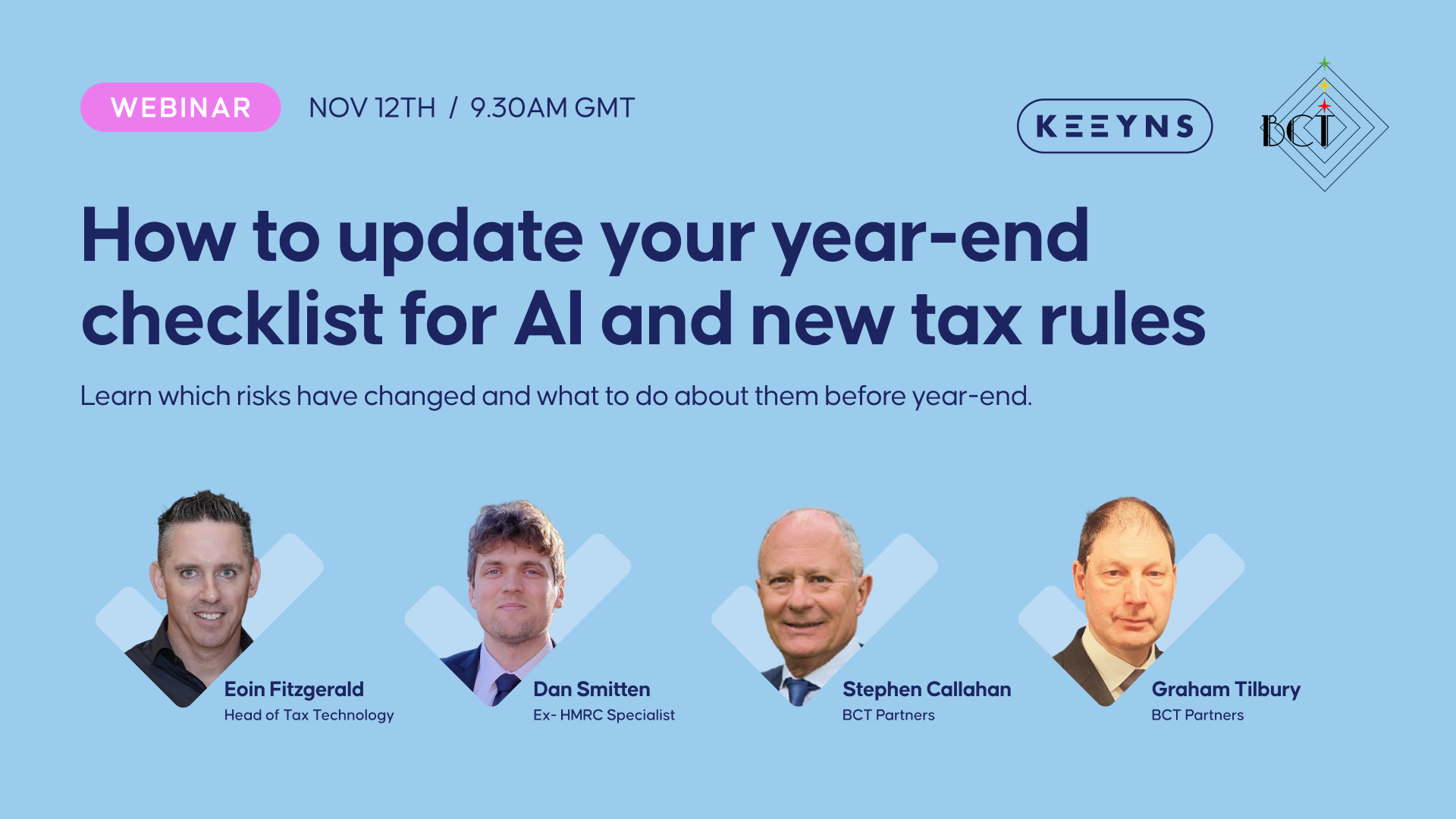
How to update your year-end checklist for AI and new tax rules
Learn which risks have changed and what to do about them before year-end.
Tax authorities no longer just check your numbers. They want to see how you got there. An ex-HMRC specialist, Keeyns and BCT Partners on what that means for this year's checklist.

Short on time? Start here.
- Your checklist is older than your risks. Most were written before AI tools and this year's rule changes. Graham's advice: don't roll last year's forward. Start from a clean page.
- HMRC is building the data to check how you got there. Its 10-year Quantexa deal pulls data it already holds into one place, and e-invoicing will add more. Dan expects risks to be flagged before an officer even opens your file.
- More of the burden sits with you. Guidance, nudge letters and new duties to flag uncertain positions and correct errors. If you had the information to get it right and didn't, "reasonable care" gets hard to argue.
- Spreadsheets and email won't survive that conversation. Eoin's point: most tax governance still runs on both. Can you show every filing, owner, status and deadline, in real time?
- Fix the data before the AI. The biggest issue for a tax team adopting AI isn't the AI. It's the quality of the data underneath. Without it, Graham calls the rest a house of cards.
- AI needs an owner, and a paper trail. Copilot doing reconciliations counts as AI in your tax process, so document it and check it. And prompts about advice or structuring can become discoverable.
- What's most often missing: the board. Stephen sees it again and again. Tax risk goes on the register, and the board never really engages with it.
Who you hear from


Could you list every filing, owner, status and deadline by Friday?
That's Arnold's test for any year-end checklist. If the honest answer is "give me a week and a few spreadsheets", that's the gap the panel talked about.
Keeyns puts every entity's tax deadlines and processes in one place. Nothing gets missed, every process stays on track, and you're audit ready when the questions come.
Full transcript
Welcome and introductions
Arnold: OK, good morning and a very warm welcome. My name is Arnold de Bruin. I'm the CFO of Keeyns and I'll be your moderator for the next hour. So first of all, thank you for joining us. And let me introduce you to the team.
So we have Dan Smitten from Trident Tax, Eoin Fitzgerald, head of technology of Keeyns. And we have Graham Tilbury and Stephen Callahan, both from BCT Partners. Welcome, gentlemen.
And the key message of today is that tax authorities no longer just check your numbers. They want to see how you get there. And if your year-end checklist was written before AI and the latest rule changes, it probably can't show them.
So today we have 4 topics to discuss. The first topic is what changed this year, the AI and the new regulation. How tax authorities look at data, process, and disputes. Where AI and workflow software fit, who owns them. And part 4 is your year-end checklist roadmap: governance and technology. And at the end of the session, there is room for questions. Please feel free to ask questions and we will take care of them in the last part of this session.
So, Graham, Stephen. What actually changed this year?
1. What changed this year: AI and new regulation
Graham: Thank you, Arnold. Pleasure to be here. My name's Graham Tilbury, and I'm one of the founders here at BCT Partners. It's a pleasure to be on this webinar with such esteemed colleagues. I've been in this business for more than 3 decades, and I guess I'm kind of the bottom half of the duo. I look at tax technology, tax data, tax AI. And I get as far as process and then I like to hand over to Stephen, so I'll just let you, Steve, tell them about your half.
Stephen: Good morning everyone. Yeah, Stephen Callahan here, partner at BCT Partners. I've been specialising in tax risk management and governance for about 20 years now. And as Graham said, I start at the top. I like to start with the board, the strategy, the policies and the procedures, and then Graham and I meet in the middle.
Graham: Thanks, Stephen. So, just a couple of slides at this point in today's proceedings. We're not going to read the slides out to you, you can look at the slides after the session. But what we want to draw your attention to is the fact that regulation in tax has been accelerating with regard to process and data for many years. Very slow start, you can see the history in the slide there, but what we have seen is some real acceleration over the last 12 months. And even since we've been putting these slides together for a variety of these events this year, we keep seeing more and more changes, and of course we've only just had the budget here in the UK, so there's even more change already happening.
So just to highlight a few of the items from my bottom-up perspective, I think clearly the biggest thing that's happened in the last half a year is HMRC announcing their 10-year deal with Quantexa for sovereign AI for the UK tax authority. They are going to be getting a lot of the data that already exists and trying to pull it together to make it a lot easier for HMRC to make sure the filings from companies are right and that the tax that they are paying is correct.
We also know that we've got e-invoicing coming to the UK and there's consultation happening again around data submissions from electronic point of sale devices, so more and more data is coming through. We look at this and we potentially make parallels with other countries, India for example, where a lot of this data has now been automated by the tax authorities, and you are starting to see notices being thrown out in their thousands every day towards taxpayers, and that need for the taxpayers to meet the same level of automation, the same level of AI as the tax authority, so that they don't drown in these notices coming through. So as I say, a lot's happening right now. Stephen, maybe if you want to just have a couple of points on the top-down rather than the bottom-up side of this.
Stephen: Thanks Graham. I'd start by going back a few years, and some of you may be familiar with the OECD document Tax Administration 3.0. That document has been around for a little while now, it's had a few updates, but it's really coming to life in the UK.
Following the UK's recent budget, there was a consultation paper released asking for input, feedback on the transformation of the tax authorities for the administration of corporate tax, and they directly refer to the OECD paper 3.0. That means that from a corporate tax perspective, they're looking to drill into the underlying data.
This is also reinforced in the UK by the new transfer pricing provisions that are coming in as from the first of January, where on an annual basis the corporates will be needing to provide the data that supports their transfer pricing. Not just the master and local files, but the underlying data by which they calculate their transfer pricing. This data is effectively going to go into a risk engine. Now from a UK perspective, this means that you're effectively going to be under a transfer pricing audit on an annual basis.
This is an example of the UK. We're seeing this happening globally now, and it's off the back of, as I said, the OECD paper 3.0. In addition, in the UK, a couple of other points: the requirement for subsidiaries to be audited for some groups is going to be removed, and there was the provision to include a profit and loss account for small businesses that is now being removed as well. All of this signposts the tax authorities wanting access to data. They're not needing the documents, they want the underlying data. Thanks, Graham.
Graham: Cheers Stephen. So, just another few points here and a few interesting headlines from the last few weeks. Firstly, having mentioned the use of products like Quantexa, like OProject, where tax authorities are using these big data stacks to create something that AI can operate on: we saw 87% of tax practitioners at a recent conference strongly agreed that their tax department would benefit from access to the same AI tools that are used by tax authorities. And given what we're seeing, as I was saying, in places like India, with this huge volume of notices now coming out, powered by AI and a big data stack, you can see why taxpayers need to have a similar engine themselves.
But there are some other interesting points here, one of which is we're seeing a lot more focus again from tax authorities about the difference between probabilistic and deterministic AI. Tax authorities want taxpayers to use deterministic AI when it comes to any of the numbers going into the tax returns. And as Stephen was saying, you're getting data submissions from things like the ICTS regulations. You can't sit there and say those numbers came to me from ChatGPT, Copilot, Claude or wherever else, if you can't show that evidence and that trail, so you need to have something deterministic in your system. Meanwhile, the authorities can use probabilistic tools to try and look for outliers in the data to focus in where they're going to be doing their audits and their enquiries. So there is a little bit of an asymmetry in the system here, unfortunately.
We also know that the spend that HMRC has put in for Quantexa is about 175 million pounds, and we know that as a rule of thumb, or at least according to the overall statistics published by HMRC, for every 1 pound they spend on these compliance activities, they expect an average yield of 23 pounds. So by my mathematics, that means HMRC are expecting to see an increase of 4 billion in terms of additional tax to pay for that investment in Quantexa, pulling together all of that data.
But it isn't just about the technology, it is also about the information powers. Stephen, I don't know if you can just very quickly, 30 seconds, share what's happened with Shell.
Stephen: Thanks Graham. Very quickly, there's a court case in the US where Shell has requested the IRS's instructions into AI as a disclosure. Now whilst that is a US issue, the UK information powers have been changed now. So if you're using AI in terms of any advice or correspondence, in terms of structuring, those prompts, those questions you're asking AI, will become discoverable information documents.
Polls
Graham: Thanks, Stephen. So we've got a few quick polls, so if we can just quickly rattle through those and get a little bit of information from the audience, that would be great. So we're just going to give you like 30, 45 seconds to answer each of these polls.
First one is: is tax helping shape the organisation's AI strategy? So if you can just provide your inputs on that, we'll give you half a minute and then we'll move on to the next question. Arnold…
Quite a bit. Interesting.
Yeah, but it's still changing, yeah.
Graham: Yeah, oh absolutely. These things take a little bit of time to process through, but: slightly, not at all, a little, a lot. Yeah, I mean, if you'd asked me in advance, I would have said you're probably going to get more around not at all and slightly, so I guess that's not wholly unexpected. Could we have the second poll please?
OK, so this one I think is definitely more interesting, and we'll come back to this later. We know a lot of organisations do benchmark their use of tax technology, their use of global business service centres, but with the amount of use of AI happening in tax, you would have thought that should also be part of that benchmarking environment. So, just curious to see if anyone was currently doing that benchmarking, whether formally or informally. I guess quite pleased that it's even hitting 25%, so that's very good news. If we can do the third of the polls please.
OK, now this is about how confident you are in your organisation's approach, and this is a question we've asked at each of the last 4 events we've been doing, both at conferences and other events this year with Keeyns. So, very interesting to see whether or not we get a similar answer every couple of months or if there are slight variations.
I would say that historically, we tend to be low to middle in terms of confidence in the organisation's approach, so the fact we're seeing "a little confident" coming out on top, I think, is fairly much aligned with where we've been in the past. And if we just quickly go into the final of those questions, then hopefully I won't be in too much trouble for overrunning our time allocation: how confident are you in your own ability to use AI for tax?
And again, we've asked this as a pair of questions along with how confident you are in the organisation, and historically we see a significant enough difference that people tend to average out at quite confident, whereas the polling around the organisation tends to be more around a little confident. So, looks like we've got less of a gap today than we sometimes get. I'm not sure if people are less confident in themselves or more confident in their organisations, but I think it's probably a good thing if that gap is reduced. So, thank you very much for your input there, everybody, and Arnold, I'll let you move us on to the next segment.
2. How tax authorities now look at data, process and disputes
Arnold: Yes, thank you, Graham. I already introduced Dan, and Dan is an ex-HMRC specialist. But he's speaking from his own experience, so what he shares is his view, and HMRC has not reviewed it. But then, you've sat on the other side of the table, so what do authorities do with all this data now?
Dan: Yeah, so just as a brief introduction, I was at HMRC for around 8 years, predominantly as a corporation tax specialist and case lead in the old Large and Complex team, before moving over around 3 years ago to assist clients in the private sector with HMRC disputes.
And I wanted to provide some perspective from my time at the department and also what I've seen since leaving. And I think the first thing is there's a real shift in the approach from HMRC: a greater focus on trying to achieve much more with less. Now what that means is traditional enquiries remain important, but the department is putting a much greater emphasis on preventing errors and addressing risks across wider groups of taxpayers. And I think better-connected data and AI is intended to support that approach.
And I think that's really illustrated by the published HMRC figures for 25/26, where there's 12.1 billion in cash expected compared with 21.1 billion in upstream yield. So cash expected is your traditional revenue HMRC expects to recover from enquiries and traditional, standard enquiry work, whereas the upstream yield is a measure of recoveries based on stopping errors before they arise. So whether that's amended guidance, the still relatively new guidelines for compliance, or client disclosures made following nudge letters.
And the nudge letter campaigns, they're not new, but we're seeing more and more of these campaigns. HMRC take two data sets, clash them together, and then produce a significant population of taxpayers where they can write to you in a one-to-many approach rather than approach you for individual enquiries.
And I guess if HMRC are going to produce twice the revenue from these campaigns in comparison to its traditional enquiry work, from a much lower number of staff, it's clear why HMRC sees substantial value in taking a much greater step in this direction.
That's not to say HMRC are relaxing their traditional enquiry work, and indeed HMRC have announced a further 5,500 frontline enquiry staff in the last two budgets.
But the other noticeable change is the approach to these enquiries. So HMRC has access to a substantial volume of information from various sources: from other public bodies, financial data from the Common Reporting Standard, or information shared by other overseas tax authorities. And that scope's only increasing. In December last year, the UK and 24 other jurisdictions announced their intention to implement a framework for exchanging readily available property information.
HMRC increasingly use the information available to it to identify risks and inform their enquiries, even before the enquiry reaches the caseworker.
And I think, as Stephen and Graham mentioned, the Quantexa partnership is one of real interest. The initial step, having worked at HMRC, is to bring together the quite fragmented data they already have and provide a stronger foundation for analytics and AI. Once they've got a more connected picture of taxpayers and their relationships, it should enable them to highlight potential risks at a much earlier stage.
This builds on the current tool which they use, which is called Connect. And I've seen Connect referred to in some articles recently as HMRC's AI system, but it's much, much more rudimentary than that. But what it does do is provide officers with a detailed information pack identifying potential risks, summarising financial data, previous enquiries, links between companies and other entities. And I think the Quantexa partnership should allow for a much more complete picture and more analysis before an officer even begins their enquiry.
The one obvious and significant gap for HMRC at the moment is how the information they have from enquiries feeds into other enquiries. So what I mean by that is detailed invoices, supplier and customer information obtained through one enquiry doesn't always inform enquiries into other taxpayers. Better use of the information HMRC already holds would narrow that gap, and I think it's quite an easy step for Quantexa to take.
And that ties quite neatly into the proposed VAT e-invoicing requirements that are coming in from 2029, which improve the structure and quality of invoice records. Currently the intention isn't for HMRC to automatically receive every invoice, but the government is consulting on precisely what HMRC will have access to, and I think it's quite clear they're going to have access to a much wider data source, and it'll be in a much more easily analysed format.
So the other recent and noticeable change is a greater focus on process. As Stephen and Graham mentioned, there has been an approach from HMRC called Project Snowball, a systems and processes review for large businesses. It was led by non-tax specialists, it was led by data handlers and data specialists. They went in, interrogated the systems, the data, where it was held, who was responsible for it. And I think the starting point then is how a business manages risks across its system, rather than a technical challenge in the company's returns. That then feeds into the tax specialist's review of the company when they then come out and start their enquiries.
So the other thing that we've noticed is a real onus placed on the taxpayer themselves to get things right. The starting point for that has been providing more material for taxpayers. That's included the updated guidance, various spotlights highlighting approaches or arrangements that HMRC don't agree with, and the numerous guidelines for compliance. So, taking a positive light, this could be HMRC acknowledging that the UK tax system is very complicated and that people need help to get their affairs correct. The more cynical view might be that HMRC use this information to later inform their arguments on penalties. Put simply, if a taxpayer had access to the relevant information needed to get things right and they didn't, how can it be argued they took reasonable care?
HMRC has also introduced powers placing responsibility on the taxpayer to identify scenarios where tax treatment is uncertain in their own returns. So the uncertain tax treatment regime requires qualifying large businesses to identify any legal interpretation taken that is contrary to HMRC's known position. And currently that is quite a small population.
But there's a consultation this year where HMRC proposed a much wider coverage. So under the extended powers, taxpayers would be required to identify any position taken where HMRC's position is unknown or where there is a credible legal alternative. And that is an incredibly wide definition. It includes not just legal interpretation but also differences in valuations, apportionments or calculations, which I think you can see would impact a significant number of returns.
The recent budget also introduced the correction of errors measures, and it's another step in the same direction. So these measures require taxpayers to take reasonable steps to correct identified inaccuracies. Now, you would assume that's similar to the current rules, but the significant difference is that where there's a failure to meet the duty to correct, it increases the inaccuracy to be treated as deliberate rather than being treated as careless or a mistake.
So taken together, the direction is clear. There's a much greater emphasis on taxpayers to ensure their affairs are correct. HMRC are providing further guidance to ensure a taxpayer can get the position correct in the first place. Where the position isn't clear, there is a responsibility to identify uncertain positions taken and notify HMRC. And finally, where an error is identified, there is a much greater push for taxpayers to correct the identified errors themselves, with more aggressive penalties when this isn't completed.
I always understood that if you look hard enough into someone's books and records, you'll find mistakes. At the end of the day nobody is perfect, and HMRC don't expect you to be. But I think HMRC wants to understand what controls are in place to minimise these errors, what measures are in place to identify the errors when they do arise, and then finally, if errors are discovered, what actions were taken to amend the position.
My slides are obviously a bit more basic than Stephen and Graham's, but that's it from me, so I'll hand back to Arnold now.
Arnold: Yeah, and just a question then. Without naming anyone, what made one business easy to work with, from your side of the table, and another one harder?
Dan: I think it's that final point. So easy to work with is companies that acknowledge their own mistakes, that address them and then come to HMRC with a complete picture. If you think of an officer sat at their table, they've got, for large companies, anywhere between 8 and 15 clients, and they have enquiries into each of them. If somebody comes forward to them and says, look, this is what we've done wrong, this is how it happened, this is what it is, and this is the amount of tax that's at risk or the tax that needs to be addressed, that's one less thing for that officer to deal with, and actually it's quite neat and tidy versus the combative approach.
And I think that's where it's a real benefit to being in a large business, where you have that relationship with what used to be called a customer compliance manager. They've gone through various names.
Arnold: OK, Dan, can I ask you just a follow-up question on that? In your experience, are people more likely to come with a "look, we've made a mistake" and own up to it, versus the other? What do you see in that mix? What does it look like?
Dan: I think on this side of the fence, it's quite difficult to get people to understand that actually making that disclosure, you're in a much better position.
And on both sides of the fence that's true. I think if you're an officer and somebody comes to you and says this is what's happened, we've identified it completely unprompted, obviously you are going to treat them much better than where you are 2 to 3 years into an enquiry and you finally establish that there's a mistake or an error. And at that point you're considering penalties, having gone through a significant process to get there. At the end of the day, that's going to really negatively impact the view they take on the resolution position.
Arnold: Interesting. Thanks.
3. Where AI and workflow software fit, and who owns them
Arnold: So if authorities see more and expect you to show how you got there, where does technology fit in? Eoin, over to you.
Eoin: Yeah, thanks, Arnold. I'm just moving to the next slide.
Yeah, and that was an excellent reminder actually of where we're going directionally from the guys, and what the business environment looks like today. Dan at the outset mentioned doing more with less, and actually I came from Dell, right? So that was almost a mantra on the private side for a long time, to do more with less. Interesting to hear it on the HMRC side as well. Graham mentioned that there were notices in their thousands going out in India.
Stephen was talking about transfer pricing data being given annually, which essentially means that you're being audited real-time, more or less, on the transfer pricing side of mind, putting invoicing aside. And more work being done electronically before it ever reaches the caseworker. So even though they're talking about hiring an extra 5,500, before it ever gets there, it's qualified. So there isn't really a bottleneck when it comes to finding the issue, qualifying it, giving it to somebody to handle it. And then from a penalty perspective, there was a reference to the onus being on the taxpayer to be correct before the filing, so increased penalties if you file incorrectly.
Now, if you're hearing all that, then the direction of travel is fairly clear. And the question I would have for the listeners, as you're listening to it, is: where is your business and your tax function on that journey right now? Because if that's where it's going, then you need to be ready. And some of you will have the role of senior accounting officer, and a question for you is: how do you demonstrate good tax governance inside your companies today, in real time? What does it look like? Are you comfortable with it? Does it look and reflect what you'd expect in that conversation that you're going to have with HMRC down the line?
And on the screen right now, in the top part, is how we see customers and companies managing tax governance today, across the world, not just in the UK: using email and spreadsheets. Almost without exception. Although there are some companies that have some processes, for the most part, this is what we see in the top part.
Now think about it for a second. If HMRC is using AI and algorithms, and will in time have the data sets that were referenced from e-invoicing and transfer pricing, do you think a spreadsheet and an email are still going to fly? And I think that's probably something that I'd like you to reflect on.
The question that was asked of me was: where does workflow sit? And I would say to you, workflow sits right across your business. From a tax perspective here today: your compliance, transfer pricing, accounting, the annual filings; in company secretarial and legal, it could be trade licences, again annual filings in the company section; and payroll. So all of those are just examples of where workflow really sits well, and something that we at Keeyns actually support our customers with today. So anywhere you have a process, a monthly, quarterly cycle, even end-of-month cycles, involving teams either inside or outside your organisation, workflow helps to drive those. And what we see in the top part here is, for the most part, they're being driven by email and spreadsheet tracking, OK?
And again, I would say, whilst every other part of a business today has some tool driving it, from the tax governance perspective, what we see here on the bottom is that it's generally driven by email and spreadsheets.
Just going to skip forward a slide here. There's a question that was asked also: where do we see good uses of AI today?
And I would say, on the top part of this slide, a particularly good use case is legislative change. One of the tasks that I had in a previous role was to gather all of the legislative updates that impacted the business across the region, 35+ countries, and to circulate that quarterly. Now, that was about 2 days' work: gathering all the emails from the Big Four and the different sources, tax authorities, going down through each of them, reading them to see which changes were relevant for our business, then consolidating into a document, rereading it to make sure that they were relevant for the business itself before you send it out, and then sharing it to an audience of about 300. And that was before thinking about whether this was even relevant for the people that it was going out to, given that it was a diversified business.
And so today, LLMs can do this almost on the spot. It takes you a little bit of time to build it, but you probably shouldn't be paying for it. So all the sources that are out there today that are free, you can use those, leverage them. Farmers, and you can add to that probably every time you send one out: you'll find there's another source that you hadn't included in your prompt before. You can update it and make sure that it goes out in better shape than it did before.
Certainly, we spent a lot of time on the language, and I think maybe I'd spend less time even on the technicalities and the accuracies, and more and more on just making sure that that information is shared with the right audience, and let people come back and ask the questions then. I think that's probably one of the most important parts, that people do ask those questions.
Some other examples here. These are all ones that are used in business today, in real time. A question that was also raised here for me was: who owns the AI piece? So I know Stephen and Graham will address this as well shortly, because it is part of the governance. And obviously, you still have your IT teams, you have your functional teams, so in your case it might be the tax team, and you may have data or legal teams as well, depending on how you're using it and where it sits. But for sure, everybody's using it, whether it's a personal device or a professional device. You're better off making sure it's inside your business network rather than outside it.
My last slide today. The top part of this slide, I suppose, is how I think the tax function is viewed from outside. The wider finance organisation, the wider business organisation, operations: they look to the tax team as those with the knowledge. They trust us. They understand that if they get information, normally you can bank on it, and it's a function that's in control. When you're operating on the other side, it's less so. And I suppose the tax organisation spends its time making sure that the answers it gives are correct.
To Dan's point about all the audit questions that come in: you're testing the business consistently with questions that come to the tax function, and now you're taking those, making sure that they're accurate before you're responding. And that takes a lot of work. And so below the waterline here, I think, is how the function appears to me today: a lot of activity, not necessarily visible to the outside, but certainly it's happening, and it's more or less concealed.
I'm going to pass it back to you, Arnold.
Arnold: Yeah, but maybe, Eoin, did you consider yourself a firefighter at that time, or how would you describe yourself?
Eoin: Yeah, it's a good question, Arnold. I think you had multiple hats on. I think some days you were firefighting, some days you had a police hat on, some days you had a nurse's uniform on. So depending on what you got thrown into, and that could be multiple times a day you were changing uniforms. Needless to say, no two days were the same. The nurse's uniform looked very good on me, as did the fireman's suit.
Arnold: OK. Yeah, and you ran the indirect tax across, let's say, 40+ countries at Dell. So what did "well controlled" look like there?
Eoin: Yeah, I suppose, being honest, prior to having digital controls around your view on where things are at, for the most part it was Excel documenting. You may have gone back to your six-month-old template to update it for where things are at today, but no sooner had you closed the file and sent it or shared it than it was outdated by possibly a week or two already. It certainly wasn't real-time.
At that time it certainly wasn't real-time, but it was making the best of the tools that were available, I would say. And certainly things have moved on, and I think there are opportunities now for businesses to leverage better tools. Maybe one example I will give actually: we did see e-invoicing implemented in a country in Europe, where the compliance, which took a number of days, went down to hours because we managed to automate it. And for the reasons that Dan referenced earlier, and Graham, on the questions that get generated: whilst we reduced the manual steps and all of that work by a huge percentage, the actual work in that country went up by 40%, right? Because the work just moved from pre-submission prep to post-submission, answering questions.
And so if, in your businesses, somebody says this is great for optimisation, it makes it really efficient, we'll be able to reduce tax team numbers: when these kinds of changes go in, it creates a visibility into your business that creates questions which need to be answered. And the people answering those questions need to understand what the question's asking, and they need to understand the business. But the skill set needed in receiving that is very different to the skill set needed to prepare the information in the first place.
So I would say to you, be cautious about calling out the optimisation piece, because actually there's work coming down the tracks that doesn't exist today.
4. The year-end checklist
Arnold: I have one question to test any checklist. If HMRC or the board asked, could you list every filing, owner, status and deadline by Friday, what would be the answer? But that's one question. Graham and Stephen, you have the full checklist.
Graham: Thank you Arnold, and thank you Eoin and Dan. There were some really interesting thoughts that you were putting out there for everybody. We're going to spend hopefully no more than the next 9 or 10 minutes on this last section, so that we've got plenty of time for your questions, and I can see there have already been some very interesting ones coming in. Please do keep them coming.
We're going to talk about the year-end governance checklist. There's a lot of points here; we didn't want to fill the screen real estate too much. If you want to have a look at some more of the detail behind a lot of these checklist questions, you'll find some extra content in the white paper that will be made available to you, as well as on these slides. So between Stephen and myself we'll just pick an item each from the next 4 slides, because we divided the checklist up between governance, process, technology, and people. So, Stephen, I think I'll let you kick off with this one.
Stephen: Thanks, Graham. Considering what's been discussed this morning, the checklist becomes more and more important. Tax is going through a fundamental change. I don't think there's been such a time when the technology and the tax administrations have been advancing so quickly. And from my perspective on governance, I've been asking: is your tax risk management framework currently fit for purpose?
What I mean by that is many organisations use the three lines of defence. First line is the operational. Second line, I like to call the buddy, provides guidance and support to the first line. The third line is the internal audit. Now, in many instances I've come across tax maybe only being looked at once every 3 years, or even being out of scope for internal audit.
And what I'm saying now is: if tax authorities are looking to access the underlying data, does that framework operate on a real-time basis? It doesn't. So on your checklist, how are you going to be addressing the needs you have for a more real-time tax risk management framework?
And I've spoken in the past about the 3 lines of defence moving down to 2 lines, where the 1st and 2nd lines are actually happening in real time, and the 3rd line is far more frequent, potentially its own AI agent checking what the 1st and 2nd lines are doing. So from my perspective, the risk management frameworks we have today may not be fit for purpose in the future. Over to you, Graham.
Graham: OK, so we'll now start thinking about some of the more process-oriented areas of the checklist, and the one that I want to just highlight here is the risk register itself.
This is clearly an item which tax is used to inputting on, and where we go through and maintain that list of tax risks. But actually, AI has made such a fundamental change to how a lot of tax organisations approach this that we end up in a position where we don't just need to roll forwards and update what we're doing around our checklist. We need to pretty much fundamentally start over. Go back to a clean piece of paper to make sure that we're not missing anything in those risk registers and the risk reviews. I think there's just been a very fundamental change in how tax is doing its work.
We'll just try and hasten ourselves along, and I'll also quickly choose one of the IT points as well. So here, I'd just like to highlight data quality, or that single source of truth.
We've seen this a lot with the tax authorities' approach. We're seeing these stacks, whether it's Connect or the Quantexa project, all of these big data intelligence tools, and what they need is good-quality data. And as soon as a tax department, a tax function, is trying to put AI in place themselves, the biggest single issue they're going to get isn't the AI, it's not the automation, it's the underlying data quality. And if you can't go back and address that data quality, then everything else which feeds from that data is going to be at risk. So one of the most important things you need to do from a technology perspective is investigate how your data quality is being managed and how that data quality can be improved. Otherwise, you're just building a house of cards.
And Stephen, I'll let you pick up the last of our four categories, people.
Stephen: And looking at people, the skills are changing. You may be asking yourselves: what are the skills of the future, and how can we train our tax teams? I was talking to a client about this yesterday, and if we're looking at technical tax, a lot of that could be replaced in the future by AI, but there's still got to be the person in the loop.
Does that person, that technical person, have the skills to understand the processes and controls that are now going to be needed around the technical advice they provide? So I think this is a fairly fundamental question going forward: the skill set within the tax teams is changing.
Are you equipped? Are your advisory people aware of how controls work, what they need to do? Are they aware, as I said before, that the prompts they put into the AI chatbots will become discoverable information?
Graham: OK. And just one last point at the end here, referencing back to benchmarking, which we talked about earlier on in our session.
You've got a lot of very large changes that have been prompted by regulatory change and by the significant adoption of AI tools over the last year, year and a half. This means that not only do you have to look at rewriting your checklist rather than just rolling forward last year's and updating it, but actually it's really important to get that benchmarking in place, to do some basic comparison with your peers to make sure that you're not falling into that lower quartile. Because otherwise, I think, as has been said, an HMRC inspector is always going to go for the low-hanging fruit, and if you're the organisation which has done least to update your year-end checklist, you are going to be vulnerable when it comes to the conversations about the Business Risk Review Plus, for example. Sorry, Arnold.
Arnold: No, no problem. The questions are coming in, so I'm also looking forward to your answers to those questions. But maybe one final question to you, Graham and Stephen: which item do you find missing most often from the year-end checklists you review?
Stephen: From my perspective, it's board engagement. Think about everything we've been talking about. Are we engaging with our boards, the CFOs, in a more real-time way? Or are we just highlighting the risk register and that's it? So what I see very often missing is the board engagement in terms of tax, and an in-depth analysis of where tax is going.
Q&A
Arnold: OK. Now, let's open it up. We have questions coming in all the way through here. Let me go to the first question: What happens to an organisation with systems that are not interlinked, meaning manual connection will be required? Should such organisations be concerned, and when realistically will HMRC push hard for a less manual, interlinked process? Dan, first, your first reaction please.
Dan: Yeah, it depends on the size of the company. I mean, if you're a small company, it's entirely reasonable that you're not going to spend money linking it together, and you might have historic systems in place. If you're a large multinational business, is it responsible that you still rely on manual connection, or should you have taken steps to automate that process?
And I think the only argument back is that HMRC systems still require manual connection, and they're still quite a way away from being fully interlinked. But I would assume they will push for that, particularly for larger businesses, in the near future.
Stephen: I'll just add a point here that in terms of the manual connection, that is a risk point, and you would expect there to be a control to ensure the accuracy of the transfer of data between two systems, or in that manual process. Determining whether that is a key control depends on what data is going through that manual process and the significance of that data. So that does become a risk point, and in conversations with HMRC, HMRC have asked for those key risk points. So it's assessing that manual intervention.
Eoin: Can I just follow that up, guys? My experience in the UK is less than yours, for sure. But my understanding of Making Tax Digital, going back a number of years, is that there was to be a digital thread from source systems to the tax office portal, in this case HMRC's, and that was the whole thrust of Making Tax Digital, right? So when I read this question, it strikes me: is this not what Making Tax Digital was supposed to do in the first place? And if that's the case, it's already legislated for. Well, if it's already legislated for, have you seen anybody penalised where there has been…?
Graham: I mean, this, I think, is exactly the point, Eoin. They legislated Making Tax Digital for indirect tax, for VAT, in the UK. They kept pushing it out for corporate tax. Let me just take the question in two parts. I don't see there is the appetite for HMRC to push hard, because they put the legislation in place, as you said. Has it made any tangible difference in terms of HMRC chasing people and pushing people from an indirect tax perspective? I don't think so. But I think it does act a little bit like HMRC sending out nudge letters. It's showing what HMRC expects, and it's showing that if that expectation isn't being met, they can then ramp up the level of penalties against you, knowing what the expectations were.
But equally, I see this as something where HMRC are already leapfrogging this. They don't need to worry so much about the digital journey if they start collecting source data from your ERP system, because then the only thing that matters to them is: well, actually, if you've got that digital journey wrong, they're going to find out about it. And so they don't need to push hard for it. Actually, I do believe organisations should be concerned, but not because HMRC are going to push harder to make that connection. Because HMRC are going to spot where that connection hasn't been put in place.
Eoin: Fully agree.
Arnold: OK, next question: Do the panel think it is AI in the loop or the human in the loop? And we do the popcorn method. That is, anyone who wants to react can react.
Eoin: I think it's AI in the loop. I think AI is a tool that the team should use, not the other way around. That's as I see it.
Graham: So, human in the loop is obviously something that's become very trendy, but I just don't like this kind of framing, because AI means so many different things. Do we need to look at human in the loop when it comes to the use of a large language model? Absolutely, because large language models are probabilistic tools. All they can do is give you a good idea or a rough idea of something. They can't tell you with 100% certainty. So any time you are using a probabilistic AI tool, then absolutely a human needs to be reviewing what is happening. But you could equally have a deterministic AI. You could have an expert system, you could have some form of linear regression happening, you could have some form of cognitive linguistics applied. There are many different AIs which are deterministic.
If it's deterministic, then you don't need to have a human in the loop, other than for the things where you know it falls outside of that system. And at that point, it's not about a human in the loop, it's just: I know I can't deal with this, it's going directly to the human. So I think it just really begs us to think a lot more nuanced about what we mean by AI, because AI covers a very broad church of different technologies.
Arnold: OK. Then I have a specific question coming in for you, Dan: Our advisors prepare most of the computations. If there's an enquiry, how much of the evidence is on us, and how much is on them?
Dan: I mean, fundamentally, your return is your responsibility. So reliance on your advisors is always a good starting point for demonstrating you've taken reasonable care, and that's particularly true the more complicated or technical the risk is. But it's consistently been decided in case law that just relying on your advisor isn't sufficient in a lot of cases. You need to demonstrate that you've queried things, or you've tested their approach.
The big question for me here, linking back to the overall topic: if there's an error in your return or your accounts due to your adviser using AI, did you know your advisor was using AI to do your returns? Did you know how high their use of AI was going to be? Did it form part of your agreement with them? Because I think HMRC need to be comfortable that you've taken every reasonable step to ensure your return is correct, and obviously instructing an adviser is part of that, but it isn't all of it.
In terms of the evidence, I would expect them to have a lot of that for you. And then finally, I guess from HMRC's point of view, if you do get it wrong because of your advisor, their view is: you got it wrong, your accounts are wrong, it needs to be corrected. Any kind of resolution of that is between you and your advisor.
Stephen: Dan, can I just pick up on legal professional privilege and the use of AI, if the use of AI goes outside the organisation and it's deemed to be in the public domain? I think that's an interesting aspect of this question as well, because that came up recently in a case as well, didn't it, that basically the use of AI breached professional privilege?
Dan: Now, there is a question as to whether or not… I think it was mentioned in that case that using one of the closed-environment versions isn't. But I do think, as we've seen, HMRC will push that and they will test it. So I'd be cautious as to how strong that defence, that legal privilege, is once people start using AI tools.
Arnold: OK. I have a specific question for Eoin: Our finance team has started using Copilot for reconciliations. Does that count as AI in our tax processes, and do we need to document it?
Eoin: Yes to both, Arnold, just conscious of time. Yes, it's AI, and yes, you definitely need to document it. And I would also be having a second check in relation to whether it's come up with the right answer or not. That's not to say that it won't have saved you time across hundreds of filings and entities in different countries, but yes to both.
Arnold: And Dan, how…
Stephen: Can I just add one point, please?
Arnold: Yeah, go ahead.
Stephen: These questions are really interesting, and at the moment it's clear to me that people are feeling their way through this change, and they're doing it individually. The tax authorities have the benefit of looking across all organisations. And this, as Graham was saying, I see as a real opportunity now for benchmarking: for organisations to compare what they're doing, what they're thinking, with their peers, so they can get a much broader view of where they stand. Because if they're not understanding it, then the tax authorities will be able to pick them off.
Eoin: Stephen, just to add to that, right: tax authorities also have the benefit of hindsight. So if in 3 years' time it's like, oh, you know what, we should have done this: well, they actually have the data, and they'll have the statute of limitations to just do that with the information that they have. So hindsight will exist in 3 years' time for what they should have done, and to run those same checks again, which is logical. That's exactly what anyone wants to do in that position, right? But it's a warning to those that are sharing the data today to be aware that that data set is there. It's there for the next 5, 7, 10 years, depending on the country. And you can reanalyse that information in 7 or 8 or 10 different ways that people haven't even imagined today. That benefit of hindsight will come later, with the information that you're sharing today.
Arnold: That's a perfect point. It's a great point to finish this question.
Summary and close
Arnold: Yeah, and that brings us to the end of the session. We're almost at time, so first of all, let me bring it together. In my view, 3 things to take away:
- The checklist is older than the risks.
- Tax authorities see more every year.
- AI needs an owner.
That's the summary of what we have discussed, all in one line: tax authorities no longer just check your numbers, they want to see how you got there.
So, everyone who registered will receive the recording, the year-end checklist, and the BCT Partners white paper. And if we did not get to your question, we will follow up with you directly.
So thank you, Dan, Eoin, Graham and Stephen, thank you very much. Thank you all for joining, and I wish you good luck with year end.
Panel: Thanks, Arnold. Thank you.