

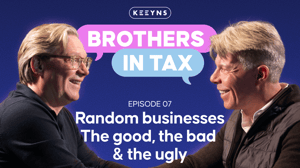
If we don't understand it, we don't do it: the brothers' business portfolio
Racing on a runway, a 40-year-old outdoor goods trader, a payroll software company and an online liquor store: Ruben and Ramon van Aarle have built, bought and sold far more than a tax firm. In episode 7 of the Brothers in Tax podcast by Keeyns, Ramon hosts as the brothers open up the portfolio, the good, the bad and the ugly, and the one rule they now never break.
Episode 7 · 24 min · November 3, 2026 · Hosts: Ruben and Ramon van Aarle
Short on time? Read the 5 key takeaways or jump to the FAQ.

Five things to take from this episode
"If we don't understand it, we don't do it", Ruben says. After a few misses, the rule is firm: "we never invest again, things we don't understand." [09:08]
Their best deals were 40-year-old businesses that needed new energy, not a rescue: "if you buy something which exists 40 years, it'll not collapse in one year". [08:16]
Payroll software company BCS was a long-time Taxperience client, linked by wage tax: "all the difficult wage tax, basically the calculation we did, but then it needed to end up into a payroll slip." [10:24]
At BCS the brothers acted as the supervisory board and hired a CEO who stayed on after they "sold it in 2022". [12:35]
"If you have to invest 100 euros, it's 50 each", Ramon says. That keeps them aligned when deals go well and when they don't. [16:45]
Short on time? Start with these
Questions answered in this episode
Besides Taxperience and Keeyns: a drag racing business, an outdoor and barbecue trading company they held for about eight years, payroll software company BCS, an online liquor store, and their own private equity firm. [Listen at 01:15]
Understand it first. "If we don't understand it, we don't do it", Ruben says, and after a few misses: "we never invest again, things we don't understand." [Listen at 09:08]
Because it connected to their tax work. BCS was a long-time Taxperience client, and the wage tax calculations ended up on its payroll slips: "all the difficult wage tax, basically the calculation we did, but then it needed to end up into a payroll slip." They sold it in 2022. [Listen at 10:24]
Cashflow-positive companies with recurring revenue, with a soft spot for SaaS. Ruben: "they need to be cashflow positive." [Listen at 21:48]
It started as an investment out of Taxperience. Today, Ruben says, "now we're really 24/7 around the clock." [Listen at 18:37]
About the hosts
Ruben van Aarle
CEO and co-founder, Keeyns
Started his career at Arthur Andersen (later merged into Deloitte), co-founded the tax advisory firm Taxperience in 2006 and co-founded Keeyns in 2017. Follow on LinkedIn
Ramon van Aarle
COO, co-founder, Keeyns
Started at Ernst & Young, moved to Arthur Andersen and co-founded Taxperience with Ruben. Follow on LinkedIn
Together they have 25+ years in tax as advisors, entrepreneurs and now software founders.
About Brothers in Tax
Brothers in Tax is the podcast by Keeyns. Ruben and Ramon van Aarle have 25+ years in tax as advisors, entrepreneurs and now founders of Keeyns, the tax management platform for multi-entity companies. Each episode is their unfiltered take on the industry they've helped shape: the wins, the mistakes and the lessons in between.
See all episodes · Subscribe on Spotify · Subscribe on Apple Podcasts
Keep listening

Hiring on instinct, launching too early, and the mistakes the brothers would undo.
Listen now
Why the brothers stepped out of advisory and bet on software.
Listen now
How two brothers both ended up in tax, from Arthur Andersen to founding Taxperience.
Listen nowFull transcript
Ramon [00:32]: Hello everyone. My name is Ramon van Aarle and I'm sitting here together with my brother Ruben.
Ruben [00:38]: Hello, I'm Ruben. And together we are Brothers in Tax
Ramon [00:40]: Tax and welcome to our podcast, where we'll talk about our years in tax, what is happening with the tax technology and other business endeavours. And we have been entrepreneurs for quite some time, and the last episode was about building a team, but this episode is about building a business portfolio, Ruben. So,
Ruben [01:00]: Wow.
Ramon [01:01]: Sounds good. Sounds good, sounds good. So what companies have you built or invested in? If you look back.
Ruben [01:07]: Yeah. You want to hear everything?
Ramon [01:09]: Yes. That's the, that's
Ruben [01:11]: The idea.
Ramon [01:11]: That's the idea.
Ruben [01:12]: Good, bad, and ugly.
Ramon [01:13]: Good. Bad and ugly. Yes, please.
Ruben [01:15]: Okay. Well, of course we started with Taxperience. That was I think, you know, we elaborate on that long enough already. And building our own tax firm was really nice.
Ramon [01:29]: I knew,
Ruben [01:29]: I knew back then, 'cause we now started a boutique, an international boutique firm, which back in 2006 actually didn't exist in the Netherlands. We also saw that our website was copied afterwards, at least 10, 15 times. Not only in the Netherlands, but actually everywhere. Right. So I always said back in the days, what we did was not new, but new in the Netherlands. Because, you know, Andersen just collapsed and
Ramon [02:01]: Couple days earlier.
Ruben [02:02]: Yeah. Couple of years earlier. And as a result of later on, also a lot of spinoffs with who we basically also started our international network as this is how we built our international network. But it was really a really cool journey to do and yeah. Learn there really a lot. Yeah. So that was Taxperience. That was number one.
Ramon [02:23]: Yeah. But normal professionals, they say, okay, so this is our own company and then let's stick to that for 30 years and maybe buy some real estate. That's what people do. When they have a little bit of money. But that, that's not where you finished, right?
Ruben [02:39]: No.
Ramon [02:40]: How come?
Ruben [02:41]: How come? I don't, how come that? I don't that I perhaps, but apparently we like the entrepreneurial part, so much of the experience that we said, okay, let's do a little bit more business. Yeah. And then we, the first basically business we started was the Dutch quarter mile. Yeah. Right. Remember that? The Dutch quarter mile
Ramon [03:08]: A long time ago. Yeah.
Ruben [03:10]: What was the idea behind the Dutch quarter mile?
Ramon [03:12]: At a quarter mile? It was going fast with fast cars just to chase each other on I think a runway. At an airport. And there was so much fun that we decided to start a business in it.
Ruben [03:25]: Yeah. Was
Ramon [03:27]: Successful was fair? No, I don't think, I think the liquidation of the company cost more money than the turnover we had in the business, right? Or
Ruben [03:39]: Yeah. And the, It actually came from the US right, because it's very big there. And we thought, okay, we can do that with car enthusiasts in the Netherlands as well. So it was also more marketing than had absolutely nothing to do with tax, right. No, but
Ramon [03:54]: Well, it was fun.
Ruben [03:55]: It was fun. It was
Ramon [03:57]: That was fun and had a
Ruben [03:58]: Journey.
Ramon [03:58]: Yeah. And our partners in that journey we still see today. We, so we can smile about that. So that's, I wouldn't call it an f-up, but maybe it was not the next Shell International. That's true. But then we, what was the biggest win in the investments we made?
Ruben [04:17]: Not perhaps I should go chronologically or you want doesn't matter.
Ramon [04:23]: Whatever. Doesn't matter. No.
Ruben [04:24]: Okay. I think the next investment we really did that was in Homey.
Ramon [04:29]: Yes, that's true.
Ruben [04:31]: So that was a company trading company and knives, outdoor stuff for camping, hiking bikes, but also everything connected to barbecue and now also travel, right? That was very nice company. Totally different than different
Ramon [04:56]: Advisory practice.
Ruben [04:57]: Again, totally different than the Dutch quarter mile
Ramon [04:59]: Yes. Racing company. Yeah. There's no line of business in it. So what do you see in No
Ruben [05:04]: Line is also a line.
Ramon [05:05]: That's a line. What do you see in the Homey story back then, the
Ruben [05:08]: Homey story. That was cool because again, this was a product and we always said we also want to have, let's say once, a company where you sell actually something. So not a service, not an experience, but stuff, whatever it may be. So it was again, we learned there I think a lot on Yeah. Different kind of people inventory, but also the risks attached to inventory.
Ramon [05:38]: Yeah. Different line of industry,
Ruben [05:40]: Foreign exchange problems we never had in the tax business. Right. But now we have, let's say
Ramon [05:46]: That's true.
Ruben [05:46]: The dollar went up or down
Ramon [05:48]: Buying things in China.
Ruben [05:49]: Buying things in China.
Ramon [05:51]: Yeah. Yeah. And for the listeners to be correct, we were investors in the companies. True.
Ruben [05:56]: We did not really run it, but we were, let's say, active investor. We had,
Ramon [06:00]: We had great partners running the show over there. I think we had that investment for eight years maybe. It was a nice ride. Yeah.
Ruben [06:10]: So that was good. I think we. We saw that a lot. Learned a lot.
Ramon [06:16]: And what was the idea of to buy a business? That's one thing. But then what was the idea behind the investment?
Ruben [06:25]: Yeah. The idea was basically to dust the company over a little bit. Right? It was 40 years or just 40 years old company established name in the market for, what they're doing. Very nice people. It had just the owner for the last 40 years. So then you always end up with a business. This is just, how is the
Ramon [06:51]: And yeah,
Ruben [06:52]: It needed some new things, right? Some fresh energy, different views, new people. That's true. Other ideas.
Ramon [07:00]: Yeah, that's true.
Ruben [07:01]: Other marketing.
Ramon [07:04]: If you compare the company today, because we still know the company, right? Yeah. If you compare it to when we bought it.
Ruben [07:13]: Yeah. I would say totally different. Totally different. Yeah. Yeah. The atmosphere back then and today, that's, yeah, that's a big step. I think all but good for the company, right. So, we can only applaud for the person who started it back in the days. Yeah. Great founder. Yeah, great founder. That's perhaps also how companies should be, right? That you you own them for, yeah. A part in your life and Yeah. Give them to someone else, to someone else who to grow, make it better further, whatever.
Ramon [07:49]: So true. So true. There was an incredible company back then, and then with a new energy group, new management, new investors group as well. Probably more money and a different way of working. You create an even better company, I would say, which gonna last for another 50 years. So probably the founder will with pride as well. So if you do good things for the company, then basically the return on investment will be good as well. Is that a simple point of conclusion? Maybe, or,
Ruben [08:16]: Yeah, not always. You, there is always a factor, of luck, but I think, yeah, in essence, yes, if you buy something which exists 40 years, it'll not collapse in one year, right? Customers are, but if you then, you know, bring new things to the company, yeah. Add different kind of sources fresh ideas. It keeps going, it transforms slowly and yeah, you have all of a sudden a fresh company again. It's true. And then very
Ramon [08:51]: Cool, very cool.
Ruben [08:51]: Result And profit is then the outcome. The outcome.
Ramon [08:56]: And what makes you say yes or no to new business idea or investment? If your phone's gonna ring in five minutes and then, Hey, Ruben, do you have a minute? What will pop up in your head straight away?
Ruben [09:08]: Yeah. I think for both of us, it now applies that if we don't understand it, we don't do it because it's the trading basically. I think with our dad, our family everyone was always trading, so we kind of listened in always as small children. But I think that that is, that, that's the first thing. If we don't understand, we don't invest that can also bring us basically to the next company. That was actually BCS, that was a client of Taxperience for many, many, many years. And the owner was always doubting to sell or to basically give it or sell it to his children or to them to private equity. And that was strategic buyer and then again, to the family. So he was always doubting what's best for the company. Yeah.
Ramon [10:08]: Two years. The process
Ruben [10:09]: Two years the process. But yeah, because of the fact that this was a software HRM payroll business, and still out there today. It was kind of connected to our business, right. To Taxperience. So all the difficult wage tax, basically the calculation we did, but then it needed to end up into a payroll slip.
Ramon [10:36]: Yeah. That had a big link with that Pfizer request.
Ruben [10:38]: And that was of course BCS. And the other way around we were doing business.
Ramon [10:44]: Yeah. Yeah. And then the, I think we had that for five years. There was a nice journey, but it was the company was even bigger than Taxperience back then. There was
Ruben [10:58]: That was also all in, right? Yeah. There was all in, if you think about it,
Ramon [11:01]: It was all in,
Ruben [11:02]: We went all in, we took a huge loan from the bank. Huge loan from the founder and the owner at that time. Otherwise
Ramon [11:12]: No, he helped us out.
Ruben [11:13]: He helped us out. Otherwise it never possible to do this. But I think also this company, we kind of, because this company also existed 40 years, we also dusted it off more or less with new ideas, fresh ideas new people. Bought some companies.
Ramon [11:32]: Yes. And yeah. But we weren't there every day. Right. So we were still working at Taxperience. And also those were the years that we started Keeyns. So that to me, it felt really strange that we were investors in a very big company while driving to the Taxperience office every day. Do the tax work. And, starting Keeyns business as well. How do you look back at that?
Ruben [12:05]: Yeah. From a risk perspective, perhaps we should have done it the other way around, right? Put a lot of diamond effort really in even more in BCS. But I think what we did good there was also, let's say, hire again the right people. So we were just a very active, now we did not have a formalised supervisory board, but we were basically the supervisory board. But we had a very good management team running, run the day-to-day business.
Ramon [12:35]: Yeah. Very good. CEO we hired together with our partner there. And he's still there, right? Yeah. So we sold it in 2022. And he's still there. That says something. So that, that's nearly 10 years. After our phone call, whenever he would be the CEO and going for the next journey at BCS. Very
Ruben [12:55]: Yeah, it was
Ramon [12:56]: Very nice. Right. Did you, do you regret selling it? Or, or what's. How do you see buying and selling? Is that a thing or do you want to keep it, or
Ruben [13:07]: As an entrepreneur slash shareholder. I, and as an advisor to some of my clients I advise back at the day that at Taxperience always, why would you sell your a m? Right? Yes. I know. If you have a company which is making money, yeah. Why would you sell it? Because, yeah, you need money Also, next year, the year after, if it goes that this is from outside looking inside, right? Yeah. You see different things because it's not always that easy. There are always risks. You always see good things
Ramon [13:42]: From the outside. Yeah.
Ruben [13:44]: But this company was, BCS was really, I would say it was a pearl. And we have been very lucky that yeah, we could basically purchase part of the company together with the son of the owner. Right. So I, I sometimes, no, I don't regret we sold it, but if we would still have it, I think it would also have added a lot to our current, basically to Keeyns and our current day-to-day activities.
Ramon [14:16]: Client portfolio.
Ruben [14:17]: Client portfolio. Yeah.
Ramon [14:18]: Combination.
Ruben [14:19]: Combination. But I don't regret, I never regret it was a, it was also a great, right.
Ramon [14:25]: Me neither. Yeah. If you look and that this is a point where we have a also a nice discussion, you and me always on keeping it or selling it, I'm more of the selling part or maybe sorry for that, but in the end, you always put your signature on the paperwork as well. To me it's I think we had a very good journey in five years, and now the company also has a good journey with the new owner who has more money and scale, and much deeper pockets and is scaling it internationally. And then to be honest, that we didn't have the funds to make that happen. So I think, and the
Ruben [15:02]: Banks didn't want it.
Ramon [15:03]: Right. And the banks didn't want it.
Ruben [15:04]: So it's also honest truth.
Ramon [15:05]: Yeah. And not only for us, but also for the company and the people working there. I think it's, it was the right time to, yeah.
Ruben [15:11]: Yeah. No, absolutely. So in I, let's say as an entrepreneur, but as an in, let's say just as a shareholder investor, yeah. This was a hell of a Right. And was fantastic. Yes. So I've. Was good. Yeah. From all angles actually.
Ramon [15:32]: Right? Yeah. And I think that, yeah, sorry. Yeah.
Ruben [15:35]: And it gave us also, again, let's say different, yeah. More space to invest again further. Right. So
Ramon [15:43]: That's true. That's true. No, that's absolutely true. And I think maybe the audience is happy to learn why we invest together, because I think 80, 90, maybe a hundred percent of the investments we do together, how can you
Ruben [15:55]: Yeah. I think, yeah, I like it, we do. It keeps, yeah, we can keep each other sharp and Yeah. Looks like Prep studios that we're always 100% aligned, but that's not true. Right? So,
Ramon [16:12]: Mostly,
Ruben [16:13]: Mostly we are, but it sometimes the, so I think we keep each other very sharp there, and we never have to look back or watch your shoulder, or, and there are no, there is no knife in my back or not in your back. It's whatever is best for the both of us. And if you sign, I sign and the other way around, so yeah.
Ramon [16:36]: Yeah. That's,
Ruben [16:38]: There is 100% trust and more that let's say. And if it goes sour, we go sour, then we go together.
Ramon [16:45]: It's like smiling together and crying together. Right. If you have to invest 100 euros, it's 50 each, which is better. Right. And then we're gonna make it going down to zero or a hundred back. And then together it's better to do it together, I would say.
Ruben [17:02]: Did things go sour? We talked about the quarter mile was good. Yeah.
Ramon [17:07]: No, yeah. Yeah. We had
Ruben [17:08]: Was really good.
Ramon [17:09]: No, we had the Dutch quarter mile already. We also invested in a liquor online liquor store. But we weren't really good at that. So that we lost some money there, but there were also a learning curve. That's true. So I think we also had a laugh on that one, and we learned, and then
Ruben [17:30]: That was, it was actually on the liquor. There was one we needed some liquor when we had to that's also true.
Ramon [17:37]: We lost the money. But it, but
Ruben [17:38]: There was also let's one company, the gro, then that became my gro miserable. Right. That was just a small amount. But that was you said No, at that time. I should have followed you.
Ramon [17:54]: Yeah. I
Ruben [17:54]: Was
Ramon [17:55]: Okay
Ruben [17:56]: Together.
Ramon [17:56]: Lucky me. So I said no to a drinking investment. That's okay. That's also new, but Okay. But there's no line of industry. There's no,
Ruben [18:05]: No, there is.
Ramon [18:06]: We do it all right. We with the right people, with the right, business case.
Ruben [18:10]: And if with the right business case, if we, but I think we never invest again, things we don't understand. No. Or if, let's say we also don't know the next buyer. So we're not that. And kind of blindfolded to invest in everything, I think.
Ramon [18:30]: And is is Keeyns also, and do you see Keeyns as an investment or is Keeyns
Ruben [18:37]: Well, it started I think as an investment, but out of Taxperience, but now we're really 24/7 around the clock. Thinking or working in or home teams, right. So no, this is
Ramon [18:55]: The tech landscape.
Ruben [18:56]: Yeah, exactly. For meeting is, yeah. Really all in again.
Ramon [19:02]: Yeah, it's all in again. Yeah. Yeah. So it's that that's our day-to-day job, and it, it's maybe an investment maybe
Ruben [19:08]: We invest a lot in.
Ramon [19:10]: Yeah. Yeah. And let's not forget, Equa Capital Partners. Right, right. Because we also have a private equity company, partners in a private equity company. Can you tell something about that? How that how we incorporate that was the idea and the background and where do we stand today?
Ruben [19:27]: Long time ago, both you and me, we were basically the tax lawyer or in the team of tax lawyers of CVC Capital Partners. Right. So one of the largest private equity companies in the world. And we always admired what was happening there. Making money with other people's money and then investing in companies, because, and we always like to do the line of business. And then after BCS, yeah. Both of us said, yeah, what to do next, what to do with the money. You can put it on the bank account, which we Of course did in the first time. But for you, I mean, it's quite boring right? Doesn't
Ramon [20:09]: Make any sense. Also. Yeah.
Ruben [20:12]: But the, we bought some shares, but it's, that's not where the, your heart is sticking much faster from so we said perhaps we can invest more frequently in companies. And then there were, actually two investment bankers from NIBC who were looking around because NIBC became more kind of a real estate bank invest investor, basically. And at the same time, we talked to the head of Irish Luxembourg family office who wanted to come back from Luxembourg to the Netherlands. Yeah. And also wanted to invest more directly. Basically with own money, more control, and not on behalf of a family. That's basically how the idea arose to start our own private equity firm. Yeah. Equa Capital Partners.
Ramon [21:12]: Yeah. Back then it was in 2022. Starting with five partners, and now we have a couple of employees working there working on the portfolio companies. And I think we bought nine or 10 s already eight companies already. Investments minority or majority shares. But there is a strict line what we
Ruben [21:37]: Absolutely buy
Ramon [21:37]: And
Ruben [21:37]: Won't
Ramon [21:38]: Buy. Right? Yeah. Can you tell a little bit on that?
Ruben [21:40]: Yeah, of course. Because we invest heavily with our own money as just started, we started as a cornerstone investor. Basically, yeah. We said we don't want put things full at risk anymore, right? So, the company needs to have, let's say they need to be cashflow positive. It needs to be in the line of industry. So it, and we love, SaaS companies. We love tech-enabled company robotics. And that, that's basically the line of business where we started to invest with Equa and also our partners have their the knowledge and the network. And we love, let's say recurring business models. Yeah. That's where we were looking at. And started to invest
Ramon [22:30]: Really nice ride over there. And also taking our partners at Equa doing the day-to-day operation. And they have, and I think we have 80 to 90 limited partners also investing in Equa, which is I think impressive. Absolutely. And they're also winning together and maybe, hopefully not, but losing, yeah. Together. Right. And
Ruben [22:54]: We have some beautiful portfolio companies, so it's both funds already, so it's, yeah. It's a great journey also. But I see those investments also, you look sometimes more clear at things because you're not in it the entire day. Right. It's we utilise the networks. Try to,
Ramon [23:22]: I fully agree. That's true. That's true. You sometimes you don't see it in your own company that way. You need to be, but if you are not constantly working at the company, you have a, sometimes you just have great ideas, which can bring, which you can bring a company further. And obviously I think we have a very solid network in tax, legal and finance, which is very handy for all the company companies we've worked in or for. Right. And that's true. We will continue to do so, for the foreseeable future.
Ruben [23:54]: That's also nice to do something. And sitting in this chair is nice for one, two hours having this podcast. But in the end we're, yeah, we're too young to do nothing. Yeah.
Ramon [24:07]: We're already grey, but we're young. So, we're gonna push those investments also for the next decades. Also together, hopefully. So we,
Ruben [24:19]: I have no doubt about that.
Ramon [24:20]: No, no, me either. Me neither. So let's do that. That's a promise. I want to thank the audience for listening to this podcast. My name is Ramon, thanking Ruben.
Ruben [24:29]: Thank you.
Ramon [24:30]: Thank you, my brother in tax. And we see you on the next episode. Bye-bye.
Ruben [24:35]: Bye-bye.