
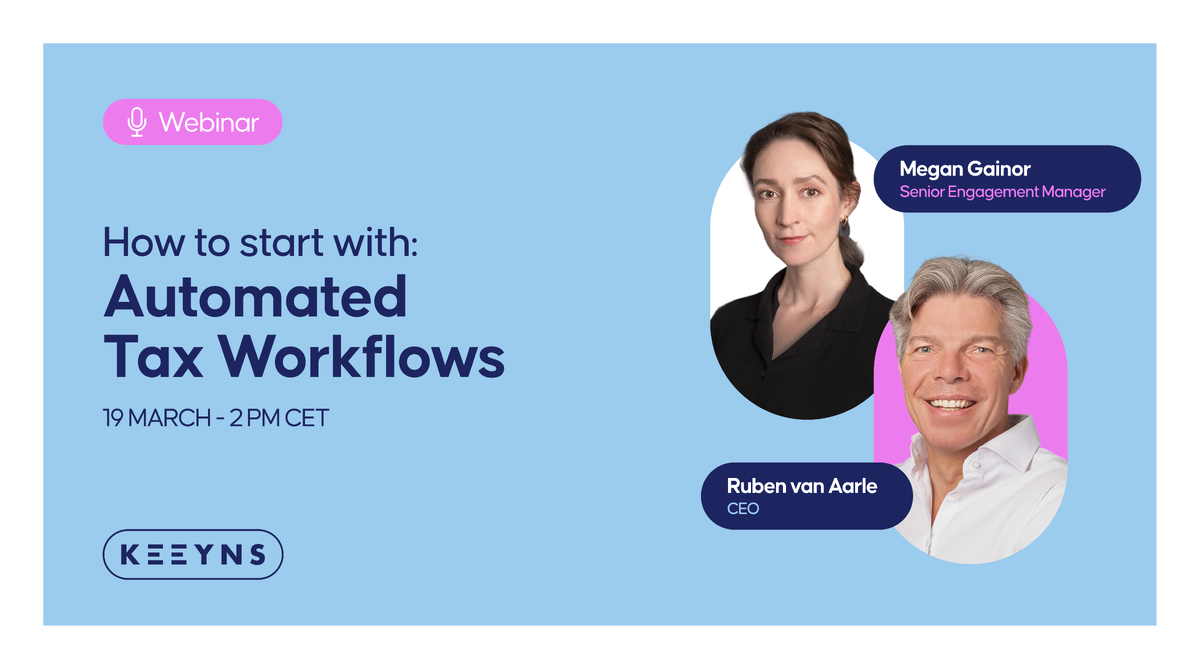
Are you ready to automate your tax wokflows?
Sign-up now!
More and more organisations are moving away from manual processes towards automation. That is what Burt and Maurice see every day in the field. What still comes as a surprise, however, is that tax does not always follow this trend — even though it is one of the departments that would benefit most from streamlined processes and real-time data.
In this webinar, Burt and Maurice addressed the who, what, when, where, how and why of tax automation — and explain why making this shift should be a top priority for tax teams today.
Everyone is talking about digitalisation and AI, but many tax professionals are left wondering:
The age of automation is not just about technology — it is also creating new roles such as Tax Innovation Manager, Tax Technology Manager and Tax Transformation Manager. Larger organisations are already taking concrete steps in this direction. The question is: how can you keep up?
Burt and Maurice will dive into these topics and answer the questions above. Their insights will help you take the first steps towards automating your tax processes, resulting in:
Within a year, your tax team could be benefiting from automation — focusing on innovation instead of firefighting, while staying in control of growing compliance risks.
Without the right foundations, however, organisations risk falling behind.
As automation accelerates and resources remain limited, roles are increasingly replaced by technology rather than new hires. This creates a real opportunity for tax professionals to take on a more strategic role.
CFOs are prioritising innovation, risk control and efficiency, yet most organisations still lack a dedicated tax technology role. This webinar shows how to move forward — even without one.
Head of U.S. Business Development
Director of Global Business Affairs
Burt: Alrighty. I think we're, I think we're live here. so Maurice, we'll go ahead and jump into it. First off, I want to welcome everyone to this session. Maurice and I are obviously excited to discuss a trend we're seeing across the entire tax industry. As more and more teams move away from manual processes to automation, and we're planning the day to, to dive into all the specifics.
So the who, the how, the what, when, why, of why teams should focus and make this shift the top priority, and we'll dive both into what we're seeing across the entire industry. As well as what we're learning from our clients and hearing from them firsthand. and maybe with that, we'll, before we dive into the nitty gritty here, we'll kick things off quickly with introductions.
you can hop to the next slide. And, obviously for those who don't know me, my name's Burt Gesner, I lead up US operations for us at Keeyns. we, for many years, obviously have served multinationals and had a presence in the us. I joined the team about a year and a half ago, to launch our boots on the ground here and expand our presence serving US based multinationals as well as plenty of us domestic only businesses as well.
Interestingly, I actually don't come from the world of tax. My background is primarily investment banking where I spent most of my time working on large sell side M&A transactions. And it was actually during the due diligence of those transactions that I just realized how big an opportunity there was in tax.
We'd be working potentially with a billion dollar company, and you'd see there might be one, two, maybe three people in the entire building that knew the important and relevant information on the tax side. And then obviously got connected, with Ruben, Ramon and the entire team at Keeyns. and were able to learn about what they were doing, and I saw how it would fit so well into a large corporation.
So I had the chance to join and it's been a great ride to this point. On the personal side of things. I'm based, in the Washington DC area and as you can tell by the pictures here, I am an avid golfer, and still try to play competitively whenever I can. And I'm also a big live music fan, specifically country music, for those who wanna know this specific.
So excited for this session. And maybe Maurice, I'll let you kick things off on your side and, then we can jump into the fun
Maurice: Thanks Burt, and, good having you on the team. from my side, Maurice van Hoven, I have a background in tax. I studied tax law, tax economics, and worked as a tax lawyer for some years, but then I made a career shift into operational banking and that's why also I like the fact, of working at Keeyns.
I like to combine tax, operations and working internationally. It's all about processes and that's what we of course, will also have as a topic to one of the topics for today. My part at Keeyns is I mainly focus on partnerships. So from that perspective, I have always these type of conversations and happy to add my, contribution to this webinar today from a personal note.
Golf, yeah, that was one time for me, but now as you can see, I have a clear focus on, My biggest priorities, of course, my kids, my two small ones, and a construction of a house. So from that perspective, my personal note, let's dive into the topics of today. What do we see, the age of digital digitalization and automation is here.
What do we wanna see, say in the this regard? We see that everybody is talking about now, about nowadays about digitalization, AI automation. What does it mean? How does it affect me? What does it mean in my way of working? what happens, how to get started? It's a big struggle for everybody. When we look into the tax domain, we even see to the big corporates with whom we work, they even have within their organization new functions like tax innovation manager, tax technology manager, tax transformation manager.
These companies already for many years had the idea, how do we get started? And now you even see within that domain that even the profile of people is changing. And what are we working on? So it's a big topic, but the question is of course, how to get started, for today. And what do we want to do is dive in a little bit deeper on the complexity, what we see.
In the world of tax, what do we see? What is happening? In general? We see across the world compliance, the burden of compliance is growing. So more compliance around multiple topics in multiple different ju jurisdictions. and even the complexity around those topics is increasing new legislation coming in as well.
Then if you offset it again compared to the capacity, what people have within their organization, it's a real big struggle, to make sure that you make sure that you do the compliance on time and that you keep up with the complexity as I just mentioned, which is where you have to comply with all those jurisdictions.
So it is even nowadays, difficult to find the right who can help and do this, but then not even thinking about how can. Technology we used in this perspective, if we then have a look at how is this now being addressed by tax? And we see from a technology perspective that tax is left behind, staying behind.
When we have conversations with leaders within the field, CFO, hat of tax, regional hat of tax, we see that there is a lot of conversation within companies about automation. You trying to use and start using technology, finance is already a step ahead. That even is even coming out of reports from the big four as well.
You see clearly that the finance made this step already many years ago, but also from a budget perspective. Tax is always lagging behind the ERP implementation, the transition, the updates, they are priority number one. And if tax would like to make a change, it's always a challenge or difficulty, to get that done.
that's a little bit my perspective, how I view it, but Burt, maybe you want to tap in on this topic as well. How do you see it from your perspective?
Burt: Yeah, I think the things we hear most from the US side of things are. One definitely being left behind. And that's not only left behind, but they're often from the tax side being forced into tools that aren't really built for tax.
So I think a lot of the response of, Hey, we as a tax team need this tool. They often say, we have this tool, why don't you make that work? And the reality is. Tax needs, tax tools. and that ties directly to the other piece, which is the budget, right? So we're gonna talk plenty about budget later on, but that's also being one of the elements left behind for a lot of tax teams.
So much of what you're seeing in Europe, much of the same here in the US in terms of being left behind. And, like I said, having to use other tools and, realizing even more. We need our own stuff. so that's what
Maurice: I, like the, I like tax needs. Tax tools. You mentioned it. Let's talk about tools now, for now a moment.
Because what, do we still see now? it's what we still see and that I think all the conversations which we have with companies nowadays. a lot of these companies still rely. Emails, spreadsheets, manual follow up, which is being done, tracking is being done. Data sits in different places, so it's an outlook.
It's in SharePoint, it's in teams, it's in platforms. So trying to gather data when it's necessary, it's a big challenge. And if you take that from the perspective of A CFO or ahead of tax, and then you talk about giving insights, it's really still limited on not having real time insights. And that is nowadays something you want to have.
And also late discovery of operational risks, which might occur within an organization. It could be that on a local level there might already be flagged something, but it's not visible yet on a head office level. And these time differences or gaps which are created create a risk and that's something you want to be able to work on.
And. This means the operating model, which is now in place, needs to be changed from that perspective. So the way we have been thought to th thought to do things, they don't work in the way we live at the moment. So this means that we need to make those changes. And this is maybe also a nice bridge to you back again, Burt, to pick it up from here.
Burt: Yeah. I think, We talk about the why, and it's fun to say the why. but more specifically what we see is tax teams and even the CFOs often know what the why is. And the part that we see folks struggle with is on communicating that why. especially for the tax teams we work with in terms of communicating to the CFO and other stakeholders in business, why that why is so important.
And we're seeing that, like I said, they're already acutely aware they need to invest. They struggle to articulate across the organization. and with that, maybe if you jump to the next slide, Maurice, we often like to break down the key factors of that why, and examine them each separately. And these are conversations we have with folks all the time.
And first is an obvious one. That's the cost side. Maybe breaking it out from budget, which we'll talk about last. It's obviously important to acknowledge the monetary costs with a new product. Which we'll talk about last, but I think there's also those time resources involved and, that often creates a lot of hesitancy when you think about the implementation and setup required for any new technology, right?
Big or small. And we often say, I like to tell my clients short-term pain for long-term gain. and I think this is because in large part of what the implementation unlocks on the revenue side. From a tax perspective and how that gets boosted. so this happens in multiple ways on the revenue side, in the tax setting, whether that's avoiding fines.
but most importantly in our opinion, it's enabling folks to focus on the value creation side of their work and doing that within their business. and I think overall we see that tax needs to be more and more involved in the business and technology most importantly, frees up the time for them to do that.
to become that true business partner rather than just focusing purely on compliance, which is what we see often, right? That's bogged down in the day-to-day, the, grunt work, all the fun stuff that, that us as tax professionals know about. and that unlocking of efficiency and time drives strong improvement on the human capital side.
but the one point that we've seen resonate the most on the human capital side is this idea of knowledge, right? So we talk about. Key person risk, turnover, risk and knowledge loss. Those are the big elements that my mind make up. The human capital piece and all of this, sounds good because you can avoid that, but we notice that people struggle to start, so that's why we talk about this concept.
Also, start small and plan big. And this allows our folks on the tax side to get early wins so that they're seeing progress immediately. And also show to those stakeholders and get increased buy-in of, Hey, we're getting ROI on this. There's visible tangible things that we can show you, that allows it.
And then also, obviously I'm biased, but I think there's no time like the presence. And all jokes aside, on the risk of waiting, I was talking the other day with someone about this concept of technological debt. So technology changing so fast, but the reality is the longer you wait to implement any technology, the mistakes and inefficiencies that are caused by that lack of technology are only increasing.
so we want to start as soon as possible to avoid that debt getting so big that when you do ultimately make the jump to technology and more of an automated approach. That you're not, so far behind that it becomes impossible and then obviously budget is a factor. I think my main point on this is be transparent with your vendors, right?
The right vendors are gonna wanna become business partners to you. So they're gonna understand your problems, but they're also gonna wanna make an identify a solution that really works for you guys. And I know, Maurice, you had some thoughts to add on this slide and concepts in general. So maybe I'll let you chime in here.
Maurice: mainly on the point, what if you wait, because of course what we see a lot as well, you can have [00:13:00] a look at it from an internal perspective and how you want to create that efficiency, cost reduction. but how to get started there. But what we also see a lot is what if you wait? Authorities are not waiting.
Authorities are also putting the digitalization as a top priority. They are already, for, as an example, from an e-invoicing perspective, they are getting the data. If they have it on a continuous basis. So if they start sending questionnaires or starting an audit, they also expect you as a company to have that data available.
Immediately, and if we talk about data, it should, can be raw EOP data, but it's also about how did we get to a certain approach, how, which decisions have been made by whom? So it's about EOP data, communication, audit trail. You should be able to provide that in a, in a, fast way. The longer you wait.
It shows you are less in control. The how. How do you manage that? You have it available. That's a small topic which I wanted to touch upon on this slide as well.
Burt: No, su super interesting. I actually think it segues into the next slide here about the impact of technology, right? You already touched on a little of not being left behind, but a lot of this stuff is apparent.
Risk and control are the two words that jump to the top of my head, and that encapsulates a lot of. What's on the screen here, obviously, automate routine tasks. I always talk about with our clients manual, low value tasks. We want to get rid of those as much as possible. which enables you to then reallocate your time to focus on becoming a business partner.
Obviously, along the lines of automating those routine tasks, you unlock risk management, you have more visibility. and then you see on the bottom right there, I'm jumping around, but real time decision making, reporting and analytics, I think. When you think about getting buy-in from stakeholders or CFO, whoever it may be, having actual tangible things to show, make the conversations much easier.
And we're moving into even more than already, an era of, easily digestible, real time information. So this idea of dashboards and reports and charts and real time data that changes as things change in your business. Becomes really valuable in improving those conversations to become that true business partner.
And I'd also mention here, not on the screen, is ai, right? I don't think we could do a webinar today without talking about AI and mentioning it at least everybody's favorite buzzword. I'll share a quote that I thought was interesting and it's AI and tax tech do not fix broken operating models. They expose their limits faster.
so I think. What we talk a lot about is, ai, everyone gets excited. They think either we might be out of a job or this is gonna automate everything we do, which is nice and scary at the same time. But what a lot of our clients lose sight of, and this goes back to why wait, is you have to have the right framework and ground foundation for ai.
So a lot of what we talk a lot about is, let's put in place a centralized framework. That gets all your data in one place. It gets all your stakeholders in one place. It gets the knowledge that lives in people's heads into a system. And then only after that step can you actually enjoy the benefits of ai.
Not to mention in one year, two years, three years from now, those benefits are gonna be even greater. But if you're not careful, you can end up in the wrong, situation and not have all of the right things in place to start. so maybe with that, I also wanna touch a little bit. I've talked about this business partner concept of how you can tie in with your CFO, and specifically what we're hearing directly from CFOs and, what they're asking from the tax departments.
So I think. First off, and, Maurice, I'm curious if you've heard the same, do more with less? I think I've, I don't know. I think it's almost every day that I hear this. Is this similar for you, that phrase you hear from tax professionals?
Maurice: Yeah. Do more with less. there is even a quote that, with one of the companies with whom we spoke, they said if people leave, we're not gonna replace 'em anymore.
Technology only. So they said like you have budget for people, but that's limited to this. We cannot allocate budget for technology, but no more people. So despite the fact how much compliance you get and in, in addition to the work you already have to the workload, this is it.
Burt: Yeah. And I think that the interesting thing about that point is this idea of doing more with less technology bridges that gap.
And it goes back to your point on not replacing people. With new people, but often with technology. And while we do see some organizations that are, have a head of tax technology or someone dedicated in that role, I would say still the vast majority of the conversations I have, businesses actually don't have that person.
So what I think is really unique opportunity for tax professionals is to assume that role to some extent, because the reality is. CFOs these days, and we meet with them, they have innovation at the top of their mind, right? They're looking, how can we innovate, how can we control risk, get more control, eliminate inefficiencies, et cetera.
And I think the tax teams that adopt that same mindset are gonna ultimately be the ones that jump into that role of true business partner, and make that shift away from pure compliance. It's, I know it's hard because it still has to get done. There's no avoiding it. But as tax professionals, we wanna make sure that we're spending our time on these strategic initiatives rather than just treading water and keeping up with the compliance side of things.
And again, it all goes back to that strategic business and maybe if you jump to the next slide, Maurice, this is a little bit, on the Keeyns side of things, but it jumps directly to what we're seeing and it's again, still that heavy focus on treading water with compliance. Powering through those times with compliance with manual processes, and most importantly having decentralized processes across the board.
And I think what we see is as you scale across more and more legal entities, as you scale across more and more jurisdictions, as you have more and more stakeholders, whether that be folks on the tax team internally, folks on the finance accounting side, internally, or even some of those external advisors you might work with.
This snowballs, right? So these manual processes and the challenges that come along with them tend to get harder and harder as you scale across those parts of the business. and I think what we're seeing more and more are the clients that are successfully making that shift to innovation and digital first approach, are really enjoying the benefits.
So historically, when people hear tax technology and the conversations I had, they immediately think of. What I refer to as tax topic specific tools. So that's sales tax engines, provision tools, and over the years there's become so, so many of these tools. What we see now is a tremendous need for what I often refer to as umbrella to your entire tax stack across your organization.
And what we talked a lot about, and you can see it in the bottom right here. Is this idea of a smart data warehouse. so ultimately we wanna have one single source of truth where all your processes are tracked. You also ensure audit readiness at a click, and also the ability to manage all those different stakeholders I mentioned before about where they have access, when they have access, because to have everything centralized, perhaps not everyone should see everything at once.
And then most importantly, I talked about it on an earlier slide too. Realtime dashboarding, which most importantly enables realtime decision making. and I think that this is just a good way to segue. Maurice, I know you're gonna jump into some of these specifics, so maybe I'll let you hit some of these features and concepts that we've seen be most relevant for our clients
Maurice: before I jump into that one, maybe to tap into the topic you're addressing right now. I think also it is relevant to go and make that the transition from manual to automated. You want to get started, but you want to stay flexible because every company, you mentioned it before, I think every company with whom we speak has, can have a different setup.
Every conversation, when we have a first call, it's always a surprise to hear how the organization is structured, centralized, decentralized, a combination of both. working with advisors in that region, but doing in-house, work within the company in another region, and. If you talk about automation, you would like to be able to make sure that you can capture both scenarios or all different scenarios in a certain way of working where you can still streamline it.
Maybe for one part of the organization you need to streamline more within the application. And in the other one, you need less information because you have it centralized. So it should align on all ways of working and giving you the option going forward to change it. And then again, keep the knowledge and the activities from the past in a certain way.
But maybe tapping in to what you have been mentioning before. From that perspective, then if we look at it, and of course we don't want it to be too biased, but of course we see that a management platform from that perspective can add a lot of value and can also make sure that you make a start in a way of working and how you can grow into.
Transition of going from manual to automated in a way that it isn't too intense, but you will start directly benefiting from a new way of working because from that new way of working, if you look at it from that perspective. The Excel sheet or the spreadsheet, which is now in place on tracking from a compliance perspective or from a risk perspective, is a lot of manual work, gathering data from all the different parts of an organization, asking a lot of people to spend time on gathering information, updating manually an Excel sheet.
Preferably, you will automate processes which are being automatically triggered by a system. People will get notifications. People can do the work based on which a company can get a live cockpit view on what's going on, a live feed of what's going on within the organization. A few minutes ago I talked about operational risk.
If something locally is happening and globally or regional has no clue that something is going on. There is a gap and you cannot act, and time can of course be an issue, [00:24:00] but you want to have insights and you want to be able to communicate and get those insights quickly. Nowadays. Also, we see that the way of working is changing.
Workflow management is a big step for a lot of teams to become much more efficient. Instead of asking, emailing, chasing, et cetera. If you have a process which you would like to put in place. Not only from a tax perspective, but also from an internal risk perspective. From a tax control framework perspective, if you can capture a way of working in a process, connect the internal and external people to it, you align and you save so much additional time, that will you.
Every company will benefit it from it. From that perspective, if we talk about collaboration. We talk about people. We talk about people, but we also talk about data. And in the past or a few minutes ago, I also mentioned before, data is not only data from an ERP perspective or documents, it is also the communication around the process.
As I mentioned before, we see a lot that data is scattered around. As I mentioned, it would be preferred if you can combine an audit file where you have the communication. The documents, the thinking, the reasoning behind it, and the timestamp on how things went in the past, not only for one topic, for every topic which you would like to have monitored.
Burt: And Maurice, maybe before you jump to the next one here, I think important to talk about, especially as it relates to the workflow piece on the previous slide, we're seeing the shift. I think workflows have been in concept in the tax space for a long time. But where we're seeing the real power be unlocked is when you can attach those workflows to dedicated workspaces.
And you've talked about not only the data that gets tracked in these, whether it's documents, communication, audit trails, but also the knowledge that data relates to. So again, I talked about it earlier, the ability to tackle turnover and get valuable information outta people's heads and into a system.
And I just think that this is such a great way to do it by having it. Centralized by process. You're not going on scavenger hunts anymore. And if something did happen, you have it all ready to go for the entire team. So I think it's that knowledge piece too, in
Maurice: Yeah. but that's a really great bridge to the next one, Burt, in that regard, imagine also from the perspective that you want to make sure that the knowledge and the activities of a company stay within the company.
And despite the fact what, with every company with whom we speak, people come, people go. So from an internal perspective, and it could even be that you might want to change from advisor A to advisor B, or within the advisor with whom you work, people go and make a promotion or leave the company, and how do you make sure that you keep the knowledge and those activities managed and it is relevant that. can try to do that through email, SharePoint, et cetera. But if you want to look back as you mentioned and see how did we do things, you save so much time when you have it structured and if you don't structure it in this way, every time you get like a questionnaire or an audit which pops up, you will have to start gathering.
And, in the perfect world and in a certain way, you want to have that data automatically. Centralized in a, in, in, in a platform. So people who leave should not be at risk. Every time. When we speak with people, when they join a company, we all, when we speak to them and we ask, when did you join the company?
How much time did it take you to really to get up to speed, to get to know the company? We hear easily 2, 3, 4, 6 months based on the size of the company and the, scope of their responsibilities. And it's all about with whom do I work? What are, what is my scope of responsibilities? Who is involved?
Where's the data? I ha suddenly I'm dragged into an audit I didn't know about. so working in a centralized, structured way can give someone who joins the company directly the knowledge of their predecessors instead of relying on people in a certain way. no, that helps a what we see as well in every conversation, which we.
Have is data and security is always a topic. nowadays, people still email a lot and then they start asking, when they start talking about technology, about security, and then we always ask the counter question like. Do you think that emailing still is then the best secure way to do it? Let's be realistic.
I think what we see a lot, the biggest risk of working nowadays is sharing documents. Data through email is a bigger risk than using a centralized solution, which is run in a, platform. and of course, be careful which platform you, you choose. Make always sure that the platform has the right certifications and security in place, and that's of course when choosing a solution always a big topic because I think the second or the third conversation with all companies, which we have.
Goes on this topic, and then it's always about how to set it up, how to make sure that the data is secure. Is it only online? Can we have it in our own cloud? Can we do it on-prem? So instead of having, discussing only text topics. A big part of the transition is also how do we make sure that we work in a centralized, structured, and safe way within our company, but also with external So this is a big topic, what we see as well, which is always addressed along, the conversations which we have. yeah. Bur by the way, I'm jumping already to the slide, but.
Burt: No, this, is perfect. I think, what we wanna talk about here is we want to practice what we preach, right? So this idea of start small plan big, we're always thinking about the future as well.
And this goes to your point you just mentioned on the last slide about picking the right vendors in the right teams to partner with. And I think a question every tax professional should be asking is what's on the roadmap, right? And for us, I won't dive into. All these specifics, but obviously more dashboard and reporting.
We already have a lot of it, but this is something we see enable tax professionals to make the business case internally because CFOs really value those real-time insights. Obviously risk and controversy. I already talked about in my mind the two biggest themes being control and risk are the top two things, and then ai, everyone's favorite buzzword here again.
Obviously it's important to first have the building blocks on top of ai, but you also want a team that knows how to use ai, not only to get stuff done, but also use it responsibly. Tying directly back to your last slide about data security, the risks that come with ai. Abundant and whether you try to do it yourself or work with a team that doesn't know how to run fast and far, is a risk to the business.
Then lastly, I talked about this concept of the umbrella to your tech stack, and a big part of that is integration. So we talk a lot about times of integrating with these vertical specific tools. Like I mentioned before, sales tax provisioning, there's transfer pricing, and how important this comes and I think.
When you talk about the future, I'm also reminded of the conversation, I have a lot of folks of this idea of buy versus build, right? So obviously you need someone who's gonna keep doing innovation, and in my mind, that's the biggest argument for buying, right? Yes. Our team has tons of veteran tax professionals on it, but at our core, we are a technology company.
We're a technology team. That is all we do morning, day, and night. and I think. The risk is when people build, it's often being built by a tax team. Maybe it is involved, but you run the risk of your technology already being out of date by the time you build it, and then you're back at square one.
You've delayed and you have ironically, even more technological debt. Back to that original on
Maurice: that topic, Burt maybe if I can add, I think the whole discussion on buyer versus Bill, I think. Depends completely on the company, on the legacy, on how they have been structured, the pros and cons, to be honest.
And I think we can complete, a whole webinar only on this topic already, so maybe we should plan it. But, in this respect, I think, it's always zooming in on the specifics. How is the company initiated? How do you already work? Do you have the capacity, the knowledge, the, as you mentioned, the option to maintain it as well, because some people even mentioned once to me.
Take at least 20% of the building costs as yearly maintenance costs as an example there. But so all to put that into place in scoping of what should be a realistic picture for the company itself. You, of course building is an option, but buying as well, but would be an interesting follow up topic, Burt
Burt: And, I think interestingly that's, that reminds me of another concept of low no code tools, which is obviously a fancy way of saying you don't need a computer science degree to use it.
And one of the ways. That I think we're innovating perhaps the most effectively. It's not one of these crazy ideas where people talk about AI and dashboards, but it's actually developing software that tax professionals can use themselves, implement themselves, and administer themselves, so that we're really empowering those folks to become the tax technology go-to person in their organization without them having to code and stuff, but have that full control of how we're structuring the platform.
So that's another. Innovation topic that I think is particularly relevant, these days as tax professionals try to put on their technology hat a lot of the time too, for me. Maybe that's a good segue. Yeah, go ahead.
Maurice: No, for me, that also comes back again to what I really mentioned at the beginning of.
You want to get started, but you want to be flexible. So also you should have a structured way of working. Also from a governance perspective, you want to have a clear governance in place, which is transparent, which is clear defined, but also you would like to have the flexibility to make it your own even more and extended, but even maybe shrink it down.
So flexibility for me in this regard is also really important work.
Burt: Yeah. No, I think that's spot on. And, as you'll see in the next slide. It's consistent with some of the, things we're hearing directly from clients, right? We've already talked a lot about today, the specific things we're seeing and hearing from them.
Obviously, you can read some of these quotes yourself. My big takeaway is back to these two things, risk and control. That's the story that our tax professionals are telling to their teams and their businesses, and that technology enables that. And those are two factors that really resonate. And you can see whether it's peace of mind, uncovering missed deadlines, which crazy to think about, but it happens all the time.
I think that goes back to that concept of risk and control and telling that story internally is gonna enable folks to get by. And. And to the extent, those are interested hearing more and more from our clients. If you hop to the next slide, Maurice. in, we recently, rolled out our tax Keeyns tax e series, where you can hear directly from our clients and they drive around in our Keeyns branded car, or I should say taxi, to talk about their experiences, of navigating the complexities of tax technology and that shift they made from manual to automated.
And I would say the one thing I certainly noticed the most in these conversations is that everyone is facing challenges when it comes to technology. And a lot of those challenges are the same. But the biggest challenge that we noticed is simply knowing where to start and how to start. we won't play the clip today, but I think those conversations can shed light for a lot of people that are struggling.
With the idea of just how to get started. so great initiative to, to learn directly from some of the folks we've worked with. And maybe with that, obviously Maurice and I would love to thank everybody here for joining us today, and talking about this, what we think is exciting topic. And maybe with that, open up the floor to questions.
People can message us directly or put 'em in the chat, either one. and we're happy to answer those before we conclude for the day.
Maurice: Maybe Burt to briefly touch upon the last part, I think due to the fact that we have many conversations with companies who are at the starting point of making this transition to really get started, part of this is always the So you like what They like to make that transition, but it's always about creating directly next to the fact that looking at the process, how is it going now, it's always combined with how can I convince my internal team or my other stakeholders internally and externally on making that transition.
So the whole part of change management is also something which needs to be considered really. because it has impact. And of course, as you mentioned, people are working in the old ways still, and it's always about how can I make people work in a different way? So we get the benefit out of it, but it's, that needs to be taken into account as a really topic, really big topic as well.
Burt: Yeah, and, I actually just got a message here. Saying, I struggle to get even budget for my yearly expenses. How can I even navigate or start the conversation with my CFO to get budget for technology? so I know we, we talked about budget a lot and maybe I'll answer this first, and Maurice, you can add to it.
It's creating the business case so directly tying into what you were just talking about, Maurice, but more importantly. I think it's storytelling. And that's where, going back to this idea of picking the right vendors, so there's some softwares out there that will hand you a tool and say, good luck, and there's some software out there that they're gonna truly partner with your business and be there the entire way.
And these are people that have experience telling the story to CFOs and justifying the budget and proving that business case. So I would say start by having transparent conversations with them and don't be afraid to ask for help because they have. That experience, and I know this is the conversations I have with clients and prospects all the time of they're really excited about the tool, what is work?
How can we get the budget? And we get creative all the time, right? So I'd say don't be afraid to ask for help from your vendors. The right ones will have the
Maurice: Maybe in addition to what you're mentioning as well, of course create the business case. That's one budget as one, but you can also schedule or show the budget of growing in, how to do things and where do you have the biggest pains.
For example, we have a client now which says In Europe, we have it managed. It's really completely centralized. But for example, apac, is for us a struggle, how to get insights. But we want to keep the, those local organizations work independent, but we need a certain level of information, which needs to be shared with us.
let's start there and then let's see how this will, how we can benefit from the process, how we set it up there and grow in different parts of the group as well. coming back. Plan, big start, small, different ways to approach it, but it's good to create a business case around this as well.
Burt: Yeah, no, I think that's spot on.
and I think that might be, the extent of the question. So I think with that, we'll go ahead and wrap up the webinar for today. Of course, if you have any questions or simply want to just discuss your own tax technology situation. Don't hesitate to reach out directly to Maurice and I. We're always happy to think along.
That's the most fun part of what we do is all the different situations and thinking along. so wish, wishing everybody a great rest of the week, kickoff to the new year, and work through the busy season and, we look forward to connecting with everybody soon. Thanks very much. Thank you very much.
Maurice: Thank you very much.