
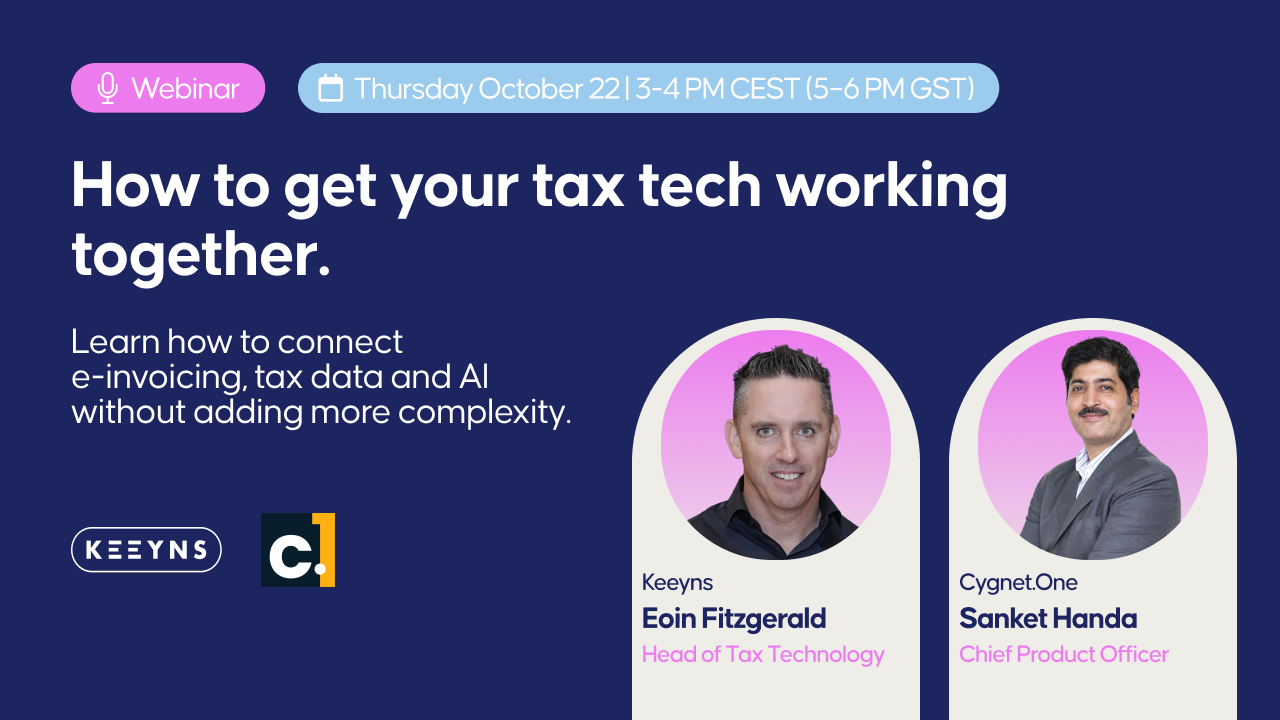
Live webinar
How to get your tax tech working together
Join us Oct 22nd
Glossary / Tax Control Framework (TCF)
A Tax Control Framework (TCF) is the part of a company’s internal control system that makes sure its tax returns and tax disclosures are accurate and complete [1]. PwC describes a TCF as a part of the internal control framework that is designed to help organizations take control over taxes [3].
A TCF is not a separate system. It is part of the wider internal control system and builds on the same principles. One example is the COSO framework, a widely used model for internal control from the Committee of Sponsoring Organizations of the Treadway Commission [1].
A TCF plays a central part in cooperative compliance [1]. Cooperative compliance is a voluntary relationship between large businesses and tax authorities, based on cooperation and trust [1]. The deal is often summed up as “transparency in exchange for certainty” [4].
According to the OECD, tax authorities can significantly reduce ⚑ reviews and audits of a group’s tax returns when two conditions are met [1]:
A TCF does not settle the final tax bill. It shows that the process behind the tax return is under control [1]. If an error still occurs, a good TCF is evidence that the error is not the result of systemic negligence [1].
The OECD guidance on TCFs is aimed at large businesses in a cooperative compliance program. It is not prescriptive and does not create new rights or obligations [1]. Every company designs its own TCF to fit its business and industry, so there is no one-size-fits-all model [1].
In practice, each country decides how much weight a TCF carries:
See the country table below.
The OECD identifies six essential building blocks for a TCF, consistent with enterprise-wide internal control models such as COSO [1]. New Zealand’s Inland Revenue uses the same six in its guidance [2].
Tax authorities start by asking management how the TCF works [1]. Then they:
Testing can be substantive or limited to selected areas. It builds on controls that already exist, such as those tested by the external auditor [1]. Even taxpayers that appear low risk are still audited to some extent, so that authorities can check their own testing methods are reliable [1].
New Zealand’s Inland Revenue gives boards a checklist of ten questions about their TCF. One of them asks: “Has the operation of the tax control framework been tested independently in the last 3 years?” [2]
|
Country |
Regime |
What a TCF gets you |
Legal or official basis |
|
Netherlands |
Horizontal monitoring (horizontaal toezicht) |
Access to a cooperative compliance covenant. A well-functioning TCF counts positively in supervision. |
Belastingdienst policy and Good Practices (2023) [5][6] |
|
Italy |
Cooperative compliance (adempimento collaborativo) |
No penalties for tax risks disclosed in time and in full. Shorter assessment period. |
D.Lgs. 128/2015, as amended [8][9][14] |
|
Germany |
No TCF regime; tax compliance management system (Tax CMS) |
Can count as evidence against intent or recklessness. Possible binding assurances in a follow-up audit (pilot). |
BMF letter of 23 May 2016; Art. 97 § 38 EGAO [10][11][15] |
|
United Kingdom |
Senior Accounting Officer (SAO) regime |
Legal duty, not a benefit. Penalties apply if arrangements fall short. |
Finance Act 2009, Sch. 46; HMRC SAO guidance [12] |
Horizontal monitoring (horizontaal toezicht) is the Dutch Tax and Customs Administration’s preferred approach for large companies [5]. It works through individual covenants based on transparency, understanding and mutual trust [5]. The starting point is that the company pays enough attention to its tax control [5].
The Administration’s good practices describe six basic principles of a TCF [6]:
Two further principles apply across all six: IT, and the role of the external tax adviser [6]. To take part in horizontal monitoring, a company must monitor its key tax risks [6]. A demonstrably well-functioning TCF counts positively in how the Administration supervises a company [6].
Under Italy’s cooperative compliance regime (adempimento collaborativo), a company needs a TCF that is part of its governance and internal control system and includes a tax risk map [8].
Certification. The TCF must be certified by an independent lawyer or chartered accountant (dottore commercialista) who is registered on the official list of qualified certifiers [9].
Revenue threshold. The threshold to enter the regime was €1 billion in 2023, €750 million in 2024 and €500 million from 2026. It will drop to €100 million in 2028 [8][9].
Benefits:
Germany has no general legal obligation to have a TCF. In a letter of 23 May 2016, the Federal Ministry of Finance (BMF) stated that an internal tax control system can be an indication against intent or recklessness when a tax return turns out to be wrong [15]. Each case is still assessed on its own facts [15].
IDW PS 980 is the German audit standard for compliance management systems. Its revised version has been mandatory for newly commissioned audits since 1 January 2023 [10].
Since 1 January 2023, Art. 97 § 38 of the Introductory Act to the Fiscal Code (EGAO) has allowed a pilot scheme. If a tax audit has tested a company’s tax control system and found no or only minor tax risk, the tax office can, on application, give binding assurances that limit the next audit [11][15]. The pilot is due to be evaluated by 2029 [15].
A UK-incorporated company must appoint a Senior Accounting Officer (SAO) if, in the previous financial year, it had more than £200 million in turnover or more than £2 billion on its balance sheet. The test applies to the company on its own or together with its UK group companies [12].
The SAO must take reasonable steps to make sure the company has appropriate tax accounting arrangements, and must confirm this to HMRC in an annual certificate [12].
Each failure carries a £5,000 penalty per financial year [12];
Valentino Group has a cooperative compliance agreement with the Italian tax authority, backed by a TCF and a risk control matrix (RCM) [13]. Aaron Meneghin, Tax Director at Valentino, says the TCF was “not big, but at the same time really important” [13].
Written procedures already existed. What changed was accountability:
“Creating the TCF, officializing all the tax risk points within the TCF and the RCM [risk control matrix], basically gave responsibility to all the control owners. Before, they were our contact point, but if something was wrong it was always a little bit difficult to say: this is on your desk. Now it’s black on white.” [13]
The next step, he says, is moving the TCF from manual to digital management [13].
|
Date |
Country |
What happened |
|
September 2023 |
Netherlands |
The Tax and Customs Administration published updated good practices on tax control: the basic principles of a TCF and what they mean for supervision [6]. |
|
June 2025 |
Netherlands |
The Administration revised its guideline for supervising large companies (Leidraad Handhaving Grote Ondernemingen) [7]. |
|
5 September 2025 |
New Zealand |
Inland Revenue updated its initial guidance on tax control frameworks [2]. |
|
2026 |
Italy |
The entry threshold for cooperative compliance dropped to €500 million in revenue [8]. |
|
14 April 2026 |
Indonesia |
According to MUC Consulting, Indonesia’s Directorate General of Taxes is assessing and preparing cooperative compliance and TCF programs [4]. |
|
6 August 2026 |
Italy |
The Italian Revenue Agency issued Circular 6/E on the new cooperative compliance rules [14]. Key points [9][14]: a TCF certification is valid for three years. A certifier can take on at most three consecutive engagements, followed by a six-year break. Existing SOX (Sarbanes-Oxley Act) controls do not automatically count as a compliant TCF, but can be reused where they are relevant to tax risks. |
Keeyns is a tax management platform for multinational, multi-entity companies. Tax teams use it to document the processes, owners and controls in their TCF, and to keep the evidence ready for when a tax authority asks for it.
A TCF only works when every process, owner and control is visible, and the evidence is ready when the tax authority asks for it. That is where control starts.
|
# |
Source |
Published |
Consulted |
|
1 |
OECD, Co-operative Tax Compliance: Building Better Tax Control Frameworks, pp. 7–25 ⚑ (doi.org/10.1787/9789264253384-en) |
13 May 2016 |
14 October 2026 |
|
2 |
Inland Revenue New Zealand, Initial guidance on tax control frameworks |
Last updated 5 September 2025 |
14 October 2026 |
|
3 |
PwC Belgium, Market push to increase transparency, tax control and governance (secondary source) |
8 January 2024 |
14 October 2026 |
|
4 |
MUC Consulting, Understanding Cooperative Compliance and Tax Control Framework: The Foundation of Future Tax Compliance (opinion piece, secondary source) |
14 April 2026 |
14 October 2026 |
|
5 |
Belastingdienst, Horizontaal toezicht bij grote ondernemingen |
Last updated 20 March 2025 |
14 October 2026 |
|
6 |
Belastingdienst, Good Practices: Fiscale beheersing – De basisprincipes van het Tax Control Framework (TCF) en de betekenis voor het toezicht |
September 2023 |
14 October 2026 |
|
7 |
Belastingdienst, Leidraad Handhaving Grote Ondernemingen |
June 2025 version |
14 October 2026 |
|
8 |
Assolombarda, Cooperative compliance guide (secondary source; D.Lgs. 128/2015, 221/2023 and 108/2024) |
Ongoing page |
14 October 2026 |
|
9 |
Studio Cerbone, La nuova disciplina dell’adempimento collaborativo dopo la circolare n. 6/E del 2026 (secondary source) |
10 August 2026 |
14 October 2026 |
|
10 |
Grant Thornton Germany, IDW PS 980 n.F. & Tax CMS (secondary source) |
31 July 2025 |
14 October 2026 |
|
11 |
Forvis Mazars, Tax-CMS als Game-Changer in steuerlichen Außenprüfungen (secondary source) |
Newsletter Steuern 1/2024 |
14 October 2026 |
|
12 |
HMRC, Senior Accounting Officers Guidance: SAOG11210 (qualifying companies) and SAOG18200 (penalties) |
Last updated 19 December 2025 |
14 October 2026 |
|
13 |
Keeyns, interview with Aaron Meneghin, Tax Director at Valentino Group |
19 June 2026 |
14 October 2026 |
|
14 |
Agenzia delle Entrate, Circolare n. 6 del 6 agosto 2026 (primary source) |
6 August 2026 |
14 October 2026 |
|
15 |
Art. 97 § 38 EGAO (lxgesetze.de) and BMF letter of 23 May 2016 on § 153 AO |
2022 (in force 1 January 2023); 23 May 2016 |
14 October 2026 |