
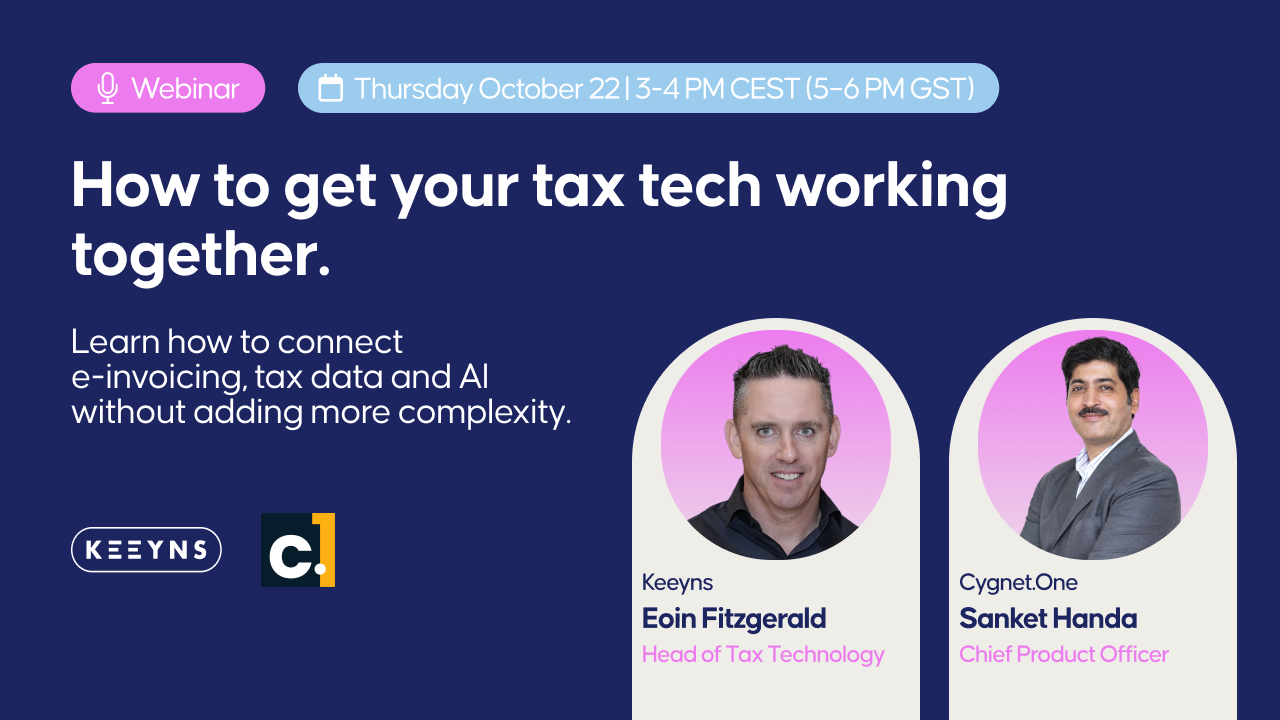
Live webinar
How to get your tax tech working together
Join us Oct 22nd

Part of the full series: The Evolution of the Indirect Tax Function | Written by Eoin Fitzgerald
The core principle: Don't reach for technology first. Technology layered on poor data just produces wrong answers faster. There's a correct order, and skipping steps is possible but rarely efficient.
The five areas of change—in order:
1. Culture (the foundation most businesses skip) Under real-time reporting, everyone who touches transaction data—the AP clerk, the IT team setting up master data—is now part of the compliance process, usually without knowing it. The tax team must become an educator inside the business, making the link between data quality at entry and compliance consequences downstream visible. This is a cultural problem before it's a systems problem.
2. Data (foundational and not optional) The window for correcting data at the return stage is closing. The invoice submitted in real time is the compliance record. Validation needs to be automated, and fixing data quality requires coordination with IT, finance, procurement, and sales—the tax function can't do it alone.
3. Technology (which, in what configuration, in what sequence) There's no universal stack; your starting point determines your path. Think in layers: ERP → tax determination → compliance/reporting → analytics → governance across all of it. Each layer depends on the one beneath. Build one clean, central data standard (covers ~80% of any jurisdiction's needs) and let filing software handle local variation (the other 20%)—like travel plug adaptors.
4. Governance (clearer than ever) Start with a live obligation register (every requirement, jurisdiction, deadline, status), clear role demarcation (who prepares, reviews, submits, is accountable), and real-time visibility. The goal: answer the CFO's inevitable question—"are we compliant, everywhere, right now?"
5. Operating model (making it sustainable) The needed skill mix—tax knowledge plus data/systems capability—is scarce (34% of tax executives cite talent shortages). Real-time reporting also disrupts the traditional managed service model: with no room to intervene between transaction and submission, providers must either embed in the technology itself or shift advisory work upstream.
Bottom line: Culture before data. Data before technology. Technology before operating model. The best-placed function isn't the one with the biggest team or fanciest tech—it's the one with an honest picture of where it stands and a plan sequenced to build on itself.
The previous chapters described where the indirect tax function has come from, where the external environment is heading, and where your business sits in that landscape. This chapter is about what to do with that picture. Not in abstract terms, but in a sequence that reflects how change actually works inside organisations.
There is a temptation, when faced with the scale of what is coming, to reach for technology first. To procure a platform, run a proof of concept, deploy AI and declare progress. That instinct is understandable but tends to produce disappointing results. Technology layered on top of poor data produces poor outputs at higher speed. A compliance dashboard built on inconsistent ERP data tells you the wrong thing more efficiently. The sequence matters.
What follows sets out five areas of change, in the order in which they need to be addressed. They are: culture, data, technology, governance, and operating model. Each is connected to the others. But the logic runs in one direction. Culture enables data discipline. Data discipline makes technology effective. Effective technology makes governance meaningful. And clear governance makes your operating model sustainable. Skipping steps is possible. It is rarely efficient.
Indirect tax has, for most of its history, been experienced by the business as someone else's problem. The tax team files the returns. The finance team provides the numbers. Everyone else gets on with their job. That division of responsibility made sense in a world of periodic, aggregated reporting. It does not make sense in a world of real-time transaction controls.
When a tax authority receives an e-invoice within seconds of it being issued, the data on that invoice is the compliance position. There is no later stage at which the tax function can review, adjust, or supplement it. The person who configured the product code in the ERP, the accounts payable clerk who processed the vendor invoice, the IT team that set up the customer master data: each of them is now, in a meaningful sense, part of the compliance process. They are almost certainly unaware of this.
This is a cultural problem before it is a systems problem. Getting clean data into the ERP at source requires people across the organisation to understand why it matters. They will not make the effort if they do not understand the consequence of not doing so.
The indirect tax team needs to become an educator inside the business. Not in the sense of running lengthy training programmes, but in the sense of making visible the connection between data quality at the point of entry and the compliance consequences downstream. Business partners who understand what their data is being used for are far more likely to get it right first time. Business partners who discover the consequences of getting it wrong only when a penalty lands are not grateful for the information arriving that late.
The practical starting points are more modest than a culture change programme might suggest. They include: identifying the business functions whose data feeds most directly into compliance outputs and starting a conversation with them about what they are producing and why it matters; building a simple internal narrative about the direction of travel, specifically that tax authorities are moving to real-time data, and what that means for how the business needs to operate; and working with finance leadership to ensure that data quality is understood as a compliance matter, not just an accounting one.
PwC has noted that 80% of tax leaders say disparate data sources complicate tax reporting and strategic planning, and that the shift from treating data as a burden to treating it as an advantage opens the door to genuinely better compliance outcomes. That shift cannot happen at the technology level. It has to start with how people in the organisation think about the data they generate.
If your business has not yet started this conversation, that is where to begin. Not with a technology evaluation, and not with a compliance audit. With the internal education that makes everything else possible.
Data is the raw material of everything the indirect tax function does, and the gap between where most businesses are and where they need to be is significant. Poor data quality - from multiple systems, inconsistent master data, and inadequate tax determination - is consistently identified as one of the primary obstacles to e-invoicing compliance. That matters because e-invoicing is not a niche requirement. It is expected to be the standard model for invoicing globally by 2030.
The traditional compliance model allowed for correction at the return stage - data could be reviewed and adjusted before submission. That window is closing. Under real-time reporting, the invoice data submitted to the tax authority at or near the point of issuance is the compliance record. Fixing data quality is not something the tax function can do alone. It requires coordination with IT, finance, procurement, and sales.
At scale, data validation needs to be automated - checking data fields before submission, capturing authority responses, reconciling what has been submitted against what has been accepted, and surfacing exceptions for resolution. The output of getting this right is visibility: clean dashboards showing reconciled data across the ERP, the filing system, and the government portal. If the dashboard is clean, the compliance process is in good shape. If it is showing gaps and unresolved exceptions, those are the problems that need attention.
None of this is solved by the tax function working in isolation. The right data architecture, the right validation logic, and the right reconciliation tooling all require active collaboration with IT, finance operations, and the business units that own the underlying transactions. In most organisations that means building relationships, making the case for investment, and being prepared to operate as a project stakeholder rather than just a technical adviser. The businesses that get this right...
Technology does not solve the problems described above on its own. But without the right technology, those problems cannot be managed at the scale that modern compliance requires. The question for most indirect tax functions is not whether to invest in technology, but which technology, in what configuration, and in what sequence.
Also remember you can only work with the technology that is available in your business tech ecosystem. You need to know what is available as it determines your options. For example Claude may have some features you find really useful but if your business is using CoPilot (and Claude is not authorised), you will not have access to it.
Chapter 3 set out the variables that define where a business sits today: the number and type of ERP systems it runs, whether it has a standalone tax engine, how its compliance function is structured, and how much of the function is in-house versus outsourced. Those variables are not just descriptive. They directly determine which technology investments are viable, which need to come first, and which would be premature without other things being in place.
There is no universal technology stack for indirect tax compliance. A business running a single, well-configured ERP with a modern tax engine and a centralised compliance team is in a fundamentally different position from one running six legacy systems, no tax engine, and a compliance function split across regions with inconsistent processes. Both need to respond to the same regulatory direction. The technology that makes sense for each of them looks very different.
The practical way to think about this is in layers:
The ERP: the system or systems from which all transactional data originates.
Tax determination: the logic that decides what tax treatment applies to each transaction, whether that native to the ERP or in a standalone tax engine.
Compliance and reporting: the software that prepares and files returns, handles digital reporting and e-invoicing obligations.
Analytics and monitoring: the tools that run across all of the above to provide visibility, detect anomalies, and support audit readiness.
Governance and controls layer: Are we in control? Can we demonstrate that control and visibility real time. I believe this is the most fundamental – yet basic of all. Imagine not knowing where you are at during the compliance lifecycle? Could you imagine running a factory with no visibility of where production stands against the monthly target. The same logic applies here.
The governance and controls layer sits across all of the above rather than beneath them - the mechanism by which you know whether the stack is working and can demonstrate that to others. Each other layer depends on the one beneath it. Analytics built on unreliable compliance data is noise. Compliance software pulling from a poorly configured tax engine will automate errors. A tax engine connected to an ERP with inconsistent master data will apply the right logic to the wrong inputs. The sequencing of technology investment has to follow the logic of the stack, not the sequence of what is easiest to procure or most visible to senior leadership.
Where your compliance function sits on the in-house to outsourced spectrum determines who owns the technology question.
If your function is outsourced, the stack that delivers your compliance outputs belongs to your provider. The question is not what technology you need but whether your provider's technology will be where it needs to be as your mandate obligations evolve - and whether your contractual and governance arrangements give you sufficient visibility to know.
If your function is in-house, the investment decisions sit with you, but the pace and breadth of regulatory change means most internal teams will still need specialist external technology even if they retain the compliance work.
For co-sourced models, the critical question is about boundaries - which parts of the stack are managed externally, which are owned internally, and how the two connect. A poorly documented, manual handoff between a provider's systems and the client's ERP is a common failure point, and one that becomes harder to sustain as reporting obligations become more granular and time-sensitive.
Think of filing software the way you think about travel plug adaptors. Every country has a different socket, and no single plug fits everywhere. The job of specialist filing software is to be the adaptor - taking your data and presenting it in the form each jurisdiction requires, without you having to rebuild your internal processes for each one.
The practical implication is how you prepare your data internally. The instinct to format and structure data separately for each local filing multiplies effort, creates inconsistency, and becomes unmanageable as jurisdictions grow. The better approach is clean, complete, consistently structured transactional data - counterparty details, transaction values, tax amounts, dates, entity identifiers - that works for roughly 80% of what any jurisdiction will need. The remaining 20%, the local field names, jurisdiction-specific codes, and particular XML schemas, is the localisation layer. That is what the software handles.
The strategic benefit is significant. One data standard, maintained centrally, fed into a platform that handles local variation. As new mandates come into force, you are plugging into a new adaptor rather than redesigning your data preparation from scratch. Businesses that build this clean data standard early will add new jurisdictions at a fraction of the cost and time of those that have not.
As indirect tax obligations multiply, governance is no longer something that can be managed from memory or a shared spreadsheet. The volume and pace of real-time reporting requirements makes operating without structured technology support increasingly untenable.
Effective governance starts with a live obligation register - a structured record of every filing requirement, its jurisdiction, frequency, deadline, and current status. That needs to be paired with clear role demarcation: who prepares, who reviews, who submits, and who is accountable if something goes wrong. Where managed service or co-sourced arrangements are in place, governance must address the handoff points explicitly - ambiguity at the boundary between in-house and outsourced teams is one of the more common sources of late or incorrect filings.
The governance later must have real-time visibility into what has been submitted, what has been acknowledged, and what remains outstanding. Centralisation of governance does not mean removing local capability, but it does mean ensuring local teams operate within a framework the centre can see and trust.
Taken together, the obligation register, clear role ownership, and live monitoring infrastructure allow a tax director to answer with confidence the question every CFO will eventually ask: are we compliant, everywhere, right now?
Culture, data, and technology are the inputs. The operating model is how the function is organised to use them. As the compliance environment becomes more demanding and the skill requirements of the indirect tax function change, the operating model question becomes more important.
PwC's 2025 research found that 34% of tax executives identify talent retention and skill shortages as a major barrier to delivering on their tax strategy. The combination of technical tax knowledge and data or systems capability that the emerging environment requires is not widely available in the traditional indirect tax talent market.
Teams that have historically focused on return preparation and audit defence need to develop or acquire skills in data pipeline management, e-invoicing formats, and system integrations. Those are different capabilities.
This is a genuinely interesting question and one the industry has not fully resolved. Real-time reporting compresses the compliance timeline to the point where the traditional managed service model - where a provider prepares and reviews returns on a periodic cycle - starts to look structurally awkward. If the invoice is the compliance event, and it happens in milliseconds, there is limited room for a third party to intervene between transaction and submission in the way they historically have.
Two plausible directions emerge. The first is that managed service providers become more deeply embedded in the technology infrastructure itself - not reviewing returns after the fact but operating and maintaining the platforms through which transactions flow in real time. The compliance service becomes an always-on technology service rather than a periodic professional one.
The second is that the human advisory layer shifts further upstream - into tax determination logic, data governance, system configuration, and exception handling - rather than return preparation. The routine work becomes automated and provider-managed at the platform level, while the specialist expertise concentrates on the decisions that feed the automation.
Either way, the managed service of 2030 will look quite different from the one of today. Providers that are building technology capability now are positioning for the first model. Those that are not may find their role significantly narrowed. It is worth asking any current or prospective provider directly: what does your service model look like in a world where every invoice is a real-time compliance event?
The 5 areas noted above are not equally urgent for every business. A company already running a tax engine with clean ERP data and a capable in-house team has a different priority set from one running twelve legacy systems with a team of two and no automation. The starting point is an honest assessment of where you are across each dimension.
Do you know the current status of all your filings - everywhere, right now?
Are your existing dashboards and controls fit for real time reporting and the audits which will be triggered?
Does the rest of the business understand what its data is being used for, and what happens when it is wrong? If not, that conversation is the starting point.
Who is responsible for data quality across the organisation, and who has the authority to enforce standards when something is wrong?
What validation and reconciliation does your function currently run, and how much of it is automated? Where do exceptions go, and how quickly are they resolved?
How many of your active jurisdictions have e-invoicing or real-time reporting mandates already in force or announced?
Have you mapped what your current invoice data output looks like against the structured format requirements of those mandates?
Is your ERP data clean enough to be submitted to a tax authority in real time without review? If the honest answer is no, what is the plan for getting there?
Is your existing tax determination methodology fit for purpose?
What other options exist within the existing IT eco-system that you are not using today? Do you have a list of the business software available in your business today?
Does your team have the combination of tax knowledge and data or systems capability that the next three to five years will require? If not, is the plan to build it, buy it, or partner for it?
There is no business that has all of this fully resolved. The function that is best placed is not necessarily the one with the largest team or the most sophisticated technology. It is the one that has an accurate picture of its own position, a clear view of what is coming, and a plan that is sequenced in a way that builds on itself.
Culture before data. Data before technology. Technology before operating model redesign. Get the sequence right, and the investment at each stage compounds into something that works. Get it wrong, and you spend more to achieve less.
The indirect tax function has, for most of its history, operated in a space that was technically demanding but largely invisible to the wider organisation. That era is ending. Data is the common currency of modern compliance, and the quality of the data a business produces is now a strategic matter, not an administrative one. The teams and businesses that recognise this early will find the transition manageable. Those that recognise it only when a mandate deadline or an audit notice forces the issue will find it considerably harder.
The sequence matters, and the ambition is real. But strategy exists in parallel with obligation. While culture is being shifted, data pipelines cleaned, and technology layers rebuilt, the filing calendar keeps moving. Audits land. Deals need tax input. The function that embarks on this journey does not get to pause while it prepares. That is the subject of Chapter 5.
This chapter draws on publicly available research and guidance from the major accounting and advisory firms, including PwC (Tax Technology Trends 2025 and the Tax and Finance Pulse Surveys 2024 to 2025), Deloitte (Global Tax Policy Survey 2025 and e-invoicing and e-reporting analysis 2025), EY (Tax Technology and Transformation Survey 2025), and KPMG (Indirect Tax Technology and Managed Services 2025); from indirect tax compliance and technology specialists including Sovos (State of Tax Compliance 2025 and Sovos Intelligence launch materials 2025), Innovate Tax (Five Trends 2025), and Thomson Reuters ONESOURCE Pagero. Where specific data or observations are cited, the source publication is noted in the text. All market observations reflect published materials available up to early 2026.

Disclaimer:
Please remember Keeyns' articles are for informational and educational purposes only. Not for specific tax or legal advice. Always consult a qualified advisor before taking any actions based on this information.