
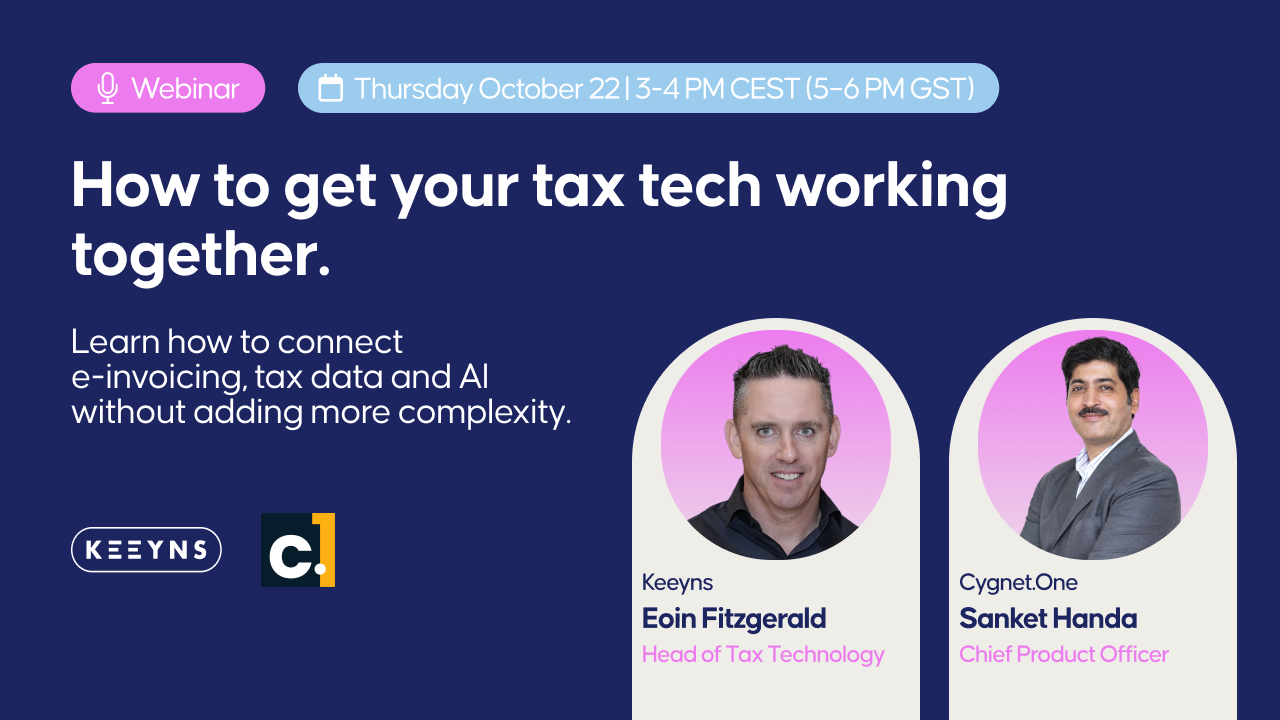
Live webinar
How to get your tax tech working together
Join us Oct 22nd

Part of the full series: The Evolution of the Indirect Tax Function | Written by Eoin Fitzgerald
The core idea: The regulatory direction is the same for everyone, but where each business starts is not. Before deciding what to change, you need an honest picture of your own indirect tax function.
Four variables that define where you stand:
Mapping your ecosystem: Ask the honest questions: How many jurisdictions and mandates affect us? How many ERPs and how clean is their data? Do we have a properly configured tax engine? Can our team absorb the next 3–5 years of obligations? Where are our data quality gaps?
Bottom line: Most businesses have pockets of strength and pockets of real exposure. The work ahead isn't fixing everything at once—it's sequencing change in the right order, so each step builds a foundation the next can rely on.
Chapter 2 described a world in motion. Tax authorities are acquiring data capabilities they have never had before. E-invoicing mandates are spreading. The compliance obligations that land on indirect tax teams are becoming more frequent, more granular, and less forgiving of error. That much is clear.
What is less clear, and what matters more for how you respond, is where your business sits in all of this. A company with a single ERP, a centralised finance team, and a dedicated indirect tax function faces a different set of priorities than a business with twelve legacy systems, a tax team of two, and a handful of jurisdictions it has grown into without much planning. The regulatory direction of travel is the same for both. The starting position is not.
This chapter is about that starting position. It looks at the variables that define how a business actually operates its indirect tax function today, why those variables matter as the environment changes, and how to think about where your business sits before considering what needs to change.
There is no universal answer here. The right response to the changes described in Chapter 2 depends entirely on what you are working with. Understanding your internal ecosystem clearly is the prerequisite for everything that follows.
Every indirect tax function sits at the intersection of several variables. None of them are fixed. But taken together, they define the gap between where a business is today and what the regulatory and technological environment will require of it in the years ahead. The key dimensions are: the nature and scale of the business, the structure of the tax team, the technology landscape, and the operating model. Each is worth examining separately.
 What kind of business?
The complexity and risk profile of indirect tax varies significantly by sector. High-volume retailers, manufacturers with cross-border supply chains, financial services and real estate businesses with partial exemption positions, and software companies managing digital services taxes across dozens of countries all face fundamentally different challenges. The practical question is straightforward:
Where do indirect tax errors create the most exposure, and is the function resourced accordingly in those areas?
 Geographic complexity.
A business operating across multiple jurisdictions is not just dealing with more compliance work - it is dealing with a different kind of problem. Multiple VAT registrations, filing formats, languages, regulatory relationships, and an expanding patchwork of e-invoicing and digital reporting mandates all add complexity that compounds quickly. Businesses with wide geographic footprints need visibility of their mandate pipeline, not just their current obligations.
How messy are your external obligations?
 Growth trajectory.
How a business has grown shapes what it has inherited. Organic growth tends to produce more consistent systems and cleaner data. Acquisitive growth tends to produce the opposite - multiple ERPs, inconsistent master data, and legacy tax configurations that may never have been properly aligned to the acquiring group's standards. Post-acquisition integration is also where latent compliance issues tend to surface, sometimes years after a deal has closed.
How messy are your internal systems and data?
Indirect tax team sizes vary far more than most people expect, even among businesses of comparable size. Some operate with a single specialist; others have built regional hubs across compliance, technology, and advisory functions. Size reflects history and internal prioritisation as much as it does genuine complexity. What matters now is not headcount but capability mix. The shift to real-time reporting and e-invoicing requires a combination of technical tax knowledge and data or systems expertise that many teams do not yet have in equal measure. Understanding that gap is the starting point.
How responsibility is distributed across the function matters just as much as who is in it. A centralised model produces consistency and clear accountability but concentrates risk - when the central team is stretched, everything slows. A decentralised model is more responsive locally but harder to keep consistent, and the central function can lose visibility into what is actually happening in local returns until something goes wrong. Most businesses operate some version of a hybrid. What matters is whether the governance structure is explicit, roles are clearly allocated, and the centre has enough visibility to catch problems early.
The skills the function needs are also broadening. Technical tax knowledge remains the foundation, but the indirect tax professional of the near future will also need to be comfortable working with data - understanding how it is structured, where it comes from, and what can go wrong with it. Familiarity with ERP configuration, e-invoicing platforms, and tax engine logic is increasingly valuable, not as a substitute for tax expertise but alongside it. Beyond the technical, project management and the ability to work across finance, IT, and procurement will matter more as transformation programmes become a regular feature of the function's workload rather than an occasional one. The teams that develop this broader skill base will be better placed to lead change rather than simply respond to it.
As digital reporting obligations multiply, the governance of the indirect tax function becomes more important, not less. The question is not just whether the structure works today, but whether it is designed to absorb the pace of regulatory change that is already underway.
The ERP is the foundation on which indirect tax compliance is built - it is where transactional data originates, tax codes are applied, and audit records are held. For many businesses, particularly those that have grown through acquisition, that foundation is fragmented: multiple ERP systems from different vendors, some end-of-life, none originally configured for the current regulatory environment. Managing continuous transaction control obligations across that kind of infrastructure is increasingly difficult to sustain. ERP transformation programmes, particularly the ongoing wave of SAP S/4HANA migrations, create a genuine opportunity to embed better tax logic at source rather than patching it downstream - but that window is finite.
Whether or not a business has a standalone tax engine sitting between its ERP and its compliance output is a significant differentiator. Without one, the internal team must monitor law changes across every jurisdiction and update ERP configurations manually - a burden that grows as geographic footprint expands and the pace of regulatory change increases. A tax engine centralises that logic, makes it easier to update and audit, and reduces the risk of errors compounding across high transaction volumes. The decision to implement one requires investment and integration effort, but for businesses operating across multiple jurisdictions, the alternative is increasingly hard to justify.
E-invoicing readiness is where the technology challenge becomes a business-wide problem rather than a tax one. Meeting an e-invoicing mandate requires changes to the systems that generate invoices, the data those invoices contain, and the connectivity between those systems and tax authority platforms - systems that typically sit in IT, finance, or operations, not in the tax function. Businesses that have not yet mapped their obligations, assessed their current data quality against incoming mandate requirements, and identified the system changes needed are behind. The regulatory timelines are not flexible, and in enterprise environments, system changes take time.
Most businesses source their indirect tax capability through some combination of in-house, outsourced, and co-sourced arrangements rather than sitting at either extreme. What matters is whether the chosen model is fit for what is coming. A business that has outsourced its compliance needs to understand its provider's capability roadmap for e-invoicing and real-time reporting - the infrastructure belongs to the provider, and the business needs visibility into how it is being maintained. A business running a fully in-house model needs to honestly assess whether its team has the skills and capacity to absorb the new obligations. The case for managed services is strongest where the business lacks either the technology or the specialist talent to manage the function at the required quality level.
The age of the business and its systems also shapes the starting point in ways that are easy to underestimate. An established business carries the weight of decisions made when digital reporting was not a concept - tax configurations, compliance processes, and data models built for a different era. A newer business may start from a cleaner technology position but can underestimate the complexity ahead and often lacks the institutional knowledge that comes from having been through audits and regulatory change cycles before.
Neither position is inherently better. The older business has more to unpick but more to draw on. The newer business has fewer legacy constraints but fewer hard-won lessons. Both need to start from an honest picture of where they actually are.
The purpose of working through these dimensions is to arrive at an honest picture of your current position. Not an aspirational one, and not a defensive one. A clear-eyed view of the strengths and constraints you are working with.
The questions worth asking include:
How many jurisdictions do we currently operate in, and how many have active or upcoming e-invoicing or digital reporting mandates that affect us?
How many ERP systems do we run, and how consistent is the tax data they produce
What other tools do we have in our IT ecosystem and do you have an inventory of these (bot options, LLM options etc)?
Do we have a standalone tax engine, and if so, is it configured to the current state of the law in every relevant jurisdiction?
How is compliance function structured, and does it have the capacity and skills to absorb the new obligations coming in the next three to five years?
What does our operating model look like, and does it give us sufficient visibility and control over our compliance quality?
Where are the known gaps in our data quality, and how would those gaps affect our ability to meet structured reporting requirements?
The answers will be different for every business. But the process of asking them is not optional. The external environment described in Chapter 2 is not abstract. It has specific, near-term implications for specific parts of every indirect tax function. Understanding your starting position is what makes it possible to respond in a way that is proportionate, targeted, and achievable.
What that assessment almost always reveals is that the challenges are not uniform. Most businesses have pockets of strength and pockets of real exposure. The work ahead is not about fixing everything at once. It is about sequencing change in the right order - so that each step builds a foundation the next one can rely on.
That sequencing is the subject of Chapter 4.
This chapter draws on publicly available research and guidance from the major accounting and advisory firms, including EY (Tax and Finance Operations Survey 2025), KPMG (Managed Services 2025), Deloitte (Tax Operating Model Transformation), BDO (Indirect Tax Automation Use Case Portfolio 2024), and PwC (Indirect Tax Edge); from specialist commentators including Innovate Tax (Five Trends 2025); and from indirect tax technology vendors including Sovos (Indirect Tax Suite for SAP 2024), Thomson Reuters ONESOURCE, Vertex, and Avalara. Where specific data or observations are cited, the source publication is noted in the text. All market observations reflect published materials available up to early 2026.

Disclaimer:
Please remember Keeyns' articles are for informational and educational purposes only. Not for specific tax or legal advice. Always consult a qualified advisor before taking any actions based on this information.