

Live webinar
How to get your tax tech working together
Join us Oct 22nd

Part of the full series: The Evolution of the Indirect Tax Function | Written by Eoin Fitzgerald
Two forces reshaping indirect tax:
The regulatory shift: Tax authorities are moving away from periodic returns toward real-time, transaction-level reporting. The EU's ViDA regulation (effective 2025, enforcement from 2030) mandates structured e-invoicing and near-real-time reporting for all intra-EU B2B transactions. This is already happening globally—Brazil (2009), Mexico (2010), Italy (2019), China (late 2024).
Why it's happening: The VAT gap: EU member states lost €128 billion in 2023 alone (9% of expected VAT). Governments want to close it. E-invoicing gives them visibility into every transaction in real time.
What it means for business:
The critical challenge: Inconsistencies across different jurisdictions, systems, and data sources will be spotted. Consistency and accuracy across everything you report matters more than ever.
Bottom line: Businesses need clean data infrastructure and a single consistent transaction model before they meet e-invoicing deadlines—or tax authorities will see your data before you do.
The world of indirect tax is not changing slowly. Two forces are converging that will reshape the function more fundamentally than anything in the past two decades: a global push towards tax alignment and transparency, driven by the OECD and governments worldwide, and a revolution in data and technology including AI is giving both tax authorities and businesses capabilities they have never had before. Understanding both forces, and how they interact, is essential for any indirect tax team thinking about where it needs to be.
The most consequential near-term change for indirect tax teams is the global expansion of e-invoicing and digital reporting mandates. This is not a future development. It has been underway for more than 20 years.
Latin America pioneered these regimes. Chile launched a voluntary system in 2003, Brazil made e-invoicing mandatory in 2009, and Mexico followed in 2010. By the end of that decade, clearance-based e-invoicing - the requirement that invoices be validated by the tax authority before they can be issued - had become the regional norm. In Europe Italy introduced mandatory B2B e-invoicing in 2019 and Poland, France, Germany, Belgium and Spain all have mandates at various stages of rollout. China has expanded its fully digitalised e-fapiao system nationwide from late 2024.
The EU’s VAT in the Digital Age package (ViDA) was formally adopted on 11 March 2025 and entered into force on 14 April 2025. It represents the most significant reform of EU VAT rules in a generation. The centrepiece of ViDA for most businesses is the digital reporting requirement: from 1 July 2030, mandatory structured e-invoicing and near-real-time reporting will apply to all intra-EU B2B transactions. For countries like Ireland that have no existing e-invoicing framework, the 2030 deadline has provided the impetus to introduce domestic e-invoicing requirements alongside the EU cross border reporting mandate.
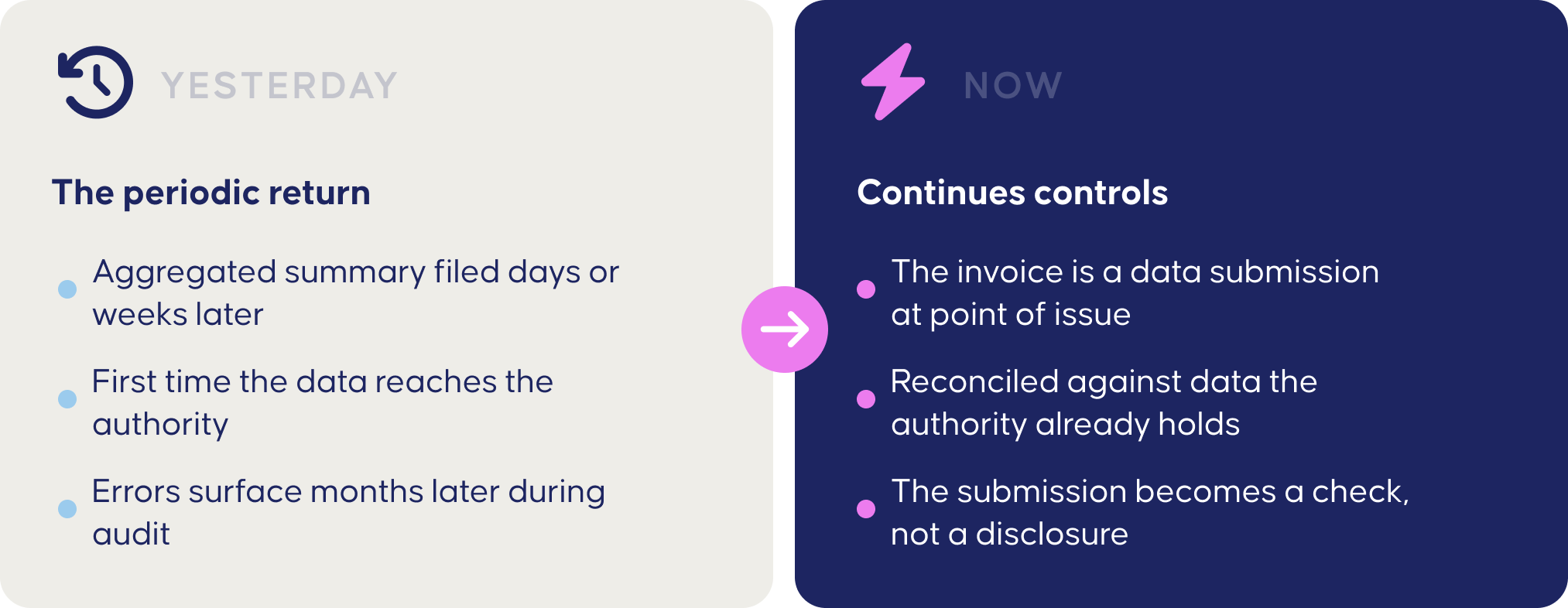
The direction is consistent across all of these. Tax authorities are moving away from relying on periodic returns that aggregate and summarise past transactions. They are moving towards receiving structured, granular transaction data at the point of, or shortly after, the transaction itself. The invoice is becoming a data submission as much as a commercial document.
The VAT gap provides the clearest explanation for why changes are happening. The European Commission estimated that EU member states lost €128 billion in VAT revenues in 2023 alone, representing 9% of expected VAT revenues. Globally, the gap between VAT due and VAT collected has been estimated at up to half a trillion euros annually. Governments with structural budget pressures and a growing reliance on indirect tax revenues have a strong and continuing incentive to close that gap. E-invoicing and continuous reporting are their most effective tools.
Whatever the label - clearance, e-invoicing, CTC, ViDA reporting - the basic idea is the same. Businesses must send invoice-level data to the tax authority, either before or immediately after the invoice is issued. The authority ends up with a complete record of every transaction, on both the sales and purchase side, in close to real time. Cross-checking becomes straightforward, gaps become visible, and working out what a business owes in VAT becomes largely an automated exercise. The monthly or quarterly summary return is no longer the primary source of truth.
The business implications are material. Data quality becomes non-negotiable - errors are visible to the tax authority immediately, not months later during an audit. The systems that generate invoices become compliance systems in their own right, with authority-mandated fields and formats built directly into the process. And as mandates spread across jurisdictions with different technical requirements, the compliance surface grows quickly. Critically, this is no longer just a tax department problem. Procurement, sales, and any other function that creates or manages transactional data must be brought into the solution. The days of those teams dictating minimum data collection standards are over.
Tax authorities, for their part, are beginning to recognise what they have. The data collected through CTCs gives tax authorities an unprecedented view of business transactions. As Sovos has noted, once the technological infrastructure is in place, tax administrations have access to a goldmine of data they can mine with analytics to identify trends, flag anomalies, and target audits with a precision that was previously impossible. The shift from reactive audits triggered by filed return discrepancies to proactive, data-driven risk profiling is already happening. Even if the anomaly is not identified right away, that data set exists into the future to be mined based on future discoveries.
Tax authorities have been investing in AI and data analytics for years, and the results are operational rather than experimental. Austria generated €185 million in additional revenue 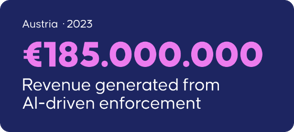 from AI-driven enforcement in 2023. Australia now processes tax assessments in days rather than months. India uses AI to flag unusual charitable donation patterns. The OECD and IMF have both documented the rapid adoption of machine learning for risk assessment, fraud detection, and analysis of unstructured data including documents and social media.
The direction of travel is toward authorities that function more like financial regulators - holding granular transaction data, running continuous algorithmic analysis across it, and intervening early when something looks wrong. The traditional audit triggered by a return discrepancy does not disappear, but it is increasingly supplemented by a model where the authority already knows a great deal before the business files anything.
For businesses, the practical consequence is simple: the gap between what a business does and what a tax authority can see is closing. An authority with access to e-invoice data, real-time transaction feeds, and cross-border reporting has a level of visibility that would have been unimaginable a generation ago. Inconsistencies between different data sources - VAT returns, e-invoice flows, transfer pricing documentation - will be spotted. Consistency and accuracy across everything the business generates and reports has never mattered more.
The common thread running through every major regulatory development - Pillar Two, transfer pricing transparency, e-invoicing, AI-driven enforcement - is data. Structured, granular, transactional data that can be transmitted, analysed, and acted on.
E-invoicing sits at the centre of this because invoice data is the raw material everything else depends on. It captures the counterparties, the goods or services, the value, the tax treatment, the timing. When that data flows to a tax authority in real time, it becomes the basis for audit risk scoring, anomaly detection, and automated enforcement. When it stays inside a business and is used well, it becomes the basis for continuous compliance monitoring, identifying errors early, and better tax planning.
Businesses that have built the data infrastructure to generate and use that transactional data effectively will be better placed - both in how they deal with tax authorities and in how efficiently they manage their own obligations. Those that have not will feel the gap.
There is also a practical warning worth stating plainly. If your internal systems are not in good shape and you are racing to meet an e-invoicing deadline, there is a real chance the tax authority will see your transactional data at roughly the same time you do. That is worth thinking about.
The complexity compounds across jurisdictions. Italy, Poland, and France each have different technical requirements for how invoice data must be structured and submitted. A business operating across ten countries with a separate technical solution for each ends up managing something that quickly becomes unworkable. The businesses best placed to absorb new mandates are those that have established a single consistent internal representation of what a transaction looks like, before it is translated for any specific country's requirements.
The forces described in this chapter are already in motion - ViDA is law, tax authorities are deploying AI, and structured data mandates are being written into legislation across every major market. The question is no longer whether to respond, but how well-placed a business is to do so.
That answer depends entirely on where a business starts. A multinational with dozens of ERP systems and operations across multiple e-invoicing jurisdictions faces a very different challenge from a single-country business on one platform. The regulatory direction is the same for both. The starting point is not.
Before any change programme can be designed, a business needs an honest picture of its own situation - its team, its technology, its operating model, and the complexity in its transaction flows. That is what Chapter 3 covers.
Sources: OECD/G20 Inclusive Framework on BEPS; EU VAT in the Digital Age (ViDA) package (March 2025); OECD Tax Administration 2024; IMF Technical Notes and Manuals 2024/006 (AI in Tax and Customs Administration); OECD Governing with Artificial Intelligence 2025; Sovos; KPMG; Deloitte; PwC; A&O Shearman; Marosa VAT.

Disclaimer:
Please remember Keeyns' articles are for informational and educational purposes only. Not for specific tax or legal advice. Always consult a qualified advisor before taking any actions based on this information.