
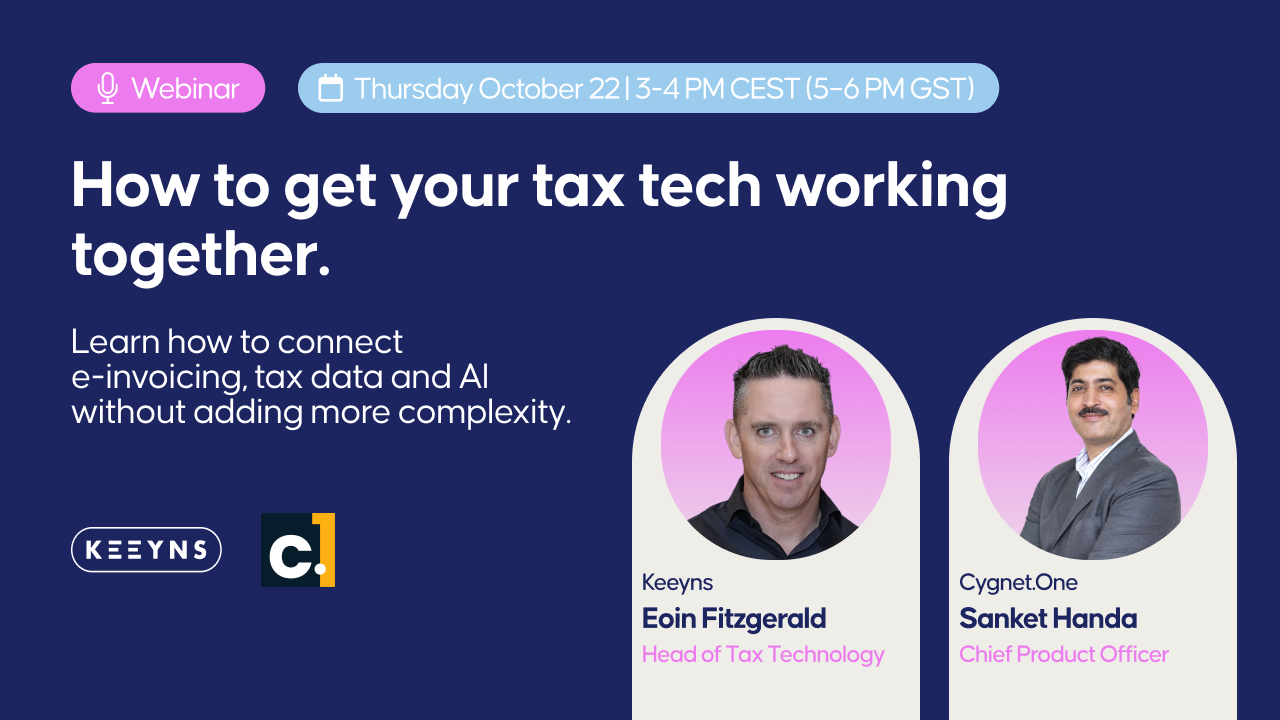
Live webinar
How to get your tax tech working together
Join us Oct 22nd

Part of the full series: The Evolution of the Indirect Tax Function | Written by Eoin Fitzgerald.
The core problem: Large organisations must process thousands of monthly tax transactions through a manual, spreadsheet-based process that relies heavily on manual effort.
The 4 steps:
Other tasks:
The challenges:
Solution: A digital transformation of the process, moving away from manual work.
Indirect taxes - value added tax (VAT), goods and services tax (GST), customs duties, excise levies, and a growing array of digital services taxes - are among the most operationally demanding obligations that businesses face. Unlike corporate income tax, where a single annual filing often suffices, indirect taxes are transactional by nature. Every invoice issued, every cross-border shipment, every intercompany service creates a potential tax event that must be captured, classified, calculated, reported, and often remitted within days or weeks.
For most large organisations, the indirect tax function sits at the intersection of finance, IT, legal, and operations. It is simultaneously a compliance engine, a commercial adviser, and an audit defence capability. Its workload has grown substantially over the past decade, driven by the global expansion of VAT and GST regimes, the intensification of real-time reporting requirements - particularly across Latin America and into the European Union - and the increasing complexity of cross-border trade flows.
But the formal tax function is only part of the picture. A shadow tax function operates across order-to-cash, procure-to-pay, logistics, and IT. These are the teams that capture customer and vendor master data, raise invoices, classify goods at the border. They do not report into tax, but they generate the data that tax has to report. Decisions taken in those functions, often without tax visibility, materially shape what gets filed and what gets challenged. Real-time reporting has made this dependency visible. Where invoices are cleared or reported to the tax authority at or near the moment of issue, the periodic return is no longer the first time the data reaches the authority. The submission is reconciled against data the authority already holds. That changes the question from "can we file an accurate return?" to "is the data correct at the point it leaves the business?".
E-invoicing mandates drive a change in behaviour from the CEO to the mail room, because the moment of truth has moved from the time of filing, historically days / weeks, to the time when the transaction is created – at the time the system created that data.
This chapter describes how that function has been structured and has operated up to the present day. It covers the end-to-end compliance lifecycle from data extraction through to submission, the role of the indirect tax team in supporting commercial transactions and deals, and the processes organisations use to manage and defend tax audits. It draws on publicly available research and guidance from the major accounting and advisory firms, the European Commission, and specialist indirect tax technology vendors.
Indirect tax is no longer just a back-office compliance function. For multinationals operating across multiple jurisdictions, it is a material business risk and a source of significant operational cost. | Deloitte, Global Indirect Tax Survey, 2023
The core activity of the indirect tax function is compliance: ensuring that the right amount of tax is calculated, reported, and paid to the right authority at the right time. That process, at its most fundamental, can be broken into four stages: extract, process, validate, and submit. In practice, each stage has historically involved significant manual effort, fragmented tooling, and a high degree of reliance on individual expertise.
The starting point for any VAT or GST return is transactional data. For a mid-size multinational this might mean tens of thousands of purchase and sales invoices per month, drawn from multiple ERP systems, e-commerce platforms, procurement tools, and intercompany billing engines. The challenge has never been a shortage of data; it has been getting data out of source systems in a clean, consistent, and tax-relevant format.
Most organisations have historically relied on standard ERP reports - SAP, Oracle, Microsoft Dynamics - to pull the raw transaction data needed for a return. Where these systems have been correctly configured, extraction is relatively straightforward. Where they have not - and KPMG's indirect tax technology surveys consistently show that misconfiguration is endemic - tax teams must apply manual adjustments, reconcile ledger balances against transaction-level data, and chase down missing or misclassified records before they can even begin to calculate a return.
This step happens in silence today. It is not seen as a business problem, it is seen as a tax problem, a reporting challenge that the wider business does not need to adapt for. The tax team has time, even if limited, to solve for it. As a result, this challenge has become part and parcel of every indirect tax reporting cycle in almost every company.
The problem is compounded for organisations operating across multiple jurisdictions. Data from subsidiaries in different countries may sit in different ERP instances, follow different chart-of-accounts conventions, and use different tax codes. Consolidating that data into a coherent picture for a regional or global compliance run is, in many organisations, a project in its own right - one that is repeated monthly, quarterly, or annually depending on the jurisdiction and it all happens in the time between the reports are downloaded and the tax return is filed, sometimes just a few days.
In our experience, tax data quality issues account for the majority of errors identified in VAT returns. The problem begins at the point of data entry, not at the point of filing. | PwC, VAT Compliance in a Digital Age, 2022
Once transactional data is extracted, it must be processed: tax codes verified, rates confirmed, apportionment rules applied, and the net VAT position calculated. For standard transactions in a single jurisdiction this is relatively mechanical. For complex businesses - those with partial exemption, mixed supplies, cross-border services, or intra-group transactions - the calculation itself can be highly judgement-intensive.
Partial exemption, in particular, has historically been a significant source of both compliance risk and professional effort. In the UK and across much of the EU, businesses that make both taxable and exempt supplies must apportion their input tax recovery. The methodologies for doing so vary by jurisdiction and are frequently subject to negotiation with tax authorities. PwC and Deloitte have both noted that partial exemption calculations remain one of the most resource-intensive elements of VAT compliance for financial services firms, insurers, and healthcare organisations.
The processing stage has also become more demanding as the range of applicable rates and exemptions has grown where the EU alone maintains over 250 distinct reduced, super-reduced, zero, and exempt rate categories across its member states.
Before a return is filed, it must be validated - internally against prior period returns, against the general ledger, and increasingly against third-party data that tax authorities themselves hold. This reconciliation step has historically been performed manually, often in spreadsheets, and is a significant source of both error and delay.
This is another step that happens in silence – within the indirect direct tax reporting compliance cycle. Poor data quality presents a real challenge in the reconciliation process, where each broken data point has to be closed out one by one, sometimes by reference to the underlying invoice to understand what was actually procured or sold versus what is stored in the systems against the same transaction. It also limits how much of the validation can be automated. Rules engines flag exceptions, but a percentage of those flagged transactions turn out not to be real issues, and each still has to be investigated before it can be cleared.
The reconciliation challenge has intensified with the expansion of transactional reporting obligations. Spain, Italy, Portugal, Hungary, and Romania have introduced real-time or near-real-time invoice level reporting regimes. In each case, the compliance team must reconcile the data present in the tax authority systems against the data in its periodic VAT return - a process that usually exposes differences (for many reasons) that then require investigation and correction.
Sovos, which provides compliance infrastructure across more than 70 jurisdictions, describes this as the 'compliance convergence' challenge: as governments move toward continuous transaction controls, the traditional separation between invoice processing and return preparation collapses, and the entire compliance workflow must be redesigned around real-time data flows.
 The final stage of the compliance cycle is the preparation and submission of the return itself.
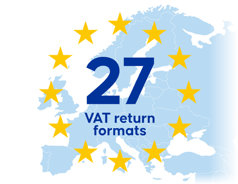
Across the EU, this means navigating 27 distinct VAT return formats - with differing field definitions, supplementary reporting requirements and different submission portals. This often means liaising with local advisors in order to assist with the submission where emailing and sharing data is a core part of the compliance step to submission.
Outside the EU, the variation is even greater: GST returns in Australia, India, Singapore, and New Zealand each follow different formats and filing cadences; Brazil's SPED regime is among the most technically demanding in the world, requiring structured XML files that combine fiscal notes with accounting and inventory data.
For most organisations, return preparation has historically involved downloading data from ERP systems into spreadsheets, applying manual adjustments, and re-keying figures into government portals. EY's 2023 Tax Technology and Transformation Survey found that 67% of tax functions still used spreadsheets as a primary compliance tool, despite the recognised risks of error, version control failures, and the loss of institutional knowledge when experienced staff leave.
Specialist compliance tools have made meaningful progress in automating the preparation step, particularly for large multinationals with standardised ERP environments to generate returns in the required format. However submission to the tax authority still relies on manual portal upload in many jurisdictions, and even where digital submission is possible only a subset of vendor offerings provide true end-to-end electronic filing in a small subset of countries. The wider compliance workflow - reconciliation against source data, response to authority queries, audit trail management, and the link back to the financial close - remains largely outside what these tools address. The result is a messy internal landscape, with a bolt-on compliance engine doing its best to map data from multiple sources into the right tax return boxes - where the end filing remains manual.
The indirect tax compliance world still runs largely on email. Tax teams routinely fire off chains to ERP owners chasing answers on transactions, to business units clarifying the nature of supplies, to external advisors supporting filings and to tax authorities managing audit queries or filing correspondence. The result is a fragmented, version-controlled nightmare where critical decisions get buried in inboxes, response times are unpredictable, and audit trails are near impossible to reconstruct. For a function that is supposed to be governed, controlled and defensible, the irony is that the primary operating tool is one of the least structured and least auditable in the enterprise.
We still see organisations spending 60 to 70 percent of their compliance time on data gathering and validation. The actual return preparation is often the easiest part. | EY, Tax Technology and Transformation Survey, 2023
The second major pillar of the indirect tax function is audit defence and controversy management. VAT audits have become more frequent, more technically sophisticated, and more data-intensive over the past decade, as tax authorities have invested in digital audit infrastructure and built out specialist VAT audit teams.
Historically tax authorities selected businesses for VAT audit through a combination of risk-based profiling, industry-sector sweeps, and cross-referencing of data from multiple sources. In jurisdictions with real-time reporting - Italy, Spain, Hungary, Portugal, Saudi, Israel - authorities can identify discrepancies between a taxpayer's submissions and those of its counterparties almost immediately. In jurisdictions without real-time reporting, authorities increasingly use pre-populated return data and statistical models to identify outliers.
The European Commission's 'VAT Gap' report, estimates the EU-wide VAT gap at approximately 128 billion euros - the difference between the VAT theoretically due and the VAT actually collected. This figure highlights non compliance drives political pressure on member states to intensify enforcement, which translates directly into increased audit activity for businesses.
Preparing for and managing a VAT audit requires the indirect tax team to assemble a substantial volume of supporting documentation: original invoices (both input and output), bank statements confirming payment, contracts, import and export documentation, evidence of the business purpose of expenditure, and correspondence with the tax authority. For historical periods - audits in the EU can cover up to four years of returns (10 years in Germany), or longer where fraud is alleged. This can mean retrieving records from archive systems, tracking down former employees, or reconstructing the tax treatment of transactions from incomplete records.
The burden of documentation has increased significantly with the shift toward audit-by-data. Tax authorities now routinely request SAF-T (Standard Audit File for Tax) data dumps - structured XML exports of general ledger, accounts payable, accounts receivable, and asset register data - which they then subject to automated analysis to identify anomalies. Marosa, a specialist VAT compliance firm operating across the EU, has observed that taxpayers who are unable to produce SAF-T data in the required format within the authority's deadline face significant procedural risk, regardless of whether their underlying VAT position is correct.
The management of a live audit typically involves close coordination between the in-house indirect tax team, the company's external advisers (usually a Big 4 or specialist boutique firm), and the relevant business units that can explain the commercial context of disputed transactions. PwC's VAT controversy practice notes that the quality of the initial response to an audit enquiry - both in terms of substance and presentation - materially affects the trajectory of the audit, since first impressions are difficult to reverse once formed.
The best audits are won before they start. Businesses that maintain audit-ready documentation as a matter of routine are in a fundamentally stronger position than those that reconstruct it under time pressure. | PwC, Indirect Tax Controversy: Practical Guide, 2022
It is worth being honest about what external advisers most often provide in this context. The bottleneck during an audit is rarely technical expertise; the in-house team can usually interpret the rules. What they cannot do is absorb the surge in evidence retrieval, response drafting, and reconciliation work on top of the normal compliance load they are actually resourced for. External support is, in a large share of cases, a bandwidth solution rather than an expertise solution. Headcount planning that assumes a steady-state compliance workload systematically under-provides for audit-driven peaks, and the gap is then filled by external spend that does not always reflect the underlying skill mix required. Quite simply, external resources do not help in preparing the response when knowledge of internal data, systems. Further existing relationships with key internal business partners is important particularly when responses are time sensitive and reliable support from the wider business is needed at short notice. External resources simply do not add value in these cases.
Beyond compliance, indirect tax teams play an important advisory role in corporate transactions - mergers and acquisitions, restructurings, real estate deals, and outsourcing arrangements. The indirect tax implications of a transaction can be significant: VAT on the sale of a business or its assets, customs duty exposure on supply chain integration, and the unwinding of historic VAT registrations and group arrangements all create both risk and opportunity.
Companies operating across multiple jurisdictions or with complex supply chains also require support on initial setup, ongoing maintenance, and cross-border invoicing arrangements - particularly in markets such as Brazil, the EU, and India where intra-territory reporting obligations exist independently of customs borders. Key advisory workstreams include:
1. Due Diligence.
In an M&A context, indirect tax diligence covers VAT registration history, treatment of complex supplies, input tax recoverability, and open audit exposures. The objective is to quantify inherited VAT risk - misfiled returns, incorrectly recovered input tax, misapplied exemptions - and assess whether deal protections are adequate
2. Transaction Structuring.
Where a deal is being structured rather than simply assessed, the indirect tax team can influence architecture to reduce cost and complexity - for example, the choice between a share sale and an asset sale has direct VAT consequences, as does the design of intra-group service arrangements and intercompany pricing.
3. Special Projects.
The indirect tax team is regularly drawn into time-bound, non-recurring projects that fall outside the normal compliance rhythm - supply chain reconfigurations driven by Brexit, US-China tariffs and war; ERP and finance transformation programmes requiring tax logic to be re-specified; and carve-outs or divestitures requiring the untangling of shared registrations and intercompany arrangements. These workstreams sit on top of steady-state compliance rather than replacing any part of it, demand a different skill mix, and are where external advisers are most heavily relied upon.
4. Post-Acquisition Integration
After close, the indirect tax team works to integrate the acquired entity's compliance processes, ERP tax configuration, and VAT registration profile into the acquirer's operating model. ERP misalignment between legacy and acquiring systems is a recurring source of transitional compliance risk.
Across most large organisations, the indirect tax function has historically been staffed by a combination of qualified tax professionals - often with a background in practice at the Big 4 or at specialist boutique firms - and compliance specialists, who may be more operationally focused. The function is typically housed within the Group Tax team, which reports to the CFO or to a Group Finance Director.
The balance between in-house resource and external support varies significantly by organisation size and philosophy. Very large multinationals - FTSE 100 and Fortune 500 companies - tend to maintain substantial in-house indirect tax capability, supplemented by external advisers for complex transactions, major audits, and jurisdictions where local expertise is required. Mid-market companies more commonly rely on a smaller in-house team supported by co-sourcing or outsourcing arrangements with the Big 4 or regional firms.
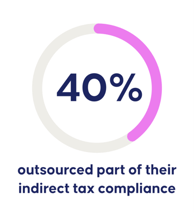 EY's 2023 Tax Function of the Future survey found that approximately 40% of large organisations had outsourced or co-sourced at least part of their indirect tax compliance in the preceding three years, with the primary drivers being the cost of maintaining specialist headcount, the increasing complexity of real-time reporting requirements, and the difficulty of keeping pace with regulatory change across multiple jurisdictions.
This picture also understates a related point. A meaningful share of external spend goes on bandwidth, not expertise. Audit cycles, real-time reporting cutovers, and ERP migrations all generate workload spikes that a team resourced for steady-state cannot absorb. The shortfall surfaces as external invoices rather than as visible gaps in capability, which makes it easy to under-resource the function in the first place.
Historically technology investment has lagged behind the increasing demands placed on the function. Despite the proliferation of indirect tax technology platforms - from compliance automation tools to tax determination engines to reporting solutions - the adoption of these tools at scale has been constrained by the cost and complexity of ERP integration, the need for specialist configuration skills, and - perhaps most importantly - the challenge of securing IT budget and project resource for what is often perceived as a non-revenue-generating function.
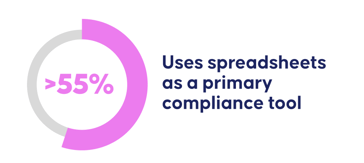
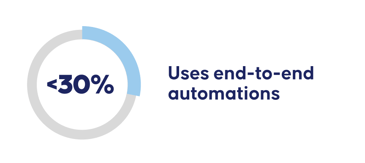
Keeyns, in its annual VAT Technology Benchmark Report, has documented consistent gaps between the technology ambitions of indirect tax teams and the tools actually in use. In their 2024 survey, over 55% of respondents identified spreadsheets as a primary compliance tool, despite the acknowledged risks; fewer than 30% had implemented end-to-end automation for any of their major compliance jurisdictions.
The indirect tax function as it stands today is characterised by high operational complexity, significant reliance on manual processes and spreadsheet-based tools, and growing pressure from both regulators and business leadership. The compliance lifecycle of extract, process, validate, and submit is labour-intensive and error-prone, particularly where data quality at source is poor and ERP configurations are inconsistent. Advisory work requires deep technical expertise across a wide range of transaction types and jurisdictions. Audit defence demands organised, audit-ready documentation and the ability to respond quickly to increasingly data-driven enquiries from tax authorities.
The function has carried this workload through a combination of in-house specialists, external advisers, and a long tail of spreadsheet-based tooling. That model has been remarkably resilient. It has absorbed the expansion of VAT and GST regimes, the addition of digital services taxes, the introduction of real-time reporting in a growing number of jurisdictions, and the steady tightening of audit expectations, while continuing in most organisations to file on time and defend its positions when challenged.
That resilience should not be mistaken for stability. The environment in which the function operates is changing rapidly. Real-time reporting obligations are expanding across Europe and beyond. Tax authorities are investing in digital audit infrastructure. The regulatory perimeter of indirect tax is extending to new areas, including digital services, platform economies, and carbon markets. At the same time the cost base of the function is also under increasing scrutiny from CFOs who expect tax to participate in the wider finance transformation agenda.
These pressures do not exist in isolation. They are part of a broader and deliberate shift driven by two converging forces.
1. The first is a global regulatory push for greater tax transparency, real-time visibility, and alignment between what businesses report and what authorities can independently verify. The European Commission's VAT in the Digital Age package, the continued spread of continuous transaction controls across Latin America, Asia, and the Middle East, and the OECD's work on tax administration in the digital era all point in the same direction.
2. The second is a data and technology revolution, both inside tax authorities and inside businesses themselves, that is changing what can be seen, when it can be seen, and what can be done with it. The arrival of practical AI tooling, the maturation of cloud ERP platforms, and the steady commoditisation of tax engines and reporting solutions are each significant in their own right. Together they are reshaping the economics of how the function operates.
The same legislative changes that intensify the compliance burden also create a genuine opportunity. The need to rebuild data flows, integrate new tools, and reconfigure compliance processes gives forward-thinking functions the chance to redesign how indirect tax is operated from the ground up.
Understanding the forces behind that shift, where they come from, how far they have already travelled, and how much further they will go, is the starting point for any serious thinking about how the function needs to change. Chapter 2 sets out those forces and the direction of travel. Later chapters work through what that means for the business, what needs to change and in what order, and how to keep the existing function running while the transformation is underway.
This chapter draws on publicly available research, reports, and guidance published by Deloitte, EY, KPMG, and PwC; the European Commission (including the annual VAT Gap Report and the VAT in the Digital Age legislative package); and indirect tax technology and compliance specialists including Sovos, Marosa, Thomson Reuters, Keeyns, and Tax Systems. Where specific survey data or quotations are cited, the source publication is noted in the text. All market observations reflect published materials available up to early 2026.

Disclaimer:
Please remember Keeyns' articles are for informational and educational purposes only. Not for specific tax or legal advice. Always consult a qualified advisor before taking any actions based on this information.