Skip to content
The Tax Team of the Future

Module 1:
The Tax Team of the Future

Tax is no longer just about filing returns and staying compliant. The rules are changing fast — and the organizations that adapt now will have a serious advantage over those that don't.

In this module you will learn:

  • Continuous improvement of your processes allows you to stay flexible, otherwise you´ll fall behind. Pillar 2, real-time reporting, and global transparency rules are here now — not on the horizon.

  • AI is your biggest opportunity. Automation handles the compliance grind, freeing your team to focus on risk, strategy, and real value.
    You need a new kind of tax professional.
  • You need a new kind of tax professional. Technical knowledge alone is no longer enough — governance, data, and accountability are the new essentials to be flexible in this rapidly changing environment. 

Let's dive in.

Number block

Times are changing

Talking to the consultants of PwC one thing became clear: The rules of the game are changing — fast. For decades, tax teams focused primarily on local compliance, with each jurisdiction handling its own processes, often relying on spreadsheets and manual trackers. That used to work, but with growing compliance, evolving regulations and complexity and capacity decreasing, it´s no longer the suitable way of working.

But today, governments are introducing real-time reporting, global transparency rules, and complex international regulations like Pillar 2. Tax is no longer just a back-office function; it is increasingly strategic, impacting both financial performance and risk.

Especially for multi-entity, multi-country environments, cross functional dependencies (finance, HR and IT) this challenge is increasing.

Djanno, Head of Tax Technology at Alvarez & Marsal, highlights the challenge: “You cannot manage tax today the way you did five years ago. Complexity grows faster than effort.”

AI is not taking over your job

Automation and AI are reshaping work — not replacing professionals. Many manual compliance tasks are being reduced, allowing tax teams to focus on activities that add real value:

  • Interpreting data

  • Spotting risks

  • Advising leadership

  • Driving strategic decisions

PwC consultants note that technology lets your team move from execution to insight, and from insight to action. By embracing AI, tax professionals become strategic partners rather than simply report preparers.

Number block 2
Number block 3

The tax team of tomorrow

Large organisations are rethinking decentralised models. Tax is no longer purely local; it is becoming centralised and coordinated, with a global perspective.

VJ, who led Shell’s tax transformation, explains: “Tax has always been seen as a local process, with local professionals. But finance showed it could be different. That’s when we started centralising our tax processes.”

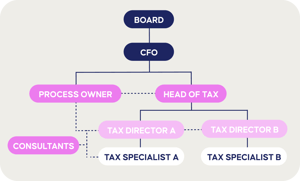
These changes demand new skills from Heads of Tax and Tax Directors. With automation and AI reducing routine tasks, the role of a process owner becomes increasingly important, ensuring smooth operations and consistent results. This person is dedicated to creating iterative processes that they have full accountability and responsibility for — with, most importantly, buy-in from the CFO and Head of Tax.

Organogram tax team of the future
The new tax team model

The age of digitalisation

Many tax functions are skipping intermediate infrastructure and jumping straight to highly tech-driven operations, particularly in emerging markets like the UAE.

But technology adoption brings its own challenges. Teams often struggle with:

  • Rapid regulatory change

  • Growing importance of data

  • New digital capabilities

There is a skill gap: modern tax professionals must understand systems, automation, and governance, not just tax law. PwC observes a major shift in the roles of Heads of Tax, Tax Directors, and Tax Specialists — a trend we explore further in this Crash Course.

Number block 4
Number block 5

The future of tax governance

Looking ahead, tax governance will be:

  • More data-driven
  • More transparent
  • Integrated with enterprise risk and ESG

Managing tax will no longer be about simply filing returns. It will require technical expertise of processes and workflows, data skills, a governance mindset, and collaboration capabilities.

Djanno summarises: “The modern tax team doesn’t just report numbers. It provides control, insight, and real value across a complex world.”

Looking ahead

Changing how the tax team operates is step one. Step two: defining clear roles and responsibilities.

Who owns tax risks? Who monitors compliance? Who coordinates processes globally?

Module 2 will dive into how organisations can structure roles and responsibilities in a flexible, modern tax governance model.